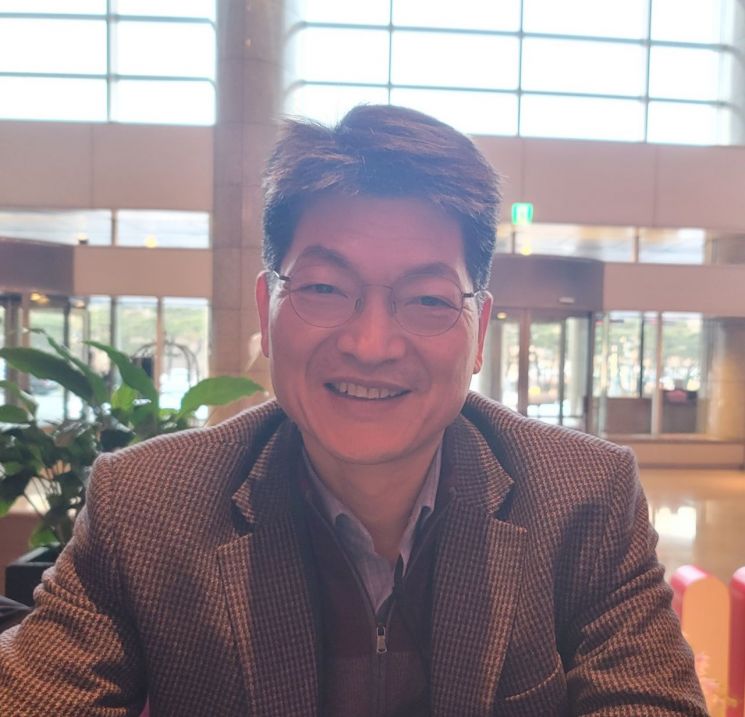
[Asia Economy Reporter Park So-yeon] "At first, people laughed at us, saying we were in the trash business. But now, the demand is beyond words."
Lee Kang-myung, CEO of Sungil Hightech, which is preparing for an initial public offering (IPO) this first half of the year, recently met with Asia Economy to express the growth potential of the waste battery recycling company.
"If an electric vehicle weighs 2 tons, the waste battery accounts for about 0.5 tons. Currently, if there are 30 million electric vehicles worldwide, in 15 years, 15 million tons of waste batteries will be generated."
Sungil Hightech is a recycling specialist company that extracts metals from electronic waste such as electric vehicles, mobile phones, laptops, ESS (energy storage systems), and power tools. It started with precious metal recycling in March 2000 and began the waste battery recycling business in 2008.
Currently, it extracts key materials of electric vehicle batteries such as cobalt, nickel, manganese, and lithium from waste batteries and supplies them to cathode material manufacturers. The recovery rate for cobalt and nickel reaches 96%. Sales have rapidly grown to 49.4 billion KRW in 2019 and 66 billion KRW in 2020.
Although the 2021 performance has not yet been announced, the industry estimates that sales have exceeded 100 billion KRW. The company has secured major battery companies such as LG Energy Solution, SK On, and Samsung SDI domestically, as well as leading global automakers as clients.
"Resources are limited, and relying solely on mining cannot prepare us for the electric vehicle era. Also, it is our role to ensure that waste batteries from electric vehicles do not cause environmental pollution. We aim to keep resources circulating continuously without additional environmental destruction."
Sungil Hightech established its factory in 2008 and began full-scale waste battery recycling in 2011, accumulating over 10 years of experience in this field. Since the waste battery recycling sector has only recently gained attention, companies with technology and know-how in this area are counted among the top five worldwide.
Of course, it was not easy from the start. When building the Gunsan Plant 1, construction began with a budget of 10 billion KRW but ended up costing 18 billion KRW. CEO Kim still vividly remembers visiting Samsung C&T to seek investment at that time.
"Samsung C&T's current 8% stake came from that time. Fortunately, since we had a business relationship, we were able to receive investment. We started with great difficulty, but another crisis came. For the first 20 months, no products were produced. Labor and chemical costs ran into several hundred million KRW monthly, totaling about 8 billion KRW invested. That period until approval was the hardest. Having grown through hardship, we aim to become a proud Korean company that upholds integrity management wherever we go in the global market."
As demand for waste battery recycling exploded, Sungil Hightech established overseas plants not only in Gunsan but also in Malaysia, Hungary, China, India, and the United States. The total annual production capacity is about 4,200 tons. The funds raised through the upcoming IPO will be used to build the Gunsan Plant 3. The company aims to surpass 1 trillion KRW in sales by 2030.
© The Asia Business Daily(www.asiae.co.kr). All rights reserved.
![User Who Sold Erroneously Deposited Bitcoins to Repay Debt and Fund Entertainment... What Did the Supreme Court Decide in 2021? [Legal Issue Check]](https://cwcontent.asiae.co.kr/asiaresize/183/2026020910431234020_1770601391.png)
















