[Asia Economy Reporter Seo So-jung] Last week, the COVID-19 risk assessment results were raised to the 'High' level nationwide, in the metropolitan area, and in non-metropolitan areas.
The Central Disease Control Headquarters (CDCH) announced on the 24th that the nationwide COVID-19 risk level for the third week of January (January 16?22) was evaluated as 'High.' In the second week of January, the risk level was 'Moderate' nationwide, in the metropolitan area, and in non-metropolitan areas, but it was raised by one level.
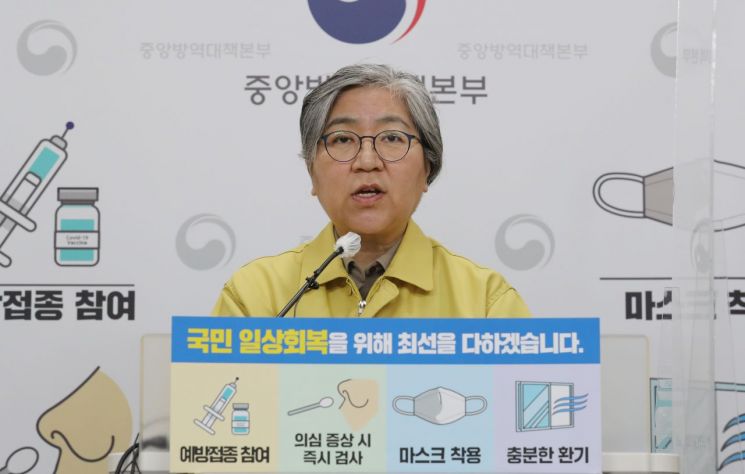
Jung Eun-kyung, Director of the Korea Disease Control and Prevention Agency, said, "The weekly risk assessment for the third week of January showed that the domestic Omicron detection rate exceeded 50%, and the number of confirmed cases is rapidly increasing," adding, "Considering the Lunar New Year holiday and other factors, we judged that there is a risk of a sharp surge in cases, so the risk level was evaluated as 'High' nationwide, in the metropolitan area, and in non-metropolitan areas."
The average daily number of confirmed cases per week increased significantly from 3,529 in the second week of January to 5,160 in the third week. Although the proportion of those aged 60 and over continues to decrease due to the expansion of the third vaccination, the proportion of confirmed cases aged 18 and over increased from 25.3% in the second week of January to 26.4% in the third week.
The weekly number of hospitalized patients rose sharply from 3,022 in the second week of January to 4,070 in the third week. However, during the same period, the number of critically ill patients and deaths decreased for the fourth consecutive week, with 309 and 225 cases respectively.
Accordingly, the capacity of the medical response system is still sufficient. The nationwide intensive care unit (ICU) bed occupancy rate dropped from 41.5% in the third week of January to 25.9% in the same week.
The weekly infection reproduction number (Rt), which had been maintained below 1 until the second week of January, recorded 1.18 in the third week, exceeding 1.
The infection reproduction number indicates how many people one confirmed case infects around them; a value of 1 or higher means 'epidemic expansion,' while 1 or lower means 'epidemic decline.'
The CDCH stated, "The ICU bed occupancy rate continues to decline due to the expansion of ICU beds and the decrease in critically ill patients," adding, "Compared to the fourth week of October last year, just before the start of the phased daily recovery, the ICU bed occupancy rate nationwide and in the metropolitan area is very low, but it remains high in non-metropolitan areas."
© The Asia Business Daily(www.asiae.co.kr). All rights reserved.
![User Who Sold Erroneously Deposited Bitcoins to Repay Debt and Fund Entertainment... What Did the Supreme Court Decide in 2021? [Legal Issue Check]](https://cwcontent.asiae.co.kr/asiaresize/183/2026020910431234020_1770601391.png)