Stable Energy Storage, Excellent Capacity Retention Prototype Developed
Joint Research Results Announced by Department of Energy Engineering and University of Oxford
[Asia Economy Yeongnam Reporting Headquarters Reporter Choi Soon-kyung] A paper co-authored as the sole first author by Professor An Geon-hyeong’s team from the Department of Energy Engineering at Gyeongsang National University’s College of Convergence Technology and senior student Yoo Geun from the same department has been published in the latest issue of the world-renowned chemical engineering journal, Chemical Engineering Journal.
The paper is titled “Nano-sized split V2O5 with H2O-intercalated interfaces as a stable cathode for zinc ion batteries without an aging process.”
In the era of the 4th Industrial Revolution, a hyper-connected era where everything is linked, the use of energy storage systems (ESS) that supply energy at the right place and time is increasing, but fatal accidents such as fires and explosions continue to occur.
The main cause of fires is the highly reactive lithium and flammable electrolytes. Zinc-ion batteries use stable zinc metal and water-based electrolytes, so they pose no risk of fire or explosion, making them one of the leading candidates to replace conventional lithium-ion batteries. Based on these advantages, a startup boom based on zinc-ion battery technology is occurring in the United States and Canada.
Vanadium oxide (V2O5), which can store a large amount of energy, has been proposed as a cathode candidate for zinc-ion batteries, but practical application to electronic devices has been difficult due to the continuous increase in energy storage capacity during the initial charge-discharge process.
Therefore, manganese oxide (MnO2), which shows stable energy storage characteristics, has mainly been used as the cathode, but its energy storage capacity is considered a drawback as it is only about 70% of that of vanadium oxide.
The research developed by the Gyeongsang National University Department of Energy Engineering team solved the essential initial charge-discharge problem of vanadium oxide cathodes by electrochemically incorporating water into the interlayer lattice of vanadium oxide.
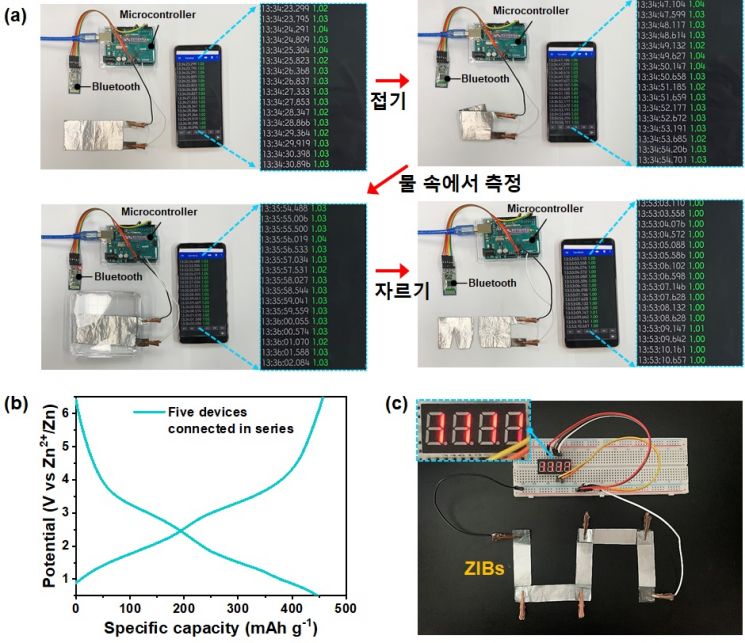
As a result, stable energy storage performance was secured from the initial use of the battery, along with an excellent capacity retention rate of 91% after 200 charge-discharge cycles. Additionally, a prototype battery that did not catch fire or explode and operated normally was successfully produced even after folding, immersing in water, and cutting.
This research was conducted jointly with the Department of Energy Engineering at Gyeongsang National University and the globally renowned University of Oxford research team in the UK.
Furthermore, with the help of Gyeongsang National University’s Technology Business Center, domestic patent application procedures are underway for the conducted research, and intellectual property rights for the specialized technology will also be secured.
Yoo Geun, who participated as the first author, said, “I have worked to solve the safety issues of secondary batteries, which have been a major problem so far, and will continue to strive to develop safe next-generation secondary batteries.”
Professor An Geon-hyeong stated, “This is a domestic technology that can solve the recent problem of ‘fires and explosions in ESS,’ and it is expected to be recognized as a safe next-generation battery without the risk of explosion or fire.”
He also said, “Although it is rare for undergraduate students to participate in research and publish papers as co-authors with master’s and doctoral students in SCI international journals, it is even more uncommon for an undergraduate student to independently conduct research alongside coursework and publish a paper as the first author in an SCI-level journal.”
This research was conducted under the Young Researcher Support Project led by the National Research Foundation of Korea.
© The Asia Business Daily(www.asiae.co.kr). All rights reserved.
![User Who Sold Erroneously Deposited Bitcoins to Repay Debt and Fund Entertainment... What Did the Supreme Court Decide in 2021? [Legal Issue Check]](https://cwcontent.asiae.co.kr/asiaresize/183/2026020910431234020_1770601391.png)