Nationwide Sales Turnover Rate at 0.56% in December Last Year
Lowest Since February 2019's 0.52%... Deepening Transaction Cliff
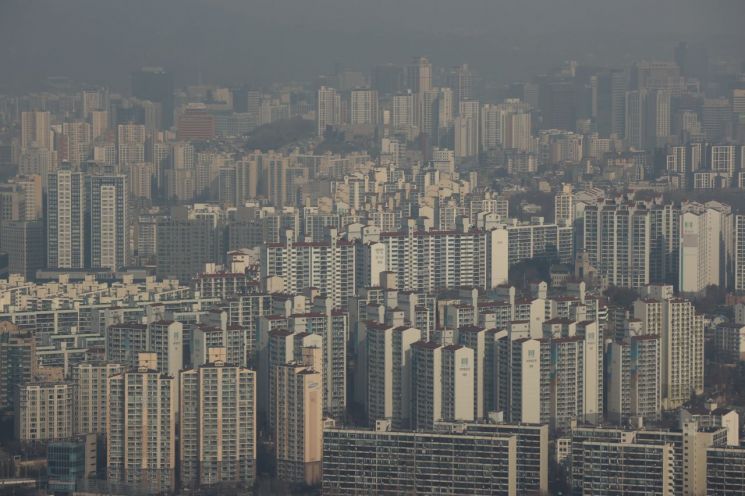
Due to real estate loan regulations and tax pressure, the monthly volume of real estate transactions has fallen to its lowest level in three years. According to the Court Registry Information Plaza on the 24th, the turnover rate of collective buildings (apartments, row houses, multi-family houses, subdivided commercial buildings, officetels, etc.) nationwide in December last year was 0.56%, marking the lowest point since 2021. This figure has been steadily declining since reaching a peak of 0.83% in March last year. Compared to a year ago, the turnover rate also significantly decreased from 0.95% (December 2020).
The turnover rate is calculated by dividing the 'number of real estate properties with ownership transfer as the registration purpose, sales as the registration cause, and completed registration' by the 'total number of real estate properties with valid registration as of the end of each month.' It is an indicator of the activity level in the real estate sales market; a lower turnover rate means fewer transactions relative to the total number of properties. A turnover rate of 0.56% means that out of 1,000 collective buildings, 5.6 were traded.
Even on an annual average basis, last year experienced an unprecedented transaction cliff. The average turnover rate from January to December 2021 was 0.69%. Since statistics began in 2010, only 2010 (0.65%), 2012 (0.57%), and 2013 (0.65%) had lower annual average turnover rates than last year.
The decrease in turnover rate last year was observed across both the metropolitan area and provinces, but the decline was more pronounced in the provinces. In Seoul, the rate dropped by 0.25 percentage points from 0.67% in December 2020 to 0.42% last year, and in Gyeonggi Province, it decreased by 0.39 percentage points from 0.94% to 0.55%. In contrast, Daegu saw a sharp drop of 0.74 percentage points from 1.09% to 0.35% during the same period. Busan also fell significantly from 1.25% to 0.56%, and Gwangju from 1.11% to 0.46%.
The overall decline in transactions is attributed to the full-scale implementation of loan volume regulations and interest rate hikes starting in the second half of last year. Seo Jin-hyung, president of the Korea Real Estate Society (professor at Gyeongin Women's University), said, "Various regulations have sharply dampened buyer sentiment, and fatigue from prolonged rapid house price increases has reinforced this trend."
The contraction in buyer sentiment particularly impacted the provincial real estate markets. In Daegu, five out of six complexes launched in December last year failed to sell out. As transactions stalled, listings have surged. As of January 24, the number of apartment listings in Daegu skyrocketed by 79.3% from 14,738 units in 2021 to 26,429 units in 2022, the highest increase rate among local governments nationwide. During the same period, Jeonnam increased by 56.6% and Daejeon by 43.8%, following Daegu.
The decrease in turnover rate also reflects the actions of multi-homeowners opting for gifts instead of sales. Although the absolute number of gift transactions decreased amid falling sales volume, their proportion increased significantly. According to the Korea Real Estate Board, which compiled statistics up to November last year, cumulative apartment gift transactions totaled 73,205 units by November, fewer than 91,866 units in 2020. However, their share of total transactions rose from 5.8% to 6.6%.
© The Asia Business Daily(www.asiae.co.kr). All rights reserved.

















