Major Presidential Candidates Submit 'Economic Task' Response to the Korean Economic Association
Lee: "Inflation Concerns and Asset Price Rise Expectations Drive Demand, Pushing Prices Up"
Yoon: "Policy Failures like LTV Played a Role, Redevelopment Restrictions and Punitive Taxation Contributed"
Divergent Solutions to Polarization… Lee: "Improving Inequality by Strengthening Basic Rights such as the Basic Series"
Yoon: "Enhancing Growth Rate Led by the Private Sector"
Ahn: "Caution Against Populism and Pension Reform"
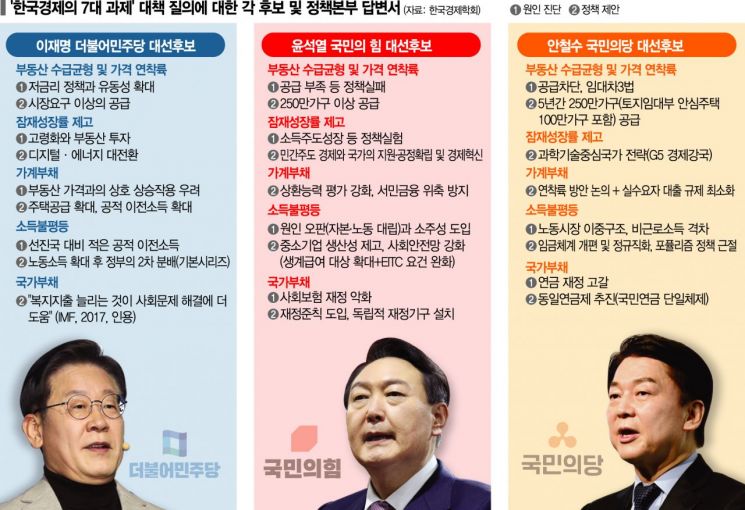
[Sejong=Asia Economy Reporter Kim Hyunjung] Major presidential candidates recently pointed to the Moon Jae-in administration’s policy failures as the cause of the rapid rise in apartment prices and instability in the real estate market, proposing large-scale supply expansion as a solution. On the other hand, regarding the household debt issue, considered a ‘ticking time bomb’ in Korean society, Lee Jae-myung of the Democratic Party and Yoon Seok-youl of the People Power Party emphasized contrasting solutions: public transfer expansion and strengthening repayment ability assessments, respectively, revealing differences in their views. Regarding income inequality, Lee focused on strengthening distribution including basic income, while Yoon emphasized improving productivity in small and medium enterprises.
According to the Korean Economic Association on the 24th, major presidential candidates and their policy teams submitted response letters containing these views to the ‘Seven Major Economic Issues Policy Questionnaire’ sent to them. The seven major issues specified in the questionnaire were selected through an internal vote by the association last month and include productivity improvement and fostering new industries, low birthrate, supply-demand balance and soft landing of real estate prices, raising potential growth rate, household debt, income inequality, and national debt issues.
◆ "Real Estate Problems Attributed to Moon Administration’s Policy Failures"… Ruling and Opposition Candidates Point Out = Each candidate criticized the Moon administration’s real estate policies, blaming them for years of instability in the real estate market. Lee pointed out, "The rise in domestic housing market prices is primarily due to low interest rate policies and liquidity expansion." He added, "As the low interest rate trend continued, concerns about inflation led to a rise in real asset prices, and the surge in demand in the market was also an important cause of price increases." He emphasized, "The next government will set the biggest policy goal as stabilizing the housing market by increasing housing supply beyond the level demanded by the market, tailored to diverse housing demands according to demographic changes." Recently, Lee announced at a press conference that he plans to supply 3.11 million housing units nationwide.
Yoon, differing from Lee who pointed to low interest rates as the background, diagnosed the cause of real estate market instability as "policy failures such as the current government’s extreme housing loan-to-value (LTV) regulations." He particularly noted, "If low interest rates and excess liquidity were the main causes of the housing price surge, the rate of increase would not have varied significantly between regions." He criticized, "By suppressing redevelopment and reconstruction and imposing punitive taxation, the government sent signals that supply would not occur in the market." He explained, "To normalize supply and demand, stable housing supply is necessary, and the Yoon Seok-youl administration will steadily supply more than 2.5 million new housing units to meet demand."
Ahn Cheol-soo of the People’s Party also pointed to the Moon administration’s blocking of supply policies and the three lease protection laws as causes of the current situation, stating, "We will supply 2.5 million housing units over five years, of which 1 million will be built as land-lease安心 (ansim) housing."
The candidates also proposed some financial policy supplements. Lee suggested easing LTV and debt-to-income (DTI) ratios for non-homeowners, Yoon proposed allowing loans based on normal housing transactions, and Ahn mentioned mortgage loans with benchmark interest rates applied to youth.
◆ Solutions to Polarization? Lee: "Basic Income" Yoon: "Improving SME Productivity" = The candidates differed in their positions on macroeconomic policies such as economic growth rate, household debt, income inequality, and national debt. Lee proposed expanding distribution through the ‘basic series’ he has mentioned as a solution to various social problems. Regarding polarization, he said, "The most important thing to improve primary distribution is to create quality jobs through industrial transformation in digital and energy sectors." He stressed, "To improve secondary distribution, it is necessary to raise the level of public transfer income and improve inequality by strengthening economic basic rights such as basic income, basic finance, and basic housing."
Yoon emphasized raising potential growth led by the private sector, government innovation support, and regulatory reform as key solutions, while repeatedly criticizing the current government’s policy failures on income inequality. He explained, "They misjudged the cause of worsening income inequality as a conflict between capital and labor and introduced unverified income-led growth policies, which worsened the situation." He added, "Policies such as the rapid increase in minimum wage damaged corporate competitiveness and dealt a heavy blow to small and medium enterprises and self-employed businesses." Among major candidates, he was the only one to advocate introducing fiscal rules, also mentioning the establishment of an independent fiscal institution and the introduction of strategic expenditure reviews.
Ahn attracted attention by advocating caution against populism and pension reform. As a solution to the rapid increase in national debt, Ahn proposed pension reform, stating, "We will promote a unified pension system by standardizing occupational pensions based on the National Pension, reorganizing the public pension system into a single National Pension system."
© The Asia Business Daily(www.asiae.co.kr). All rights reserved.
![User Who Sold Erroneously Deposited Bitcoins to Repay Debt and Fund Entertainment... What Did the Supreme Court Decide in 2021? [Legal Issue Check]](https://cwcontent.asiae.co.kr/asiaresize/183/2026020910431234020_1770601391.png)















