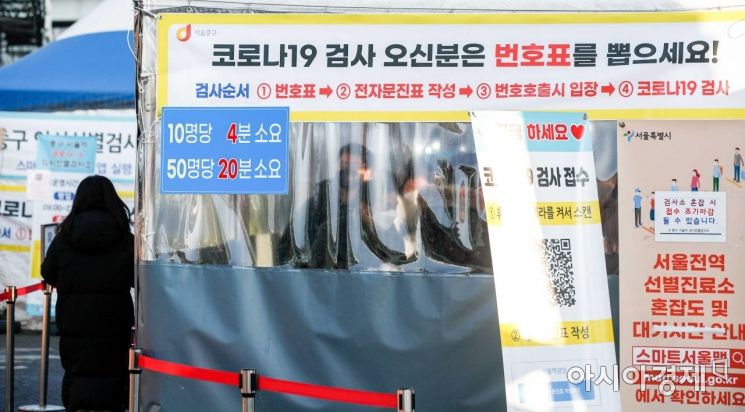
 On the 24th, when 7,513 new COVID-19 cases were reported, citizens lined up to get tested at a temporary screening clinic set up at the Sogang University Station Plaza in Mapo-gu, Seoul. Photo by Jinhyung Kang aymsdream@
[Asia Economy Reporters Seo So-jeong and Kim Dae-hyun] As the Omicron variant has become the dominant strain in South Korea, health authorities are considering exempting close contacts from quarantine if they were wearing masks properly.
On the 24th, Park Hyang, head of the Central Disaster and Safety Countermeasure Headquarters' quarantine team, appeared on KBS Radio's "Choi Kyung-young's Strong Current Affairs" and stated, "After the Lunar New Year holiday, we will implement an application (app) where individuals input the places they have visited," adding, "We are also reviewing shortening the self-quarantine period for close contacts from 10 days to 7 days, and if someone met a confirmed case while wearing a mask properly or without conversing for more than 15 minutes, they may be exempted from quarantine."
Regarding the restructuring of the quarantine system, he said, "We will first implement it in regions where Omicron infections are approaching 80-90%, such as Pyeongtaek and Anseong in Gyeonggi Province, Gwangju, and Jeonnam, and based on the situation, decide on nationwide expansion later."
Before fully implementing Omicron response measures nationwide, the authorities decided to pilot the transition of the quarantine system starting on the 26th in four areas where Omicron is already dominant: Gwangju, Jeonnam, Pyeongtaek, and Anseong.
Accordingly, in these four regions including Gwangju and Jeonnam, only 'high-risk groups' will be able to receive polymerase chain reaction (PCR) tests at screening clinics.
Park explained, "Until now, anyone could get a PCR test at public health centers or screening clinics, but with the increase in confirmed cases, it will not be possible to test everyone. Therefore, we will prioritize testing high-risk groups (those aged 60 and above, close contacts, etc.) immediately, and if someone with less relevance tests positive on a rapid antigen test, they can then receive a PCR test."
© The Asia Business Daily(www.asiae.co.kr). All rights reserved.