310,000 Private Sector Jobs Lost Due to COVID-19
Public Sector Jobs Increase by 164,000
Over 50% of Jobs for Ages 50-60
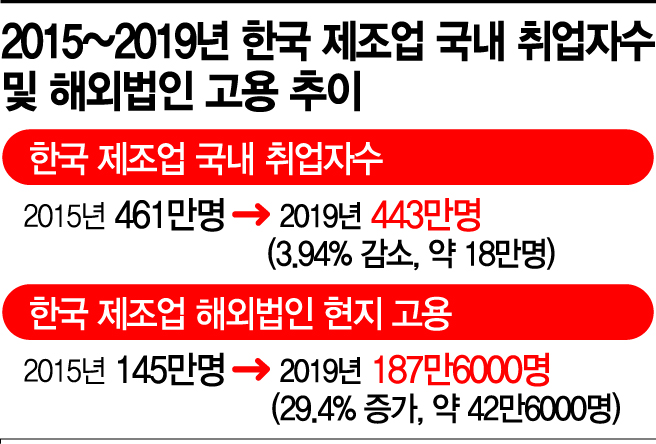
[Asia Economy Reporters Heungsun Kim and Sunhee Son] The announcements made on the 24th by the Federation of Korean Industries (FKI), Statistics Korea, and the Ministry of Economy and Finance encapsulate the polarized domestic employment issue. While employment conditions in the manufacturing sector, which should contribute to expanding jobs for the future generation of youth, are worsening, only government-led public jobs for the elderly are increasing, leading to criticism that welfare policies are being strengthened alone.
Overseas Expansion of Domestic Jobs... Only South Korea and China Moving Backwards
According to International Labour Organization (ILO) statistics, among the world’s six major manufacturing countries, the number of manufacturing employees in Japan, Germany, and the United States increased by 3.3% (340,000), 3.3% (250,000), and 3.1% (490,000) respectively from 2015 to 2019. The FKI explained that the increase in manufacturing employment in the U.S., Japan, and Germany is analyzed as a result of these three countries strengthening their manufacturing bases and continuously pursuing reshoring policies of domestic companies to create jobs at home after the 2008 global financial crisis.
On the other hand, South Korea’s manufacturing employment decreased by 1.8% to 8.1% from 2016 to 2020. The FKI added that this was mainly due to structural adjustments in the shipbuilding sector caused by a sharp decline in ship orders and structural adjustments in the automobile sector. According to employment insurance subscriber statistics from the Ministry of Employment and Labor, the number of employees in other transportation equipment, including shipbuilding, decreased by 74,000, and the automobile sector decreased by 14,000 from January 2016 to January 2020.
While overseas jobs in manufacturing companies decreased in major countries, only South Korea and China saw significant increases. According to an analysis report on overseas investments by South Korea, the U.S., Japan, and China, the number of local employees at overseas investment corporations in Japan and the U.S. decreased by 4.9% (216,000) and 0.2% (10,000) respectively from 2015 to 2019. In contrast, the number of local employees at South Korean overseas investment corporations increased by 29.4%, and China’s total overseas investment corporations across all industries saw an 85.0% (1,041,000) increase. The FKI explained, “In South Korea’s case, the decrease in exports (-10.4% year-on-year) due to the U.S.-China trade war in 2019, contraction of new facility investments by companies, factory relocations overseas, and structural adjustments in the automobile and shipbuilding sectors appear to have had an impact.”
Direct Hit from External Variables like the COVID-19 Shock
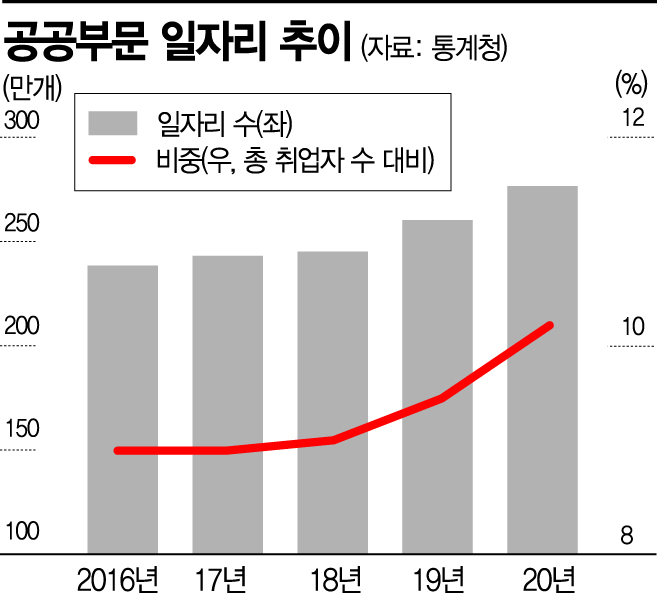
Unlike private sector jobs, which have struggled to recover from the recession, public sector jobs have steadily increased, largely due to the impact of the COVID-19 pandemic. When COVID-19 first broke out in 2020, delivering an unprecedented shock to the employment market, the total number of employed persons, including the private sector, was 26,904,000, about 310,000 fewer jobs than in 2019 (27,123,000).
During the same period, public sector jobs increased by 164,000, marking the largest increase ever (6.3%), going against the market trend. The industry sector with the largest increase in public sector jobs during this period was ‘Public Administration and Defense,’ which increased by 117,000 jobs. This was followed by education services with 15,000 jobs and health and social welfare services with 6,000 jobs.
However, by age group, more than half (53%) of the increased jobs were held by middle-aged and older workers in their 50s and 60s. The government explained this as ‘income compensation and livelihood support for vulnerable employment groups,’ but criticism has been raised that the government is confusing job policies with welfare policies.
The Ministry of Economy and Finance stated, “The expansion of public sector jobs is the result of the public sector playing an active role in responding to the employment shock caused by COVID-19 and the surge in demand for care and welfare,” adding, “We will continue to promote the expansion of public sector jobs to improve the quality of public services.”
© The Asia Business Daily(www.asiae.co.kr). All rights reserved.
![User Who Sold Erroneously Deposited Bitcoins to Repay Debt and Fund Entertainment... What Did the Supreme Court Decide in 2021? [Legal Issue Check]](https://cwcontent.asiae.co.kr/asiaresize/183/2026020910431234020_1770601391.png)
















