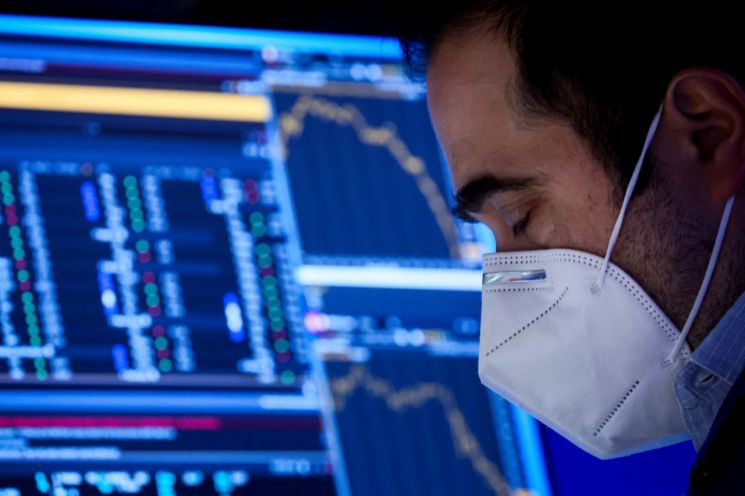
[Asia Economy New York=Special Correspondents Seolgina Jo and Yeonjin Ji] The 'tightening' cold wave is sweeping across global asset markets, including South Korea. This is because the U.S. Federal Reserve (Fed), unable to withstand inflationary pressures, is expected to embark on early tightening. As the KOSPI falls below the 2800 mark and the Nasdaq index enters a technical correction phase, stock markets worldwide have sharply frozen, and now the market is focusing on this week's Federal Open Market Committee (FOMC) meeting.
The key issue is the 'magnitude' and 'frequency' of interest rate hikes this year. Just a month ago, the market weighed in on three hikes, but now at least four and up to seven hikes are being discussed. There is talk that interest rate hikes could be implemented monthly starting from March.
◇All Eyes on Powell...This Week's FOMC
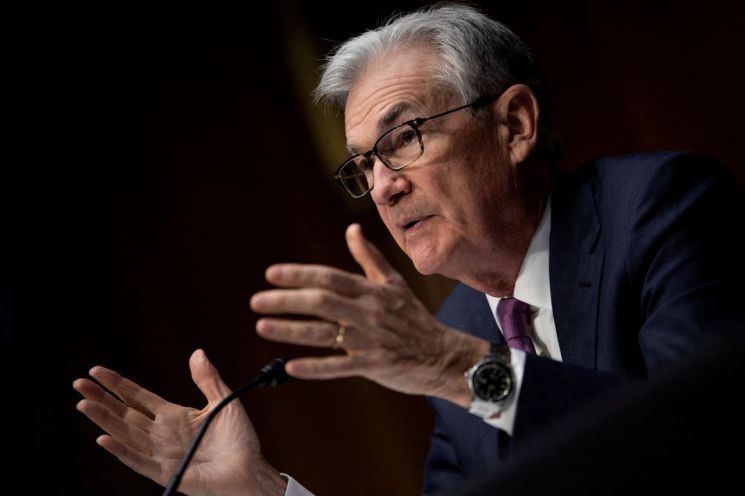
The market is paying close attention to hints from Fed Chair Jerome Powell at the FOMC meeting on the 25th-26th (local time) regarding the timing and size of the benchmark interest rate hikes. Luigi Speranza of BNP Paribas predicted, "Chairman Powell will likely try to raise market expectations for a March rate hike during this month's FOMC press conference." It is expected that clear signals will be given considering the shock it may cause to the market.
The most likely timing for the first rate hike is March, when the next FOMC meeting is held. According to the Chicago Mercantile Exchange Group (CME Group) FedWatch, the federal funds (FF) futures market reflects a 91.6% probability that the Fed will raise the benchmark interest rate in March. This has sharply increased from just over 50% a month ago.
In particular, concerns that the Fed's tightening clock may be accelerated have strengthened speculation of five or more hikes. Even if rates are raised four times by 0.25 percentage points each, the real interest rate would remain negative, failing to curb inflation at its highest level in 40 years. According to FedWatch, the forecast for five rate hikes this year is approaching 60%. David Mericle, an economist at Goldman Sachs, noted in an investor note the day before, "Our baseline forecast is four rate hikes in March, June, September, and December," but added, "The likelihood of tightening measures (balance sheet reduction) in May is increasing, so ultimately the number will exceed four."
Some even suggest seven hikes. Former Treasury Secretary Larry Summers recently attended a discussion hosted by Princeton University and said, "If I were the Fed, I would have ended quantitative easing (QE) several months ago and sent a signal," adding, "This means up to seven rate hikes this year." Excluding the January FOMC, if rate hikes are implemented monthly from March, the total would be seven.
Matthew Luzzetti of Deutsche Bank said, "Ultimately, it depends on inflation," and predicted, "If high inflation persists, the speed or number of rate hikes will inevitably increase beyond recent market expectations."
◇Tightening Fears Sweeping the Globe
If the U.S. embarks on rapid tightening, a tightening shock could occur, especially in emerging markets, causing currency values to plummet and asset values to collapse.
Seven consecutive rate hikes match the number during the 1994 bond market massacre. At that time, the Fed raised the benchmark interest rate from 3% to 6% in just one year, leading to the bursting of asset bubbles in markets such as the New York Stock Exchange and capital outflows from emerging markets.
Last week’s sharp rise in U.S. Treasury yields and the retreat of global stock markets were largely due to fears surrounding early tightening. Over the week, the three major indices of the New York Stock Exchange?the Dow Jones Industrial Average, S&P 500, and Nasdaq?fell by 4.6%, 5.75%, and 7.55%, respectively. Particularly, the Nasdaq, which is tech-stock heavy, dropped more than 10% from its peak, entering a 'technical correction' phase. The Chicago Board Options Exchange (CBOE) Volatility Index (VIX), known as Wall Street’s fear gauge, surged over 10 points from the beginning of the year to 28.85 (on the 21st). This indicates the magnitude of market fears about tightening.
On the morning of the 24th, Asian stock markets continued to decline. Japan’s Tokyo Stock Exchange Nikkei index was trading down 0.95% compared to the previous session. South Korea’s KOSPI index fell below the 2800 level.
◇Even If a Technical Rebound Occurs...Investment Timelines Should Be Short
Experts advise reducing stock allocations and increasing cash holdings. Although a rebound may occur due to price merits, it is expected to be limited to a technical rebound.
According to the domestic financial investment industry, the KOSPI’s 12-month forward price-to-earnings ratio (PER) has fallen to around 10 times, and the price-to-book ratio (PBR) to about 1 times this month. However, since these valuations have returned to pre-COVID-19 pandemic levels, experts believe a technical rebound is possible. Lee Kyung-min, a researcher at Daishin Securities, said, "Combining signals from the rapidly changing global financial markets, a short-term technical rebound seems possible for now," adding, "As the causes of the global financial market correction since the beginning of the year temporarily ease, an autonomous rebound and retracement phase of growth stocks and high-valuation stocks is likely to unfold."
The problem is that a secondary correction may follow the short-term rebound. Lee said, "Concerns are growing that rising oil prices increase inflationary pressures, which could accelerate rate hikes. Additionally, the slowdown in the U.S. leading economic index may heighten worries about economic deceleration," adding, "In a phase where concerns about economic slowdown increase, rate hikes could amplify risks across the financial markets."
BNK Investment & Securities set the first support level for the KOSPI at 2790 and the second support level at 2700?2750, considering the long-term trend of the KOSPI since the foreign exchange crisis. They forecast that, even in the worst case, it will not fall below 2600, the peak level in 2018.
© The Asia Business Daily(www.asiae.co.kr). All rights reserved.
![User Who Sold Erroneously Deposited Bitcoins to Repay Debt and Fund Entertainment... What Did the Supreme Court Decide in 2021? [Legal Issue Check]](https://cwcontent.asiae.co.kr/asiaresize/183/2026020910431234020_1770601391.png)
















