Korea Research Institute of Bioscience and Biotechnology
[Asia Economy Reporter Kim Bong-su] "Beep beep~! This beef is spoiled and cannot be eaten!" Domestic researchers have succeeded in developing a practical bio-nano electronic nose technology capable of measuring meat freshness.
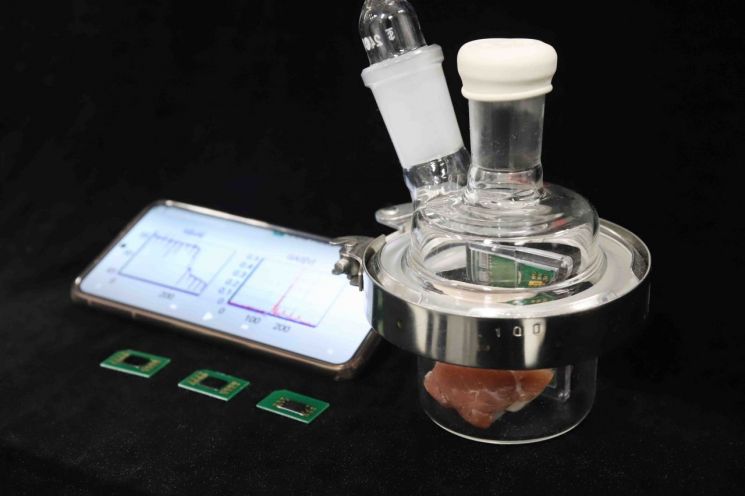
On the 24th, the Korea Research Institute of Bioscience and Biotechnology announced that Dr. Kwon Oh-seok's team at the Infectious Disease Research Center developed a portable electronic nose that can detect harmful substances generated during meat spoilage using a new compound.
Methods to check meat freshness include visual inspection or biological and chemical tests, but these lack consistency or take a long time. The electronic nose developed by the research team is based on the fact that spoiled meat emits a foul odor. This odor is caused by compounds called cadaverine and putrescine (biogenic amines), which are produced when the proteins and amino acids in meat denature. Detecting these substances with the human nose requires the spoilage to have progressed significantly, by which point the meat has lost its value as food.
The research team newly synthesized two compounds that react with cadaverine and putrescine and applied them to a bio-nano sensor, developing an electronic nose that can measure meat freshness with only trace amounts of biogenic amines. It can also measure the amount of cadaverine and putrescine produced, allowing objective judgment of how spoiled the meat is and tracking of its management status. The electronic nose is designed with a replaceable SIM card-type sensor for easy sensor replacement and uses a small battery for portability.
Dr. Kwon Oh-seok said, "By monitoring the amount of biogenic amines produced, we can not only measure meat freshness but also provide basic data to analyze the correlations of various factors affecting spoilage such as temperature and humidity." He added, "We expect that through commercialization, this technology will contribute to food safety in summer and be widely used in food-related industries."
The research results were published online on December 24 last year in the international journal in the biosensor field, "Biosensors and Bioelectronics (IF 10.613)." The technology has been transferred to companies and is expected to be commercialized soon.
© The Asia Business Daily(www.asiae.co.kr). All rights reserved.