[Asia Economy Reporter Hyunseok Yoo] Cellivery is making a full-scale entry into the cosmetics business. By supplying raw materials to its subsidiary Cellivery Living & Health, the company plans to secure stable sales and promote its technological capabilities to general consumers.
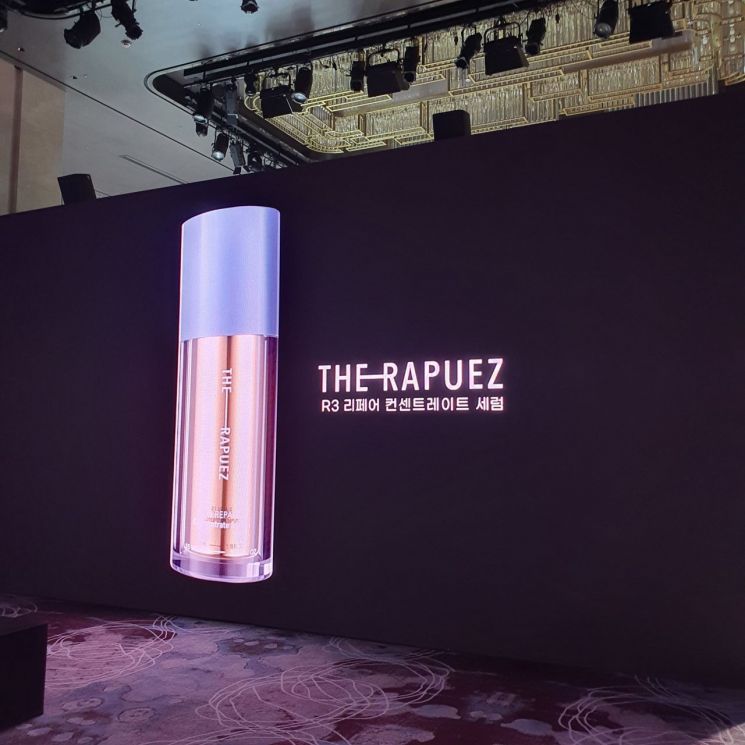
Cellivery’s subsidiary, Cellivery Living & Health, officially launched the cosmetics brand 'THE RAPUEZ' on the 21st. THE RAPUEZ applies the bio-delivery technology 'Live Delivery™,' which identifies damaged areas and delivers anti-aging active ingredients deep into the skin. The key active ingredient is 'R3 Peptide™,' known to repair and alleviate skin troubles and ultimately restore the skin.
In November last year, Cellivery acquired 100% of the shares of Ajin Clean (Cellivery Living & Health) for 14.9 billion KRW. Ajin Clean is a manufacturer of sanitary paper products that recorded sales of 37.1 billion KRW and an operating profit of 1.3 billion KRW in 2020. Specializing in the manufacture and sale of sanitary products (wet wipes), its main product is wet wipes, and since 2020, it has launched its own brand 'Shushuette.'
In December last year, Cellivery also participated in a paid-in capital increase by rights offering of Cellivery Living & Health, investing an additional 14 billion KRW. Based on this, Cellivery Living & Health invested 10.2 billion KRW to acquire land in Sejong City. The purpose is for new investment in production facilities and the construction of a new factory.
One reason for entering the cosmetics business is the synergy between bio and cosmetics. Cellivery has been researching and developing substances related to skin, including topical creams for autoimmune skin diseases such as atopic dermatitis and psoriasis. A company official said, "We confirmed that our bio technology is effective not only for pharmaceuticals but also for skin inflammation, and chose the cosmetics business as an area where consumers can easily access our technology."
It also appears to be because stable revenue sources are possible. As of the third quarter of last year, separate basis cumulative sales reached 160 million KRW. To maintain its listing on KOSDAQ, annual sales of 3 billion KRW must be maintained.
To this end, Cellivery has made various agreements with its subsidiary. In December last year, it signed a transfer contract for 'Pharmacological Substance In Vivo Delivery Technology (TSDT)' with the subsidiary. According to the contract, Cellivery Living & Health must pay Cellivery a running royalty of 3% of sales from products containing substances applied with the TSDT platform technology. Additionally, a transfer contract for the immunotherapy candidate substance 'iCP-NI' has also been signed. The amounts earned from substance transfers and technology exports are recorded as sales. A company official said, "Currently, there is only one substance under the transfer contract, but we plan to increase it to 10 in the future."
Cellivery plans to expand the sales regions of Cellivery Living & Health to improve performance. As cosmetics sales expand, Cellivery expects its performance to improve as well. Cellivery Living & Health plans to gradually enter global markets including Hong Kong, the United States, Japan, six Southeast Asian countries, and China, starting with Korea this year. A company official said, "We have currently started the beauty and bio-care tissue business," adding, "Our goal is to expand into all areas of daily health so that consumers can easily access our technological capabilities."
© The Asia Business Daily(www.asiae.co.kr). All rights reserved.