From Farm to Consumer's Table
Circling Through 4 to 6 Distribution Stages
In 2020, Major Agricultural and Marine Products
Average Distribution Cost Rate 47.5%
28.2% Occurs at Retail Stage
Labor Cost Increase Also Directly Affects
[Asia Economy Reporter Seungjin Lee] In front of the strawberry display at a large supermarket in Seoul, consumers repeatedly picked up and put down strawberries priced well over 20,000 won per 1kg. Strawberries have earned the nickname "golden strawberries" due to prices more than double those of last year. However, despite the higher strawberry prices, farmers' expressions remain gloomy. This is because the farmgate price is less than half of the consumer price, so the income farmers receive does not differ significantly.
Half of Agricultural Product Prices Are ‘Distribution Costs’
According to the distribution industry on the 25th, the gap between farmgate conditions and consumer-perceived prices is due to excessively high domestic ‘distribution margin rates.’ According to the Korea Agro-Fisheries & Food Trade Corporation’s “2020 Distribution Status Report,” the average distribution cost rate for major agricultural and fishery products in 2020 was 47.5%. This means that distribution costs nearly equal the farmgate price in the process of agricultural and fishery products reaching consumers’ tables.
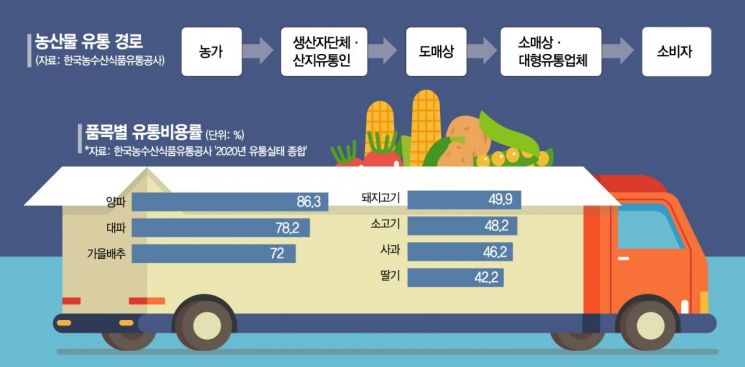
In the case of onions, the distribution cost rate reached 86.3%. If consumers buy onions for 1,000 won, 863 won of that is distribution cost, and the amount delivered to farmers is about 140 won. The distribution cost rate for strawberries, whose prices have risen significantly, is 43%, meaning that when consumers purchase strawberries at 20,000 won per 1kg, more than 8,000 won is paid as distribution costs.
The distribution cost rate increases significantly at the retail stage. The retail stage includes distribution costs such as rent, labor costs, repackaging costs, and product loss. Of the average 47.5% distribution cost rate for agricultural and fishery products, 28.2% occurs at the retail stage.
Passing Through 4 to 6 Stages Before Reaching Consumers’ Tables
The high distribution cost rate attached to agricultural and fishery products stems from the overly complex domestic distribution process. For agricultural products, the process goes from farmers → producer groups or local distributors → wholesalers → retailers or large distribution companies before reaching consumers’ tables. For agricultural products requiring processing or storage space, one or two additional distribution stages are added, increasing the distribution cost rate further.
The complex distribution process also causes consumer price distortions. Intermediate distributors can artificially control the volume shipped to wholesalers by making large-scale contracts at the field level, thereby adjusting price fluctuations. This is why consumers cannot actually feel the impact even when there is news of a bumper crop from farmers.
To minimize such price adjustments, attempts are being made to contract directly with farmers at large supermarkets to reduce distribution stages. However, there is a high risk of supply disruptions depending on the crop conditions of contracted farms, and large storage facilities must be separately maintained, so most cases still go through a complex distribution process.
Rising Labor Costs... Widening Price Gap
The price gap between farmgate and consumer prices for agricultural products is expected to widen further. Transportation, packaging, loading/unloading fees, and commissions are largely fixed costs, making it difficult to reduce these once set. Meanwhile, labor costs, which directly affect these expenses, have risen sharply every year. In fact, the retail stage distribution cost rate rose from 21.9% in 2015 to 27.4% in 2019 and reached 28.2% in 2020. This is analyzed to be influenced by the steep increase in the minimum wage since 2015. Following this trend, there are forecasts that the distribution cost rate will rise further this year, exceeding 30%.
As these problems have persisted for several years, the government has begun efforts to improve the agricultural product distribution structure. The Ministry of Agriculture, Food and Rural Affairs plans to establish a nationwide online marketplace, build smart APCs, and develop agricultural product tracking and integrated information systems from this year through 2027. Additionally, based on the analysis of the 2020 pilot operation results of online marketplaces for onions, garlic, and apples, the full-scale online marketplace project will be implemented this year targeting major vegetables and fruits.
© The Asia Business Daily(www.asiae.co.kr). All rights reserved.