Extension of GTX from Dongtan to Pyeongtaek, etc.
Easing of Reconstruction and Redevelopment Regulations in 1st Generation New Towns
Undergrounding of Gyeongbu Expressway
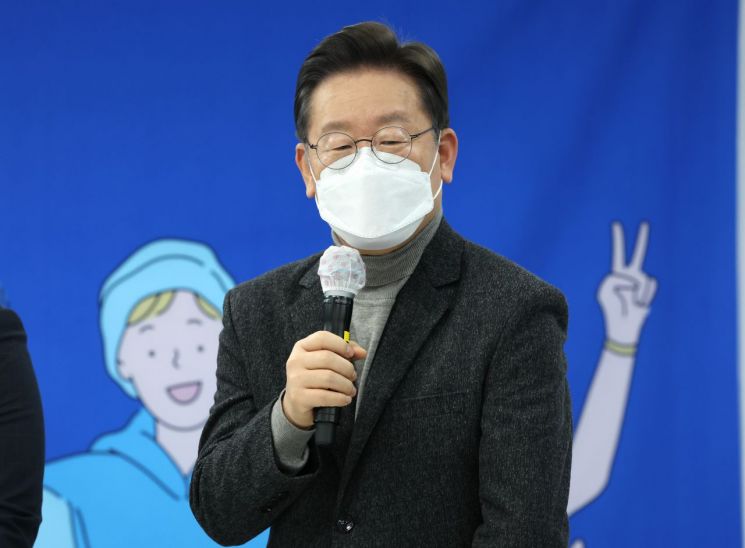
[Asia Economy Reporter Jeon Jinyoung] Lee Jae-myung, the presidential candidate of the Democratic Party of Korea, announced his regional pledges for Gyeonggi Province on the 28th.
At 9 a.m. that day, at Poeun Art Hall in Yongin City, Gyeonggi Province, Candidate Lee announced pledges including ▲ establishing a 30-minute living zone in the metropolitan area by adding new GTX lines ▲ rebirth of the first-generation new towns of Bundang, Sanbon, Ilsan, Jungdong, and Pyeongchon as smart cities ▲ expansion of the peace economy base in northern Gyeonggi ▲ improvement of location regulations in eastern Gyeonggi ▲ creation of ecological parks in western Gyeonggi. The full text follows.
With the GTX Plus Project,
a 30-minute living zone in the metropolitan area,
and a Gyeonggi filled with young jobs,
Lee Jae-myung will make it happen!
Dear residents of Gyeonggi Province,
This is Lee Jae-myung, a resident of Gyeonggi Province.
From a poor boy laborer Lee Jae-myung to a human rights lawyer,
and then to the mayor of Seongnam and governor of Gyeonggi Province,
I greet you as the presidential candidate of the Democratic Party of Korea here in Gyeonggi Province.
Thanks to the dignified authority entrusted to me by the residents of Gyeonggi Province,
I have achieved various accomplishments, big and small, to come this far.
I would like to express my sincere gratitude first.
Gyeonggi Province is the economic center of South Korea
and a microcosm of the country, accounting for one-quarter of the national population.
A vibrant and dynamic Gyeonggi Province,
a Gyeonggi where young people can dream of the future and work freely,
a Gyeonggi leading the peace economy on the Korean Peninsula must be realized.
Lee Jae-myung, who knows Gyeonggi Province better than anyone,
will surely achieve a great transformation of Gyeonggi Province.
First, through the ‘GTX Plus Project,’
I will create a 30-minute living zone in the metropolitan area.
By promoting a transportation revolution that connects the entire metropolitan area with an average 30-minute living zone,
I will greatly increase the proximity of residence and workplace for Gyeonggi residents.
Building on the transportation network projects steadily progressing so far,
I will promote the GTX Plus (+) Project by adding new lines to the GTX.
Through this, we will resolve traffic congestion in the metropolitan area
and guarantee equal mobility rights for everyone without discrimination.
I will accelerate the currently underway GTX-A, B, and C lines.
I will firmly uphold the principle of ‘transport first, then residence’
to ensure no inconvenience for residents moving into the 3rd generation new towns.
In addition, I will actively promote the GTX-A+ and C+ lines.
GTX-A+ will be extended from Dongtan to Pyeongtaek.
GTX-C+ will be extended northward to Dongducheon,
and southward to Byeongjeom, Osan, and Pyeongtaek,
and will connect from Geumjeong to Ansan and Oido (utilizing existing lines).
GTX-D will be normalized to include the Kimpo-Bucheon-Gangnam-Hanam section as originally proposed by Gyeonggi Province, instead of the current government’s Kimpo-Bucheon section.
GTX-E will actively promote the Incheon-Siheung-Gwangmyeong New Town-Seoul-Guri-Pocheon line,
and GTX-F will actively promote the Paju-Samsong-Seoul-Wirye-Gwangju-Icheon-Yeoju line.
In the future, where there are requests and demands from local residents,
additional GTX lines will be promoted
to support the formation of a 30-minute living zone in the metropolitan area.
The Western Line will be connected from Seoul National University Gwanaksan Station to Anyang,
the northern part of Line 3 will be connected from Daehwa to Geumneung to the Gyeongui-Jungang Line,
and the southern part will be extended to Seongnam, Yongin, and Suwon.
The extension of Seoul Subway Line 5 to Kimpo will be started as quickly as possible,
opening the subway era directly connecting Kimpo to Seoul and resolving traffic congestion.
Efforts will be made to smoothly promote the extension of Line 5 (Banghwa-Kimpo), Line 6 (Sinnae-Guri-Namyangju), Line 7 (Okjeong-Pocheon),
Line 8 (Seongnam Pangyo-Seohyeon-Gwangju Opo), Line 9 (Gangdong-Hanam-Namyangju),
extension of Incheon Line 2 to Kimpo and Goyang, and the establishment of the Goyang-Eunpyeong Line.
The extension of the Sosa-Daegok Line to Paju will be completed early,
and efforts will be made to smoothly promote the establishment of the Geumcheon-Gwangmyeong Line.
The Byeolnaeseon Line (Namyangju Byeolnae-Guri-Seongnam Moran-Amsa) and
the Wolgot-Pangyo double-track railway will be promoted without delay.
The metropolitan inland line (Dongtan-Anseong-Cheongju Airport) and
the Daejang-Hongdae Line connecting Bucheon Daejang to Seoul Hongdae will be actively promoted.
The construction of the Metropolitan Area 2nd Ring Expressway will be actively supported for early opening of the entire section.
The undergrounding of the Gyeongbu Expressway section in Gyeonggi Province between Yangjae IC and Dongtan IC will be additionally reviewed.
The construction of an airport in southern Gyeonggi will be reviewed in connection with the relocation of Suwon Military Airport.
The transportation revolution represented by the GTX Plus Project
will strengthen the proximity of residence and workplace for Gyeonggi residents,
develop neglected areas such as old downtowns, border areas, and water source protection zones in a balanced way,
and guarantee equal mobility rights for all Gyeonggi residents without discrimination.
Second, the first-generation new towns of Bundang, Sanbon, Ilsan, Jungdong, and Pyeongchon
will be reborn as self-sufficient smart cities.
The five first-generation new towns located in Gyeonggi Province
have become old cities unworthy of the name ‘new town.’
Parking difficulties, noise between floors, and aging infrastructure are worsening the living environment.
By enacting the so-called ‘Bundang, Sanbon, Ilsan, Jungdong, Pyeongchon New Town Special Act,’
we will transform these bedroom towns into self-sufficient smart cities.
Regulations on reconstruction, redevelopment, and remodeling will be eased,
allowing residents to choose the appropriate method they prefer.
Safety inspection standards for reconstruction and safety review standards for remodeling will be relaxed to reflect reality.
Fourth-class general residential areas allowing a floor area ratio of up to 500% will be applied,
and permits will be processed quickly to greatly reduce time and costs.
Remodeling will increase profitability through an increase in the number of households and vertical extension,
and remodeling of unit divisions in medium and large apartments will be expanded.
Additional incentives such as zoning upgrades will be considered to revitalize redevelopment.
We will make these cities self-sufficient cities that create jobs.
Major station areas will be developed as growth hubs where residential, commercial, and industrial functions coexist.
We will build urban high-tech industrial bases to gather innovation capabilities
and create jobs close to residences.
Advanced transportation means such as trams, drones, and urban air mobility will be introduced according to the conditions of the new towns.
Third, the southern Gyeonggi area will be developed as a high-tech industry and semiconductor hub,
creating a large number of young jobs.
The four techno valleys in the Gyeonggi area will be developed into a ‘global advanced industrial cluster belt’ representing South Korea.
Gwangmyeong and Siheung will be developed as innovation clusters where advanced industries, manufacturing, distribution, and residential functions converge,
and Pangyo will foster ICT-based fintech and fabless industries.
Yongin will be developed as a national strategic semiconductor industrial complex,
and the Yongin Platform City, being developed as a semiconductor hinterland city, will be promoted without delay.
Semiconductors are the rice of the 4th Industrial Revolution and the backbone of our economy.
Hwaseong, Osan, Giheung, Pyeongtaek, and Icheon will be nurtured as semiconductor hub complexes,
making southern Gyeonggi a global semiconductor hub.
The Ansan Small and Medium Research and Development Special Zone will be developed as a representative ICT convergence parts and materials innovation cluster in South Korea.
In the Banwol-Sihwa National Industrial Complex, a representative manufacturing complex,
efforts will be made to establish a digital-based process innovation simulation support center.
Old industrial complexes scattered in southern Gyeonggi will be transformed into smart-green industrial complexes,
and support will be provided to transform them into RE100 industrial complexes where 100% of the electricity used by companies is supplied by renewable energy.
Fourth, the sacrifices of northern Gyeonggi will be properly compensated,
and the foundation of the peace economy will be expanded.
The northern Gyeonggi area bordering North Korea
still bears deep scars of division.
For over 70 years, northern Gyeonggi has endured special sacrifices for national security,
and we will repay with special compensation and expand the foundation for the peace economy.
Development of US military return sites will be led by the state,
and support for surrounding areas will also be expanded.
We will actively support the enactment of the Peace Economy Special Zone Act
to create a new model of inter-Korean economic cooperation.
Border areas will be developed into advanced industrial complexes advancing into the continent.
DMZ tourism will be revitalized with Panmunjom as a hub,
and the DMZ will be developed as an ecological peace zone.
The DMZ, extending from Gyeonggi to Gangwon, will be systematically preserved,
and an administrative consultative body will be established for the development of border areas embracing the DMZ.
Historical, cultural, and tourism contents and programs in Dorasan, Imjingak, and the Hantan River basin (Pocheon and Yeoncheon)
will be expanded to support the activation of peace and ecological tourism in northern Gyeonggi.
To develop the regional economy of northern Gyeonggi,
the industrial base of each region will be further strengthened.
Successful completion of the Yangju Techno Valley and Namyangju Wangsuk Industrial Complex projects will be supported.
We will actively support Uijeongbu K-POP, Pocheon logistics and furniture, Paju medical,
and Goyang broadcasting and video cluster projects,
and carefully manage the ongoing Guri AI Platform City project.
We will promote the establishment of the 4th Industrial Revolution University at the Gyeonggi Future Education Paju Campus
to nurture future new industry professionals in AI, future cars, energy, bio, and more.
To complete the Gyeonggi circular railway network, a key project of Gyeonggi Province,
we will actively support the connection of the suburban line sections from Goyang to Uijeongbu
and from Tapseok to Byeolgaram to Byeolnae connecting Uijeongbu to Namyangju.
The extension project of the Gyeongwon Line from Baekmagoj to the Military Demarcation Line will be resumed promptly,
and the East-West Peace Expressway and Seoul-Yeoncheon Expressway projects will be promoted to expand the main transportation network in border areas.
We will actively support the upgrade of National Route 39 to a national highway and the maintenance of the Uijeongbu-Yeoncheon section of National Route 3
to prepare for the era of the peace economy.
In preparation for future inter-Korean high-speed rail connections,
we will also consider operating KTX and SRT trains to border areas.
Fifth, we will create a pleasant and convenient eastern Gyeonggi where nature and people coexist.
The eastern Gyeonggi area has endured many sacrifices to protect the Paldang water source,
which supplies drinking water to 26 million people in the metropolitan area.
Overlapping and unreasonable location regulations will be rationally improved,
and areas where preservation is unavoidable will be compensated more generously.
A dense wide-area transportation network will also be established in eastern Gyeonggi.
The Hanam-Yangpyeong Expressway, National Route 3 Icheon-Yeoju project,
and the Suseo-Gwangju and Yeoju-Wonju double-track railway projects will be carried out without delay.
The construction of the Hanam-Namyangju-Pocheon Expressway will also be actively promoted.
Support will be provided to establish an eco-friendly mobility system throughout eastern Gyeonggi,
and to create a health tour healing special zone.
Based on the beautiful natural environment of the Namhan and Bukhan Rivers in Gapyeong and Yangpyeong,
eastern Gyeonggi will be developed as an eco-friendly cultural and tourism hub.
To enhance agricultural competitiveness in eastern Gyeonggi,
the spread of smart farms and the promotion of advanced agriculture will be supported.
Sixth, we will create western Gyeonggi where ecological and cultural spaces breathe life.
By creating ecological parks where water, forests, wind, and culture coexist,
we will provide happy daily lives to residents.
With expanded national support, we will actively support the creation of eco-friendly ecological parks along representative tributaries of Gyeonggi Province,
such as Anyangcheon, Anseongcheon, Osancheon, Gyeongancheon, Munsancheon, and the Hantan River.
The relocation of Anyang Prison will be completed early,
and support will be provided for the creation of a cultural plaza including forests.
Dear and beloved residents of Gyeonggi Province,
In early summer 2018, I made 365 promises to change your lives,
and over the past three years, I have kept more than 96% of those promises.
I, Lee Jae-myung, who always keeps promises,
now make even bigger promises before you, residents of Gyeonggi Province.
With broader authority and responsibility, I will change the lives of our residents
and make Gyeonggi Province leap forward once again.
Furthermore, just as I changed Gyeonggi Province, a microcosm of South Korea,
I will surely achieve a great transformation of South Korea.
A 30-minute living zone in the metropolitan area,
a Gyeonggi filled with young jobs,
Lee Jae-myung will make it happen!
Thank you.
January 24, 2022
Lee Jae-myung, 20th Presidential Candidate of the Democratic Party of Korea
© The Asia Business Daily(www.asiae.co.kr). All rights reserved.
![User Who Sold Erroneously Deposited Bitcoins to Repay Debt and Fund Entertainment... What Did the Supreme Court Decide in 2021? [Legal Issue Check]](https://cwcontent.asiae.co.kr/asiaresize/183/2026020910431234020_1770601391.png)















