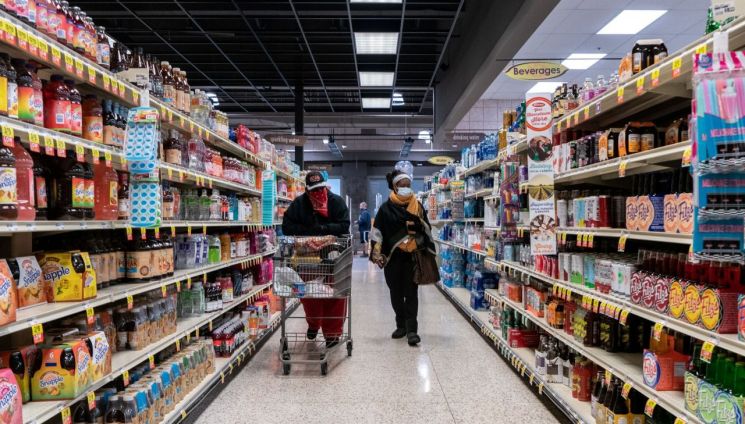
[Asia Economy New York=Special Correspondent Joselgina] Reports have emerged that groceries are disappearing from supermarket shelves in the United States as the new COVID-19 variant Omicron spreads.
The Wall Street Journal (WSJ) reported on the 23rd (local time) that the spread of Omicron is causing new supply chain pressures on the U.S. food system. As infections increase, labor shortages are worsening from processing plants to grocery stores, causing significant disruptions in food supply and transportation.
According to IRI, the food inventory rate of U.S. retailers in the second week of January was only 86%. This is lower than the pre-pandemic period, which recorded inventory rates above 90%, as well as lower than last summer. In particular, inventory rates for some items such as sports drinks, frozen snacks, and refrigerated dough were even lower at 60-70%. Typically, the retail industry aims to maintain inventory rates of 90-95%.
This is interpreted as a result of the recent Omicron surge intensifying labor shortages and causing greater disruptions in the supply chain. At Church Brothers Farms, a produce company located in Arizona, one out of every ten employees took sick leave due to COVID-19 infection. Pigly Wiggly, a major U.S. supermarket, reported that one-third of employees at its Southeast distribution center took sick leave, necessitating the hiring of temporary workers. The Pigly Wiggly manager noted that frozen vegetables and canned biscuits are particularly becoming scarce.
Eddie Quizada, production manager at a Stop & Shop store in Northport, New York, also said the impact of Omicron was significant, with one out of five employees testing positive in early January. He mentioned that although they ordered 48 boxes of strawberries, only 17 boxes were received. Vivek Sankaran, CEO of the grocery retailer Albertsons Companies, said, "We initially thought the food supply chain crisis caused by COVID-19 would normalize around this time, but the spread of Omicron has caused disruptions," expressing concern that "a bigger supply shortage could occur next month."
According to the U.S. Department of Agriculture, beef slaughter and production in the second week of January decreased by 5% compared to the same period last year. Pork slaughter also dropped by 9%. Chicken production in early January was 4% less than a year ago. Considering that meat takes several weeks to reach store shelves after slaughter and processing, analysts predict that the decline in grocery inventory will continue. WSJ reported, "labor shortages are also affecting milk and cheese production."
Brandon Johnson, CEO of Kos Transfer, a trucking company based in Wisconsin, recently stated that the COVID-19 infection situation within the company is as severe as in the early stages of the pandemic, and he has become accustomed to telling customers that there are no drivers available to transport their cargo. Earlier, CNN reported that in addition to the spread of Omicron, recent winter storms could deliver another blow to the food industry supply chain.
© The Asia Business Daily(www.asiae.co.kr). All rights reserved.
![User Who Sold Erroneously Deposited Bitcoins to Repay Debt and Fund Entertainment... What Did the Supreme Court Decide in 2021? [Legal Issue Check]](https://cwcontent.asiae.co.kr/asiaresize/183/2026020910431234020_1770601391.png)















