PCR Allowed Annually for Elderly and Epidemiologically Linked Individuals
Symptomatic Individuals Must Undergo Self-Test or Rapid Antigen Test
Respiratory Clinic Visit Tests Subject to '5000 Won Consultation Fee'
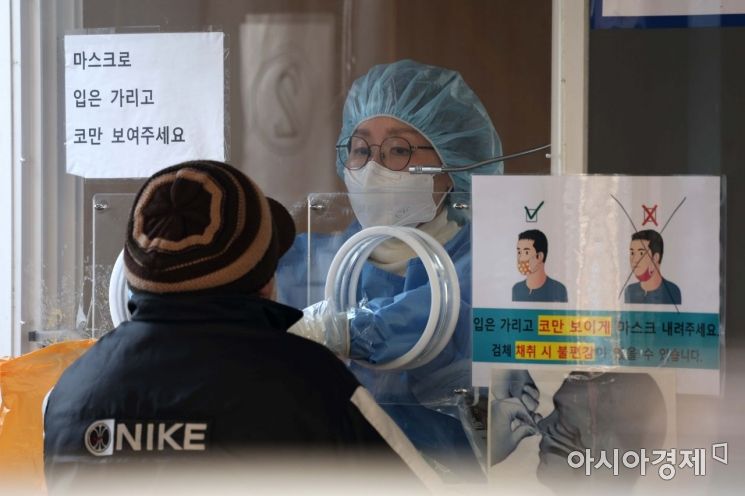 On the 23rd, when 7,630 new COVID-19 cases were reported, citizens visited the temporary screening clinic set up at Seoul Station Plaza. Photo by Honam Moon munonam@
[Asia Economy Reporter Lee Chun-hee] On the 19th, the number of new COVID-19 cases reached 7,630, approaching an all-time high, raising growing concerns about the Omicron variant. To respond to the Omicron variant, the government has taken measures such as limiting the target of polymerase chain reaction (PCR) tests in areas where Omicron accounts for more than 50% of detected cases. Accordingly, from now on, individuals under 60 years old or those with simple symptoms without epidemiological links must either use self-test kits at screening clinics or receive paid rapid antigen tests at respiratory-specialized clinics.
According to the government on the 23rd, Gwangju, Jeonnam, and Pyeongtaek and Anseong in Gyeonggi Province, where Omicron dominance has been confirmed, will switch to an Omicron response system for testing and treatment starting from the 26th. Currently, the Omicron detection rate exceeds 80% in Gwangju and Jeonnam, and 90% of confirmed cases in cluster infections in Pyeongtaek are Omicron infections. Based on data from the 16th to 19th, the nationwide detection rate is 47.1%, so dominance has not yet been achieved nationwide, but it is highly likely to become dominant nationwide next week.
In these four regions, an Omicron response system will begin on the 26th, focusing on the rapid diagnosis and treatment of high-risk groups (priority testing groups) rather than controlling and managing the overall scale of confirmed cases, by effectively utilizing limited quarantine and medical resources.
PCR Allowed Only for Elderly and Epidemiologically Linked Cases... Rapid Antigen Test 'Consultation Fee 5,000 KRW'
Under the response phase, PCR testing at screening clinics, the existing testing method, will be applied only to high-risk groups (priority testing groups). Accordingly, at the 31 screening clinics established in these areas, only those who are ▲60 years or older ▲epidemiologically linked ▲have a doctor's note indicating the need for COVID-19 testing ▲or have tested positive on a self-test kit or rapid antigen test can receive PCR testing.
If one is not in the priority testing group, PCR testing will no longer be available unconditionally even if respiratory symptoms such as cough or fever are present. Authorities judged that if everyone who visits based solely on their own judgment of symptoms were tested by PCR, the testing capacity would not be sustainable.
To receive a PCR test, one must visit a respiratory-specialized clinic and have a positive result from either a professional rapid antigen test conducted after a doctor's consultation or a self-test kit. When the rapid antigen test is positive, if the institution itself can perform PCR testing, PCR testing can be done within the clinic. The test itself is free, but a consultation fee of 5,000 KRW based on clinic standards must be paid by the individual. This is the first case where a personal expense has been introduced related to COVID-19 testing and treatment, which had previously been fully covered by health insurance.
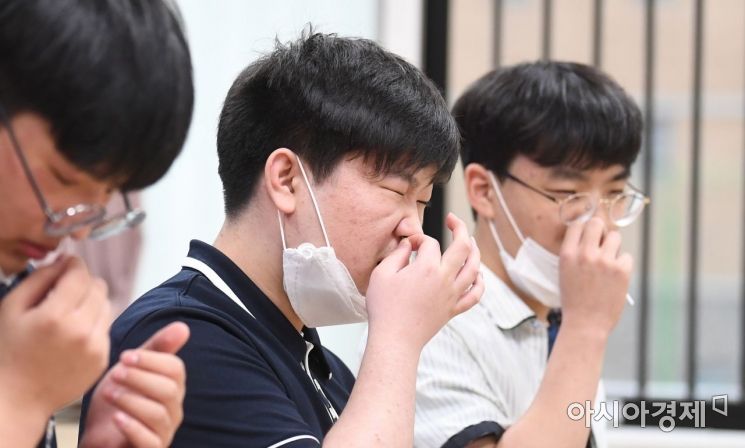 In June, students living in dormitories at a high school in Seoul are conducting self-tests. / June 3, 2021 Photo by Joint Press Corps
Self-test kits can be purchased by individuals or used free of charge at screening clinics, and if positive, PCR testing can be done at the screening clinics.
The issuance method for negative confirmation certificates, which unvaccinated individuals receive to use facilities requiring a quarantine pass, will also change accordingly. Certificates can be issued if the self-test kit is conducted under the supervision of the screening clinic manager or if a professional rapid antigen test is conducted after a doctor's consultation at a respiratory-specialized clinic and the result is negative. Results from self-test kits conducted independently by individuals will not be recognized. The validity period will be reduced from the existing 48 hours to 24 hours. To this end, the authorities plan to distribute a total of 90,000 self-test kits, 3,000 per 30 public health centers in these four regions, by the 25th.
There are a total of 43 respiratory-specialized clinics where testing and treatment are conducted: 23 in Gwangju, 15 in Jeonnam, 2 in Pyeongtaek, and 3 in Anseong. If a positive diagnosis is made after testing at a clinic, non-face-to-face health monitoring will be conducted at the clinic. If other outpatient care needs arise, a system linking testing and treatment will be in place so that patients can receive care at hospital outpatient centers.
Epidemiological investigations will also shift from the existing full investigation policy to investigations focused on high-risk groups (priority testing groups) such as family members, and the isolation period for vaccinated confirmed cases will be shortened to 7 days. Accordingly, from the 26th, vaccinated confirmed cases will be released from isolation immediately after 7 days during home treatment or other treatment processes.
© The Asia Business Daily(www.asiae.co.kr). All rights reserved.
![User Who Sold Erroneously Deposited Bitcoins to Repay Debt and Fund Entertainment... What Did the Supreme Court Decide in 2021? [Legal Issue Check]](https://cwcontent.asiae.co.kr/asiaresize/183/2026020910431234020_1770601391.png)
















