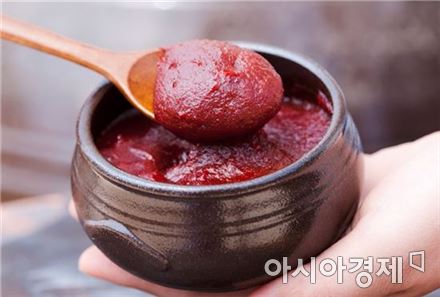
 Gochujang. Photo by Korea Tourism Organization
[Asia Economy Reporter Moon Hyewon] Thanks to the Korean Wave led by BTS (Bangtan Sonyeondan) and others, exports of gochujang and doenjang have surged in recent years.
According to the '2021 Processed Food Submarket Status: Gochujang Edition' published on the 23rd by the Korea Agro-Fisheries & Food Trade Corporation (aT) and the Ministry of Agriculture, Food and Rural Affairs, the export value of gochujang in 2020 was recorded at $50.932 million.
This represents an increase of 35.2% compared to the previous year ($37.667 million) and 62.6% compared to 2016 ($31.329 million).
Based on the 2020 export value, the major export destinations for gochujang were the United States (26.4%), China (17.3%), Japan (10.3%), the Philippines (6.0%), and Canada (4.3%).
The research team explained, "Overseas consumers’ perception of gochujang has distinctive characteristics compared to existing K-foods," adding, "It is characterized by playful consumption as 'hip food culture content' enjoyed by famous YouTubers, K-POP stars like BTS, and appearing on platforms such as TikTok and OTT."
In particular, in the United States, which accounts for the largest export share, gochujang is perceived as a seasoning sauce that harmonizes spicy and sweet flavors, differentiating it from other hot sauces like Tabasco and Sriracha, according to the research team’s analysis.
Over the past five years, the export volume of gochujang increased by 53.8%, from 14,011 tons. In 2020, export volume rose 21.8% and export value increased 35.2% compared to the previous year, showing the highest growth rate in the past five years.
According to the same report’s 'Doenjang Edition,' the export value of doenjang in 2020 was $11.72 million, up 29.1% from the previous year and 44.8% from 2016.
By region, export performance notably improved in Southeast Asian countries. Export values to Singapore and Thailand, which had relatively small shares, increased by 141.3% and 89.5% respectively compared to the previous year.
The research team analyzed, "In 2020, strong movement restrictions were imposed in Singapore and Thailand to prevent the spread of COVID-19, during which popular Korean dramas such as 'Itaewon Class' were frequently exposed to the public," adding, "This led to an increase in preference for Korean food after the lifting of movement restrictions."
© The Asia Business Daily(www.asiae.co.kr). All rights reserved.
















