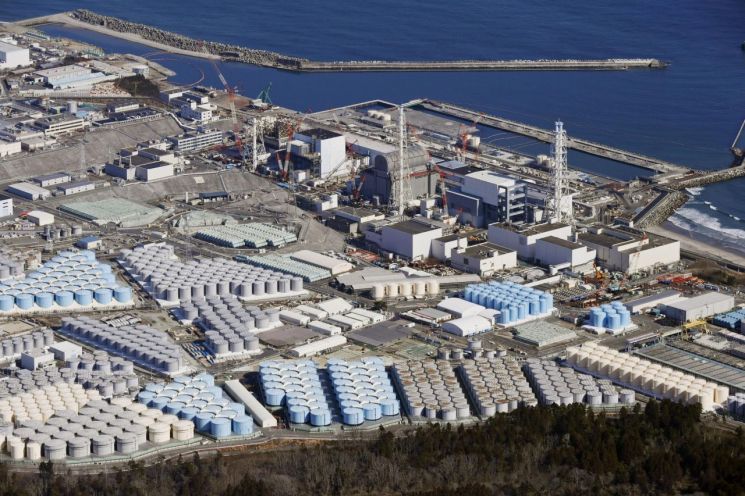
[Asia Economy Reporter Kim Hyung-min] At the Fukushima Daiichi Nuclear Power Plant in Japan, where decommissioning work is underway, local authorities are confirming a suspected leak of liquid coolant from the "frozen soil wall," which plays a role in reducing the generation of radioactive contaminated water.
The plant operator, Tokyo Electric Power Company (TEPCO), believes that part of the pipes buried underground forming the frozen soil wall has been damaged and is focusing on locating the affected area.
According to NHK on the 23rd, TEPCO discovered on the 16th that the water level in two of the four tanks storing calcium chloride aqueous solution, the coolant used to freeze the ground around the Fukushima Daiichi Nuclear Power Plant buildings, had dropped. Following this, an investigation around the frozen soil wall confirmed the coolant leak.
Based on the change in the storage tank levels, TEPCO estimates that about 4 tons of coolant have leaked.
However, TEPCO stated that since the leaked coolant is not radioactive contamination, there is no environmental impact. They also added that even if the coolant leaks, it will take several months before the frozen soil wall itself begins to thaw, so the function of suppressing groundwater inflow is being maintained.
The frozen soil wall is a device installed to prevent groundwater and rainwater from flowing into the reactor area and becoming contaminated water. It blocks water flow paths with a frozen ice wall at minus 30 degrees Celsius and is installed around Units 1 to 4 at a depth of about 30 meters underground, extending approximately 1,500 meters in length.
Although there has been controversy over the effectiveness of the frozen soil wall, which has been in operation since 2016, TEPCO explains that it has significantly reduced the amount of contaminated water generated thanks to the frozen soil wall.
However, the Fukushima Daiichi Nuclear Power Plant has continuously been a subject of controversy due to the considerable amount of contaminated water containing radioactive substances generated so far. Units 1 to 4 of Fukushima Daiichi experienced a core meltdown accident in March 2011 during the Great East Japan Earthquake due to cooling system failure. Since then, rainwater, groundwater, and cooling water contacting the damaged reactors have produced contaminated water containing high concentrations of radioactive materials.
The total amount of contaminated water generated so far approaches 1.3 million tons. The Japanese government decided in April last year to treat this contaminated water with the Advanced Liquid Processing System (ALPS) and begin discharging it into the ocean (Pacific Ocean) starting next spring.
© The Asia Business Daily(www.asiae.co.kr). All rights reserved.
![User Who Sold Erroneously Deposited Bitcoins to Repay Debt and Fund Entertainment... What Did the Supreme Court Decide in 2021? [Legal Issue Check]](https://cwcontent.asiae.co.kr/asiaresize/183/2026020910431234020_1770601391.png)