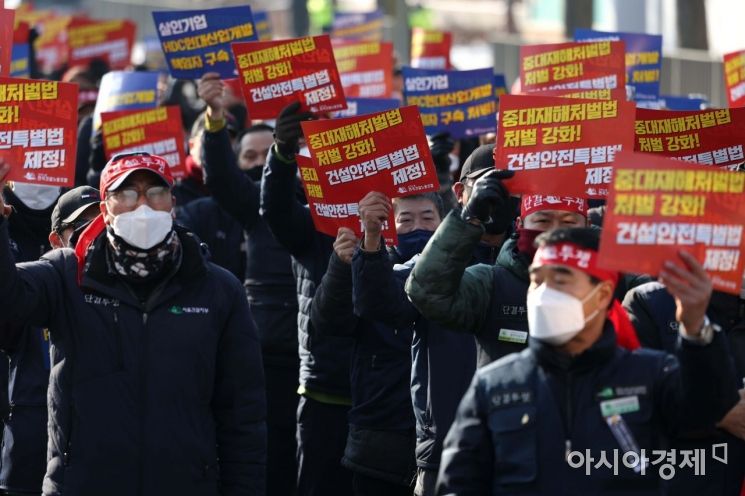
 The Korean Confederation of Trade Unions Construction Union held a "Rally of Construction Workers' Resolution to Strengthen Punishment for Murderous Companies! Strengthen the Serious Accident Punishment Act! Urge the Enactment of the Construction Safety Special Act!" on the 20th in front of the Cheongwadae Sarangchae in Jongno-gu, Seoul. / Photo by Moon Honam munonam@
[Asia Economy Reporter Junho Hwang] Amid a major collapse accident in Gwangju, it is forecasted that the impact of the Serious Accident Punishment Act, which will be enforced from the 27th, on the construction industry will be limited.
According to the enforcement of this law, if a serious accident resulting in death occurs, the management responsible for the company that did not sufficiently implement safety measures in advance will be subject to punishment of imprisonment for more than one year or a fine of up to 1 billion KRW. Industries where ESG (Environmental, Social, Governance) risks are expected to increase due to the enforcement of this law include industrial sectors such as construction, shipbuilding, machinery, and transportation, as well as material sectors such as refining, steel, and metals. Furthermore, considering the contents related to serious civic disasters included in the Serious Accident Punishment Act, consumer goods industries such as household and personal products or cosmetics may also be affected.
In the case of the construction industry, where the major accident occurred this time, it can be seen that a legal basis has been established for administrative agencies to impose business suspension or cancellation of construction business registration on the construction company in the event of a serious accident. However, Korea Investment & Securities judged that, considering only this law and the Industrial Safety and Health Act, the additional cost burden on construction companies after the law's enforcement would be low. It is also expected that while the general administrative expenses will increase as safety-related budgets are allocated to the overall organization, the construction costs per site, including industrial safety and health management costs, are calculated, so the reduction in construction margins is expected to be limited. Construction companies have promoted safety-related dedicated organizations to headquarters and appointed CSOs (Chief Safety and Health Officers) to entrust overall company safety management ahead of the enforcement of this law.
However, management of subcontractors is expected to become more important, as smaller business sizes tend to have higher accident rates. Jiwoo Lim, a researcher at Korea Investment & Securities, said, "It is necessary to pay attention to companies that disclose more detailed indicators such as subcontractor LTIR (Lost Time Injury Rate) to distinguish companies with excellent safety responses," adding, "The indicators disclosed externally by companies will also be actively used for internal risk management, so it can be inferred that more efforts are being made in subcontractor management." He further named Samsung Engineering, GS Construction, and Hyundai Construction as companies in the construction sector currently disclosing subcontractor accident rates.
© The Asia Business Daily(www.asiae.co.kr). All rights reserved.
![User Who Sold Erroneously Deposited Bitcoins to Repay Debt and Fund Entertainment... What Did the Supreme Court Decide in 2021? [Legal Issue Check]](https://cwcontent.asiae.co.kr/asiaresize/183/2026020910431234020_1770601391.png)
















