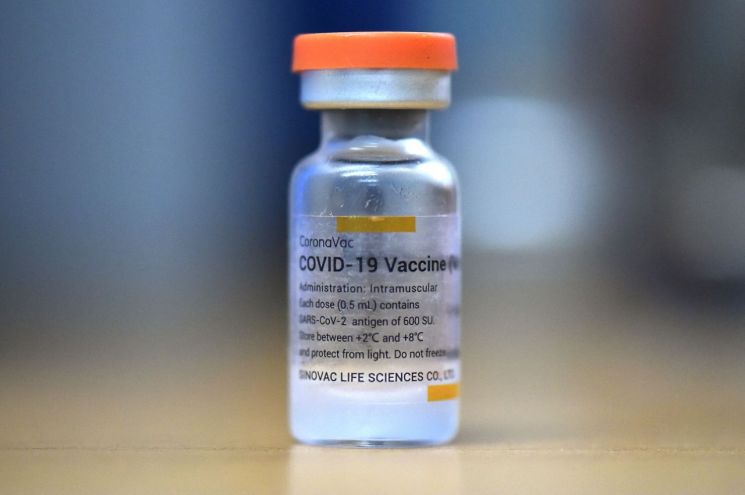
[Asia Economy Reporter Seoyoung Kwon] A study has been published revealing that inactivated vaccines, including China's COVID-19 vaccines administered mainly in developing countries, are almost ineffective against the Omicron variant.
On the 21st, a research team led by Professor Akiko Iwasaki of Yale University in the United States announced in the international academic journal Nature Medicine that "the Sinovac COVID-19 vaccine, administered in 48 countries worldwide, provides no protection against the Omicron variant." Sinovac is an inactivated vaccine made from viruses whose infectivity has been eliminated through chemical treatment. Another Chinese pharmaceutical company's vaccine, Sinopharm, was developed on the same principle.
Inactivated vaccines are more stable and easier to manufacture than other types of vaccines, but are known to have somewhat lower virus prevention efficacy. While mRNA vaccines such as Pfizer and Moderna have shown 94-95% prevention efficacy, Sinovac and Sinopharm vaccines have been measured to have prevention rates of approximately 51% and 78%, respectively.
The Yale research team analyzed blood samples from 101 individuals in the Dominican Republic who had received two doses of the Sinovac vaccine and a booster shot of Pfizer's vaccine. The results showed that before the third dose, there were no neutralizing antibodies against the Omicron variant, but after the third dose, a small amount of Omicron variant antibodies was detected in 80% of all vaccinated individuals. However, the amount of these antibodies was found to be similar to that of people who had received two doses of mRNA vaccines.
Professor Iwasaki stated, "Even two doses of mRNA vaccines do not provide sufficient protection against Omicron variant infection," and analyzed that "in regions worldwide where the Sinovac vaccine has been administered, it is necessary to receive up to two booster shots." Some express concerns that if inactivated vaccines, which account for 5 billion doses out of 11 billion doses administered worldwide, do not significantly help prevent Omicron variant infections, breakthrough infection cases could surge globally.
Previously, the Chinese government began distributing Sinovac and Sinopharm vaccines domestically from December last year, ahead of the World Health Organization (WHO) emergency approval in June last year. They also supplied large quantities of vaccines mainly to developing countries such as Indonesia, Brazil, and Pakistan, and recently announced plans to provide an additional 1 billion doses to Africa. However, Nature warns that the use of inactivated vaccines should be reconsidered amid the spread of the Omicron variant.
© The Asia Business Daily(www.asiae.co.kr). All rights reserved.
![User Who Sold Erroneously Deposited Bitcoins to Repay Debt and Fund Entertainment... What Did the Supreme Court Decide in 2021? [Legal Issue Check]](https://cwcontent.asiae.co.kr/asiaresize/183/2026020910431234020_1770601391.png)















