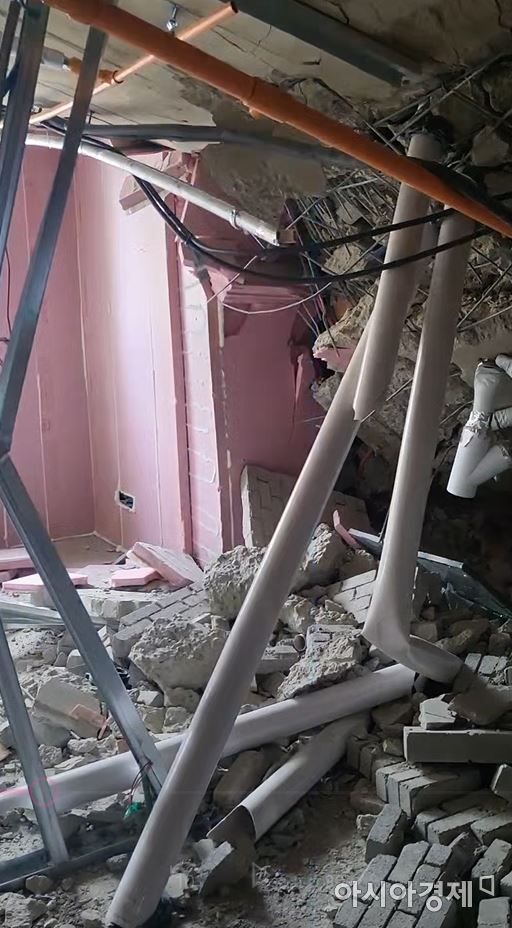
 Interior of Hwajeong I-Park Building 201, revealed to the media on the 22nd. Pillars bent like taffy and
[Asia Economy Honam Reporting Headquarters, Reporter Park Jin-hyung] Various debris was scattered as if it had been bombed.
Four reporters and Moon Hee-jun, Chief of the Western Fire Station, along with a total of 11 people, entered the interior of Gwangju Metropolitan City Seo-gu Hwajeong I-Park Building 201, whose outer walls had collapsed, on the morning of the 22nd, the 12th day after the accident, to inspect the site conditions.
The building has a total of 45 rooms centered around the central staircase: Room 1 in the southwest, Room 2 in the southeast, Room 3 in the northeast, and Room 4 in the northwest.
At around 11:18 a.m., they reached the 20th floor where the forward command post was set up. An A4 sheet with the phrase "Do our best until the last person" caught the eye. This is where the rescue workers renew their determination every day.
As of the 12th day after the accident, only one deceased person has been recovered. They say that ending every search "empty-handed" feels like committing a sin.
On the inner wall, following the recommendations of rescue engineers, an elevator and the safest evacuation area were established. This is called the "core area." Evacuation areas will be installed not only here but also in front of the entrances of Rooms 1 to 4.
The collapse occurred from the 38th floor down to the 23rd floor. Looking out from the 23rd floor, the lowest point of the collapse, the living room side was open to the outside, revealing empty space, and parts of the ceiling and floor had collapsed.
Steel rebars and concrete debris 20 to 30 cm thick that had poured down from the upper floors vividly conveyed the tragic situation at the time of the accident. Rescue workers were clearing debris by approaching as far outward as possible. Clear traces of cleared areas were visible on the floor.
The ceiling of the 23rd floor sagged slightly as if swollen, and the 24th floor, the epicenter where multiple search interruptions occurred due to falling debris, had an even more sagged ceiling.
From the 25th floor, where the outer wall stands vertically blocking the outside view, the scale of the collapse gradually increases.
The ceiling slanted inward from the outside, making entry itself difficult. The upper floor ceilings had collapsed and stacked layer upon layer. This is called a pancake structure, known in Korean as "tteoksiru" form.
The Western Fire Station Chief explained, "The ceiling is stacked layer by layer, making rescue difficult by human strength alone."
This means there is a limit to manpower without equipment. Rescue workers, relying on a single strap around their waist, used a 3-meter special steel rake to scrape away debris. Among the 17 collapsed floors, such work is being done on the 12th floor to prevent falling rocks and other hazards.
The 27th floor, where 50 bags of cement were placed, was in a more severe condition. Debris piled up from the entrance, making entry impossible. On the 28th floor, debris such as bricks piled up to knee height in front of the entrance, and the glass windows were broken.
Yellow lines were drawn near the living room walls on the 31st and 32nd floors. The fire authorities, in consultation with rescue engineers, marked safety lines and are conducting search operations within those boundaries.
Work was temporarily halted in Room 2 on the 33rd floor due to partial dismantling of a 145-meter-high tower crane leaning toward the apartment side.
The dismantling work resumed at noon and proceeded directly to the 39th floor. Along the stairs, steel rebar structures supporting formwork were visible, and about 20 square-shaped charcoal cans were placed for concrete curing.
The rooftop had completely collapsed toward the south wall, and the end of the red pump used for concrete pouring also faced the same direction. The floor near the stairs was hardened but had cracks in several places.
When a photojournalist tried to go south, the Western Fire Station Chief urgently warned, "That area is still curing and is dangerous."
Gu Woo-sik, Administrative Team Leader of the Western Fire Station, explained from the first floor, "Our personnel are controlling access at the entrance," and "The chief (Western Fire Station Chief) is counting all personnel entering and exiting without exception."
He added, "The personnel work for 30 minutes during rescue operations and take sufficient rest to manage their physical strength for safety."
The accident occurred around 3:46 p.m. on the 11th at the apartment construction site when the outer walls of Building 201 from the 23rd to the 38th floor collapsed.
As a result, one worker died and five went missing. It is presumed that they were responsible for window and fire protection equipment installation on floors 28 to 34 of the collapsed building.
© The Asia Business Daily(www.asiae.co.kr). All rights reserved.