On the 21st, 'National Monks Conference' Proceeded Despite COVID-19 Spread
Over 5,000 Monks Gathered Nationwide... "Never Seen Anything Like This"
Culture Minister's Apology Video Drowned Out by Loud Cheers, Event Cut Short
"Will Ensure No Misunderstandings Again," Ruling Party Repeatedly Apologizes
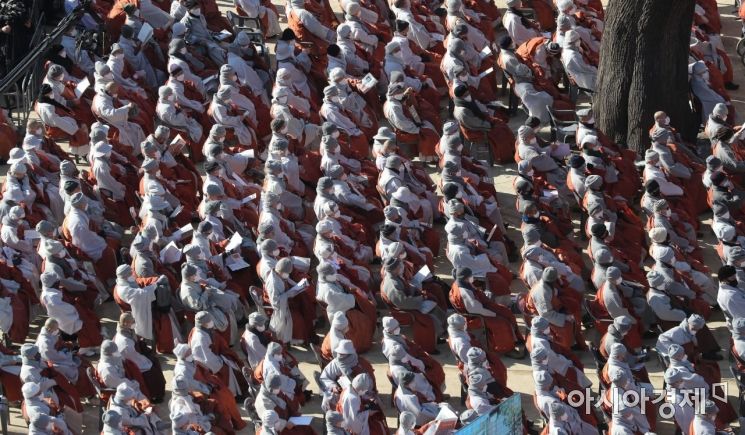 On the 21st, monks attending the "National Monk Rally for Eradicating Religious Bias and Distortion of Buddhism and Protecting the Autonomy of Korean Buddhism" held in the front yard of the Daeungjeon Hall at Jogyesa Temple in Jongno-gu, Seoul, are seen with their hands joined in prayer. Photo by Dongju Yoon doso7@
[Asia Economy Reporter Lim Ju-hyung] "I have been a Buddhist for 50 years. But this is the first time in my life that I have seen monks gather like this."
On the afternoon of the 21st, when the 'National Monk Assembly' was held at Jogyesa Temple in Jongno-gu, Seoul, Monk Eunhye shook his head and said this. His voice was calm and peaceful, but tears welled up in the whites of his eyes.
The monk said, "Usually, Buddhists rarely engage in such collective actions. It is said that they only gathered like this during the anti-Japanese movement in the Japanese colonial era long ago," adding, "So, in a way, doesn't this mean that the current conflict between the administration and the Buddhist community is really serious?"
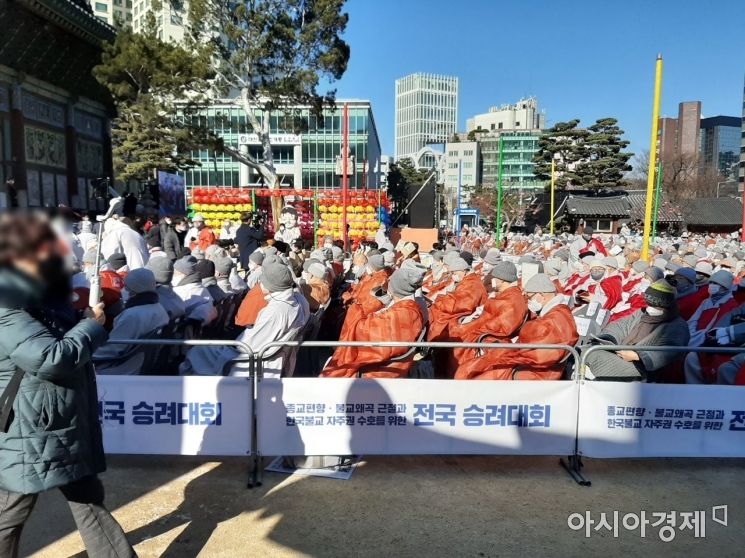 Monks attending the 'National Monks Conference' held from 2 PM on the 21st. / Photo by Im Ju-hyeong skepped@
He also mentioned the so-called 'temple toll remark' by Jeong Cheong-rae, a member of the Democratic Party of Korea, which became the trigger for the conflict to ignite in earnest. He said, "When I was young, I also worked managing entrance fees at a temple. But the money collected there does not all go to the temple; it also covers expenses such as military supplies and maintenance," adding, "We have painstakingly preserved Buddhist relics for 1,700 years. How can someone say such things?"
With 47 days left until the presidential election, Buddhist sentiment is boiling over. About 5,000 monks gathered from all over the country to denounce the government's 'religious bias.' During the event, Representative Jeong visited Jogyesa Temple to apologize in person but had to turn back at the entrance, and the apology video from the Minister of Culture, Sports and Tourism was drowned out by the crowd's jeers and protests.
◆Minister of Culture, Sports and Tourism's Apology Video Drowned Out by Shouts... Burning Buddhist Sentiment
The monk assembly was held from 2:00 p.m. to 3:25 p.m. The monks sat in seats prepared in front of Jogyesa Temple and watched videos and speeches. Inside and outside Jogyesa Temple were packed with people.
Outside the temple entrance, believers holding placards reading "Condemn the Moon Jae-in government's religious bias and distortion of Buddhism" and others holding signs saying "Monk assembly during the COVID-19 pandemic? Political interference and forced patriotism" confronted each other, but overall, the event proceeded in a calm and solemn atmosphere.
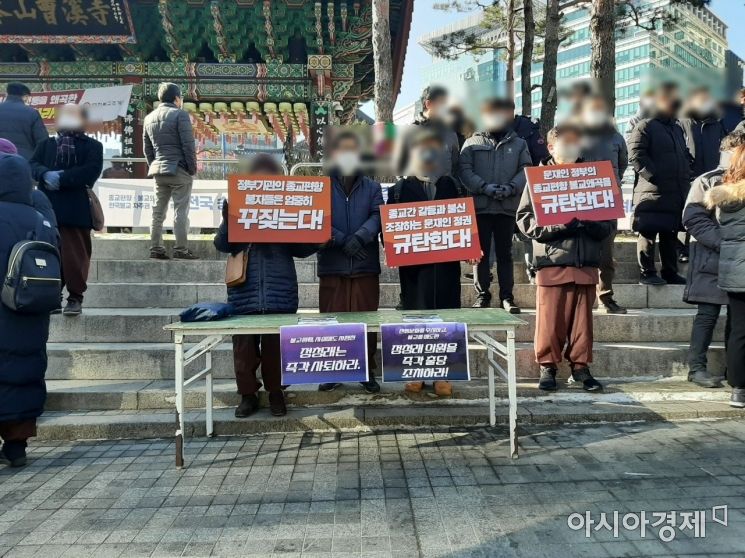 Believers holding placards criticizing the government's religious bias / Photo by Juhyung Lim skepped@
The assembly began with watching a video detailing the disrespect the government had shown toward the Buddhist community. Then, Monk Dogak, Secretary-General of the Korean Buddhist Orders Council, took the stage and said in his speech, "The president held a blessing mass at the Blue House upon inauguration, visited churches without fail during overseas trips, and even used the humiliating term 'audience' when meeting the Pope, showing a biased approach toward a specific religion," adding, "The president's personal religious beliefs are reflected in the public sphere and influence government and public institution projects."
He passionately lamented, "They treat temples and monks as toll-collecting bandits and liken them to 'Bongyi Kim Seon-dal,' branding them as a group of swindlers."
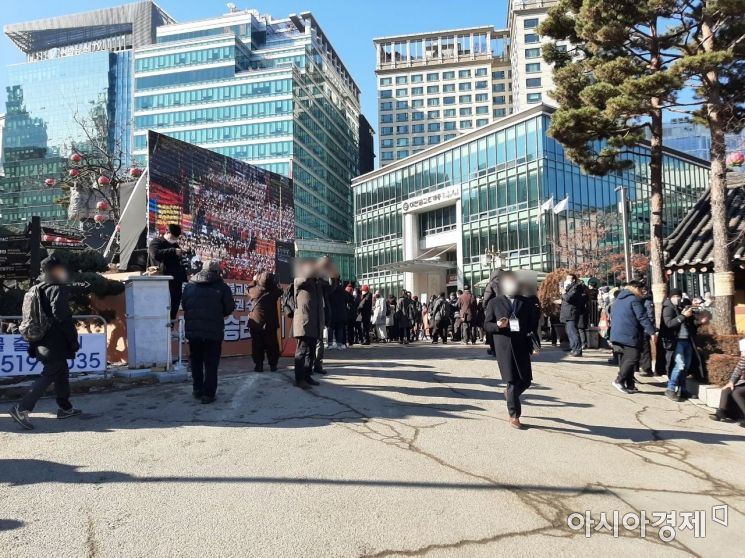 Devotees are watching the event on a large screen installed outside Jogyesa Temple in Jongno, Seoul. / Photo by Juhyung Lim skepped@
As the monks continued speaking, voices of anger gradually erupted among the audience. The conflict peaked when news spread that Song Young-gil, leader of the Democratic Party, and Representative Jeong would personally come on stage to apologize. Representative Jeong reached the entrance of Jogyesa Temple but ultimately could not enter and turned back, and Song's apology announcement was canceled after a long meeting.
The apology video from Minister Hwang Hee of the Ministry of Culture, Sports and Tourism was also drowned out by the angry crowd's shouts and was eventually cut off midway. As Minister Hwang began, "I want to first express my apologies. The government also deeply regrets the recent events," the crowd shouted back, "Go away," "No, no," and other protests.
Minister Hwang continued, "We regret not anticipating the cases related to religious bias raised by the Buddhist community. We hope all citizens can overcome the current crisis together..." but the crowd responded with shouts like "No need," "Get lost," "Nothing else, bring Jeong Cheong-rae instead," and the Jogye Order had no choice but to stop the video halfway.
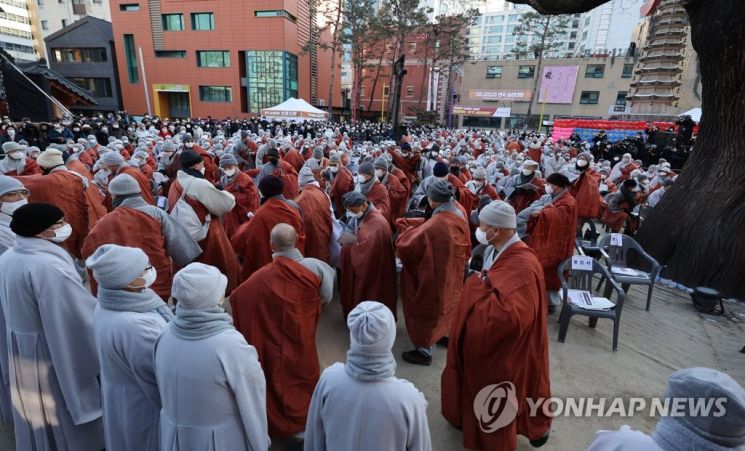 Participants of the monks' conference are leaving the venue in protest upon hearing the news of Song Young-gil, leader of the Democratic Party of Korea, announcing an apology. / Photo by Yonhap News
After the government's and ruling party's apologies were effectively canceled, believers showed an agitated reaction, saying, "We have endured as much as we can." A believer in his 50s who watched the assembly on a large screen inside Jogyesa said, "Why should we keep enduring when the government mocks and belittles Buddhism like this?" adding, "Until now, what have they been doing? Suddenly, as the presidential election approaches, they make a fuss about apologizing, but they don't even show the slightest sincerity."
Another believer said, "It's not just the Moon Jae-in government. Didn't they say during Lee Myung-bak's presidency that Seoul was dedicated to God?" adding, "This country has never once cared about Buddhist believers."
◆Jeong Cheong-rae's 'Buddhism Denigration' Controversy Adds Fuel to the Fire
The conflict between the Buddhist community and the government and ruling party intensified from October last year. At the National Assembly's Culture, Sports and Tourism Committee's audit of the Cultural Heritage Administration, Representative Jeong referred to the entrance fee at Haeinsa Temple as a 'toll' and likened the temples collecting it to 'Bongyi Kim Seon-dal,' sparking fierce backlash from the Buddhist community.
At that time, Song Young-gil, leader of the Democratic Party, and Lee Jae-myung, the presidential candidate, issued 'proxy apologies' to manage the situation, but since Representative Jeong did not apologize himself, about 50 high-ranking monks of the Jogye Order performed 1,080 prostrations, saying, "We will first reflect and repent to the people."
Eventually, Representative Jeong officially apologized on November 25 of the same year, 50 days after the controversial denigrating remarks. In a Facebook post that day, he wrote, "The cultural heritage entrance fee has long been an inconvenience to the public, and I think it was also an unfair and inconvenient issue for the temples managing the cultural heritage," adding, "I will carefully reflect on the Buddhist community's point that the concept of cultural heritage should expand from points to areas."
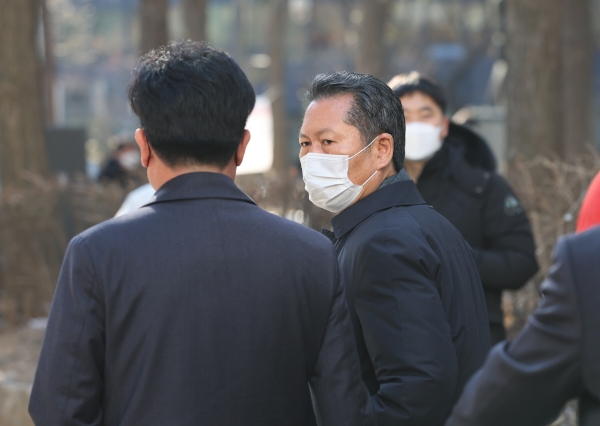 On the 21st, Jeong Cheong-rae, a Democratic Party lawmaker, who visited Jogyesa Temple to attend the monks' conference, was turned away by the organizers and left without entering the venue. / Photo by Yonhap News
He also emphasized, "Just as the national park entrance fee is returned to the people by the state, the cultural heritage entrance fee should also be returned to the people by the state," and "I will propose an amendment to the Cultural Heritage Protection Act to establish a legal basis for the state to support cultural heritage management costs." Representative Jeong tried to visit Jogyesa Temple in Jongno-gu, Seoul, to express his apology in person that day, but the religious order did not allow him to enter, so it was canceled.
As the conflict peaked, voices demanding Representative Jeong's resignation emerged from the Jogye Order. On the 19th, the Jogyesa Temple side visited the Democratic Party headquarters and criticized, "We demand the resignation of Representative Jeong Cheong-rae, who distorted the 1,700-year history and tradition of Korean Buddhism," adding, "He has hurt 20 million Buddhists in the Republic of Korea."
However, Representative Jeong firmly rejected these demands, saying, "There is no withdrawal or divorce in my dictionary." On the 18th, he said, "Core members of Lee's campaign have continuously pressured me to leave the party, but I firmly refused and sent them away," adding, "Even if the party abandons me, I will not abandon the party."
Meanwhile, within the ruling party, there are calls for Representative Jeong to voluntarily leave the party. On the 20th, Democratic Party lawmaker Cho Eung-cheon said in a radio interview, "Honestly, I can't say it out loud, but many lawmakers around me hope that Representative Jeong would voluntarily leave the party."
◆"The Lee Jae-myung Government Will Be More Careful" Ruling Party Repeatedly Apologizes
Meanwhile, Song Young-gil, who visited Jogyesa on the 21st to apologize but ultimately turned back, said to reporters, "I prepared to apologize because they gave me a chance to do so at the Jogye Order, but the atmosphere turned out like this," adding, "I deeply apologize as the leader of the ruling party for not appreciating the 1,700-year history and tradition of Korean Buddhism and for causing hurt and concern to the Buddhist community and the public."
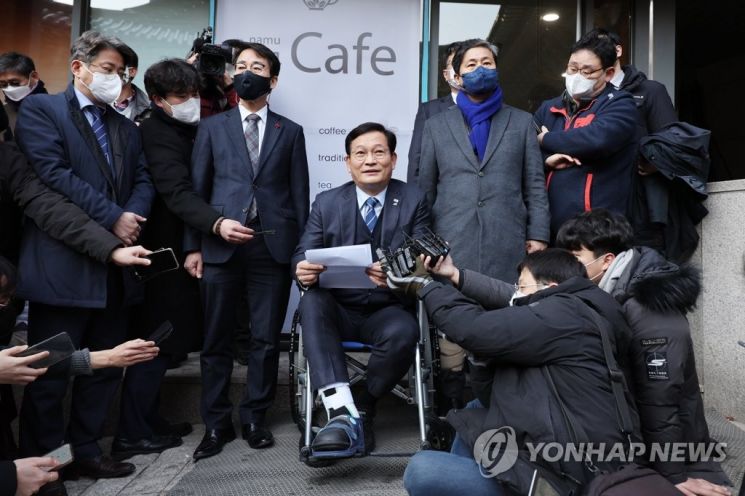 Song Young-gil, leader of the Democratic Party, delivering an apology statement at the rear gate of Jogyesa Temple / Photo by Yonhap News
He continued, "We will communicate more actively with the Buddhist community to ensure the safe and efficient management and transmission of traditional culture and relics protected by Korean Buddhism," emphasizing, "I promise to make every effort to prepare various policy alternatives."
He also said, "The Democratic Party and the government will be more cautious and thorough in words and actions regarding various presidential and government events and protocols to avoid misunderstandings," adding, "Especially when candidate Lee Jae-myung is elected and forms a government, these principles will be well observed."
Representative Jeong also apologized at a National Assembly press conference that day, saying, "Over the past few months, I have had much time for self-reflection and contemplation. I have come to recognize the grievances and unfairness of the Buddhist community," adding, "I sincerely apologize for causing concern to the Buddhist community."
He added, "Taking this opportunity, I will listen with a humbler attitude and strive harder for the mutual development of the people and the Buddhist community," and "I will do my part, however small, to improve laws and systems so that the efforts of the Buddhist community and monks who have protected precious cultural heritage are not in vain."
© The Asia Business Daily(www.asiae.co.kr). All rights reserved.
![User Who Sold Erroneously Deposited Bitcoins to Repay Debt and Fund Entertainment... What Did the Supreme Court Decide in 2021? [Legal Issue Check]](https://cwcontent.asiae.co.kr/asiaresize/183/2026020910431234020_1770601391.png)


















