Relaxation of Musculoskeletal Disease Industrial Accident Criteria
'Presumption Principle' Standards Unclear
Risk Expands Due to Workplace Sanctions
May Cause Moral Hazard Issues
Corporate Burden Expected to Increase by Trillions
[Asia Economy Reporters Jehoon Yoo, Gimin Lee] As the government significantly expands the scope of musculoskeletal disorders presumed to be industrial accidents among workers in the automobile, shipbuilding, and tire industries, corporate burdens are expected to increase by trillions of won.
It is anticipated that 8 out of 10 workers in these industries will become potential subjects. Despite concerns about severe on-site confusion, encouragement of moral hazard, and increased corporate burdens, criticism has arisen that the policy was hastily pushed forward without sufficient social consensus.
In particular, with the Serious Accident Punishment Act coming into effect on the 27th, corporate executives such as CEOs of workplaces where accidents occur face direct punishment. There are concerns that repeated sanctions on workplaces could lead to corporate collapse, compounding the difficulties.
◆Ambiguous Industrial Accident Standards and Fairness Issues Due to ‘Presumption Principle’ Without Investigation= On the 21st, the Korea Employers Federation (KEF) announced that it submitted a business community opinion letter demanding the withdrawal of the Ministry of Employment and Labor’s administrative notice on the “Revision of the Notification on Recognition Standards for Musculoskeletal Disease Industrial Accidents.”
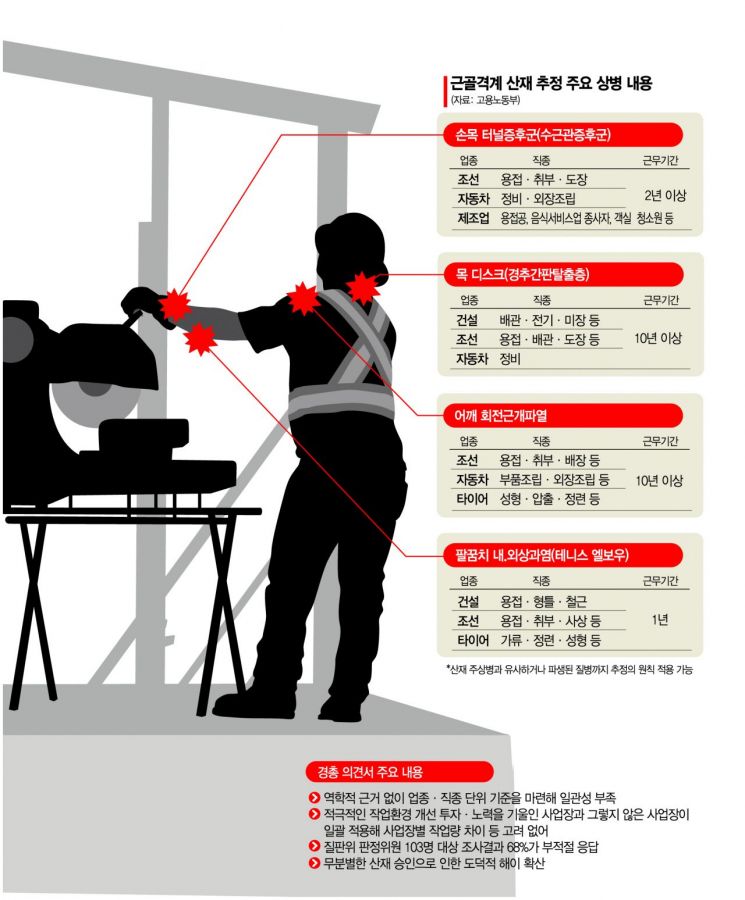
The Ministry of Employment and Labor’s proposed revision sets the presumption principle criteria for musculoskeletal diseases based on six body parts (neck, shoulder, waist, elbow, wrist, knee) and targets workers in specific industries (shipbuilding, automobile, tire, etc.) and occupations (welders, painters, mechanics, assemblers, etc.) with 1 to 10 or more years of service. The presumption principle will also be broadly applied to similar diseases in the same body parts. For example, for neck disc herniation (cervical disc herniation), similar diseases such as cervical stenosis, cervical spondylosis, and ossification of the posterior longitudinal ligament will no longer require on-site investigations.
The business community points out that the new recognition standards are set without clear medical evidence and consistency, which could significantly increase the number of industrial accident subjects. Although the Ministry conducted three related research projects, the results were derived from analyzing data for only one specific year, lacking sufficient epidemiological evidence. The KEF noted that the applied target occupations varied with each research result, raising issues with the systematic and logical consistency of the standards.
Especially in companies with high average tenure in industries such as shipbuilding, automobile, and tire, a significant portion of workers fall under the presumption principle application. For example, in a company surveyed by KEF, 50.4% of all production workers met the conditions for rotator cuff tears. Carpal tunnel syndrome applied to 41.0%, and herniated discs to 36.9% of workers.
Therefore, among 103 members of the Occupational Disease Judgment Committee (Jilpanwi), composed of orthopedic doctors and ergonomics experts, 68% responded that the presumption principle criteria are inappropriate and should not be applied, according to KEF. Professor Sugeun Kim of the Department of Occupational and Environmental Medicine at Yongin Gangnam Hospital stated, “The normal way to set the presumption principle is to define it after reviewing literature confirming the causal relationship between work-related factors such as heavy lifting, improper posture frequency or duration, vibration exposure, and specific diseases. Setting recognition standards by a convenient method without reviewing the causal relationship between work factors and diseases violates basic principles.”
He also expressed concern that “as the standards were established based on existing industrial accident application groups, it becomes easier to approve industrial accidents in specific industries and occupations, causing unreasonable discrimination.” The occupations and industries included in the Ministry’s revision mainly consist of automobile, shipbuilding, and tire sectors, which have many existing industrial accident applications and approvals. This excludes industrial accident data from small and medium-sized enterprises and related industries that have not applied for industrial accidents, leading to fairness issues between occupations and industries.
◆Concerns Over Moral Hazard and Reduced Incentives for Safety Investment Due to Indiscriminate Industrial Accident Approvals= The application of the presumption principle to musculoskeletal diseases is expected to lead to indiscriminate industrial accident approvals, spreading moral hazard issues and reducing companies’ motivation to improve working environments. Repeated government sanctions on workplaces are also anticipated, according to the business community.
According to research cited by KEF, among people diagnosed with rotator cuff disease via ultrasound and magnetic resonance imaging (MRI), over 50% are asymptomatic without pain. Considering that asymptomatic patients do not necessarily require treatment and that the medical community generally agrees on avoiding overdiagnosis and unnecessary procedures or surgeries, there is a high possibility of moral hazard.
Professor Dongpil Woo of the Department of Ergonomics at Dong-Eui University pointed out, “If unscientific standards prepared without objective work investigations are applied, companies that actively invest in improving work environments and those that maintain poor working conditions will all receive the same industrial accident approval results.” He criticized, “The Ministry of Employment and Labor’s revision reduces companies’ motivation to improve safety and health and expand investment.”
KEF stated, “If the revision passes, 70-80% of production workers at the relevant workplaces will be subject to the presumption principle, potentially leading to indiscriminate industrial accident approvals and spreading moral hazard issues.” They warned, “This will reduce companies’ motivation to improve work environments and result in repeated government sanctions on workplaces, causing serious side effects.”
◆With the Serious Accident Punishment Act and Industrial Accident Standard Revisions... “Are They Telling Us Not to Do Business?” As corporate activities are expected to shrink due to the enforcement of the Serious Accident Punishment Act, the revision of industrial accident standards has drawn criticism from the business and academic communities, with comments such as “showing off with corporate money” and “telling companies not to do business.” Prior to the enforcement of the Serious Accident Punishment Act, concerns were raised that if a serious accident such as a worker’s death occurs, corporate managers who violate obligations like establishing safety and health management systems would be punished separately from existing laws such as the Industrial Safety and Health Act, and that there are no government support policies for prevention, necessitating re-amendment.
Industrial accident insurance is a mandatory insurance fully borne by companies. There are concerns that “if musculoskeletal industrial accident standards change, companies will repeatedly be punished and only pay money, making management difficult.” According to the Ministry of Employment and Labor, the annual industrial accident insurance benefit expenditure was about 6 trillion won in 2020. Three years earlier, in 2017, it was around 4 trillion won, but after the Moon Jae-in administration took office, the recognition rate of industrial accidents significantly increased, leading to a sharp rise in benefit expenditures.
The business community expects that if the Ministry’s proposed revision is implemented as is and the scope of industrial accident insurance recognition expands, companies’ insurance premium burdens will increase much more rapidly than now. Seungtae Jeon, head of KEF’s Industrial Safety Team, said, “Since the current government, the industrial accident approval rate has greatly increased, already significantly raising companies’ industrial accident insurance benefit burdens. If the recognition scope further expands, companies’ financial burdens will intensify.”
Professor Jinwoo Jung of Seoul National University of Science and Technology also strongly criticized, saying, “After the legislature passed the Serious Accident Punishment Act, the executive branch immediately changed the industrial accident judgment standards to focus on sanctions. Since prevention measures take a long time to show actual effects, the legislature and executive have outsourced responsibility to companies.”
© The Asia Business Daily(www.asiae.co.kr). All rights reserved.