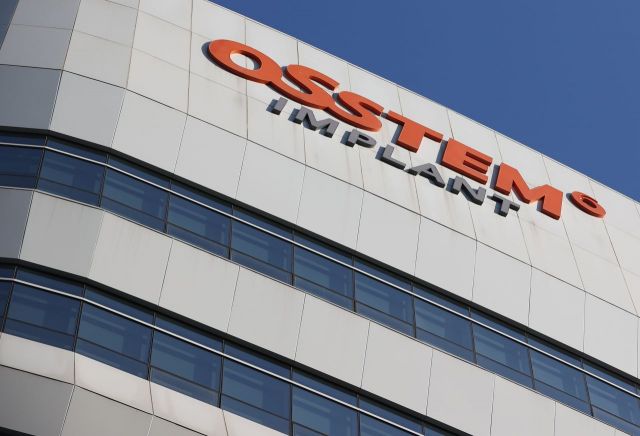
[Asia Economy Reporter Lee Seon-ae] Small shareholders, numbering around 20,000, are on high alert and closely monitoring the situation as the Korea Exchange (KRX) is expected to take a tough stance on Ostem Implant, which has been suspended from trading due to the largest embezzlement in the history of listed companies.
According to the Korea Exchange on the 22nd, Ostem Implant, which has been suspended from trading since the 3rd, is about to face a critical moment. The KRX plans to decide on the 24th whether Ostem Implant will be subject to a delisting suitability review. Depending on the investigation status, the review period may be extended by 15 days.
The exchange will determine whether to subject the company to review by comprehensively assessing how internal controls operate, the amount embezzled, and the likelihood of recovery. If it is decided that Ostem Implant is not subject to the review, trading will resume the next day. However, given the company’s lax control system that failed to detect the embezzlement of 221.5 billion KRW in advance, it is highly likely that it will be subject to the review.
If the KRX designates Ostem Implant for the delisting suitability review, the company must submit an improvement plan within 15 days. The exchange will conduct the review within 20 days from the day it receives the plan. After about a month of substantive review, the Corporate Delisting Committee, composed of nine members, will deliberate and decide. The committee must choose one of three options: maintain listing (resume trading), delist, or grant an improvement period (within one year). If additional investigation time is needed, the committee can extend the period by 20 days.
The problem is that even if delisting is avoided, it will inevitably take a long time before trading resumes, leaving small shareholders’ funds locked up.
The committee will review and deliberate on △business continuity △financial stability △management transparency, and is expected to align the schedule to reflect the business and audit reports at the end of March in the review. The exchange will base its review on documents submitted by the company, with the audit report being an objective evaluation by an external auditor. This will likely include assessments of losses from the incident and the company’s net assets. In other words, to protect investors, the audit report verification process, which could again pose a risk of trading suspension, is expected to be conducted.
Ultimately, Ostem Implant’s fate is expected to hinge on the improvement plan for internal control systems (management transparency), the business and audit reports at the end of March, and cash flow.
Financial stability will be assessed based on whether the company can maintain a stable financial structure or debt ratio through future cash flow projections if the embezzled amount is not recovered. Management transparency is also expected to be a key point in the review. The content of internal control strengthening in the improvement plan is crucial. In a recent disclosure, Ostem Implant mentioned that it will strengthen its internal control system and establish and implement a perfect recurrence prevention plan and a firm management improvement plan.
In this process, the damage falls squarely on the small shareholders. According to the Financial Supervisory Service’s electronic disclosure system, as of the end of September last year, Ostem Implant had 19,856 small shareholders, who hold 55.6% (7,939,816 shares) of the company’s shares.
During the review and deliberation process, the suspension of stock trading is expected to be prolonged, and compensation for damages will inevitably be delayed. The longer the trading suspension lasts, the more individual investors’ funds will be locked indefinitely.
Currently, about 1,500 shareholders have gathered to file lawsuits for damages against Ostem Implant. As of the 16th, approximately 1,400 small shareholders have registered as plaintiffs with the law firm Hannuri, which is preparing a class-action lawsuit. Over 70 people have also joined the joint lawsuit platform “Hwanan Saramdeul.”
© The Asia Business Daily(www.asiae.co.kr). All rights reserved.
![User Who Sold Erroneously Deposited Bitcoins to Repay Debt and Fund Entertainment... What Did the Supreme Court Decide in 2021? [Legal Issue Check]](https://cwcontent.asiae.co.kr/asiaresize/183/2026020910431234020_1770601391.png)















