PCR Allowed Annually for Elderly and Epidemiologically Linked Individuals
Symptomatic Individuals Must Undergo Self-Test or Rapid Antigen Test
Respiratory Clinic Visit Tests Subject to '5000 Won Consultation Fee'
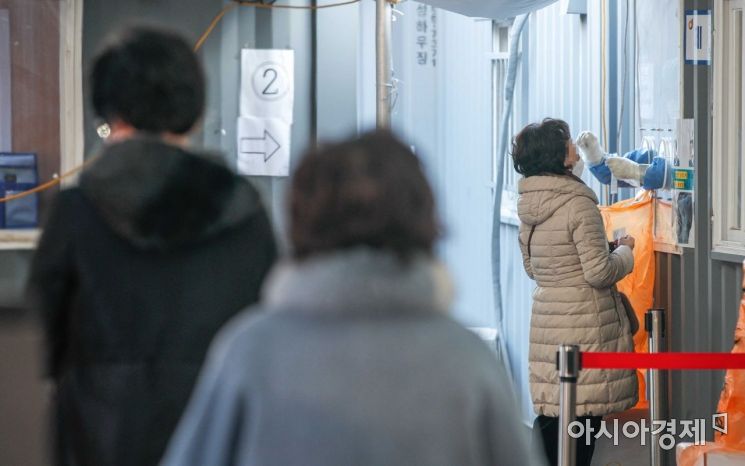 On the 21st, when 6,769 new COVID-19 cases were reported, citizens visiting the temporary screening clinic at Sogang University Station in Mapo-gu, Seoul, are getting tested. Photo by Jinhyung Kang aymsdream@
[Asia Economy Reporter Lee Chun-hee] In the future, regions where the Omicron COVID-19 variant accounts for more than 50% of cases and becomes the dominant strain will have restrictions on who can receive polymerase chain reaction (PCR) tests. Individuals under 60 years old or those with no epidemiological links but exhibiting simple symptoms will need to use self-test kits at screening clinics or pay for rapid antigen tests at respiratory-specialized clinics.
Lee Ki-il, the 1st Controller of the Central Disaster and Safety Countermeasures Headquarters (CDSCH) and Director of Health and Medical Policy at the Ministry of Health and Welfare, stated at the CDSCH regular briefing on the morning of the 21st, "We will gradually implement a testing and treatment system targeting respiratory-specialized clinics and various screening clinics in regions where Omicron is rapidly increasing, such as Gwangju, Jeonnam, Pyeongtaek, and Anseong."
He explained the current situation in these areas, saying, "In places like Gwangju and Jeonnam, about 80% of cases are Omicron. Pyeongtaek, where many U.S. Forces Korea personnel are stationed, has about 90% of cluster infection confirmed cases as Omicron, and Anseong is a neighboring area of Pyeongtaek." When the detection rate of a specific variant exceeds 50%, it is analyzed that the variant suppresses existing variants and becomes the dominant strain.
Simple Symptomatic Individuals Cannot Receive PCR... Rapid Antigen Test '5,000 KRW Consultation Fee'
Accordingly, from the 26th, these regions will first apply the Omicron response quarantine medical system. Through this, the government plans to effectively utilize limited quarantine and medical resources to focus on rapid diagnosis and treatment of high-risk groups (priority testing groups) rather than controlling and managing the overall number of confirmed cases.
To this end, PCR testing at screening clinics will be applied only to high-risk groups (priority testing groups). High-risk groups are limited to ▲those aged 60 or older ▲those with epidemiological links ▲those possessing a doctor's note indicating the need for COVID-19 testing ▲those who test positive via self-test kits or rapid antigen tests.
Simply having respiratory symptoms such as cough or fever does not qualify for PCR testing. The controller explained the reason, saying, "This was a difficult decision, but since anyone can come based on their own judgment if they have symptoms rather than medical judgment, the current PCR capacity cannot handle it."
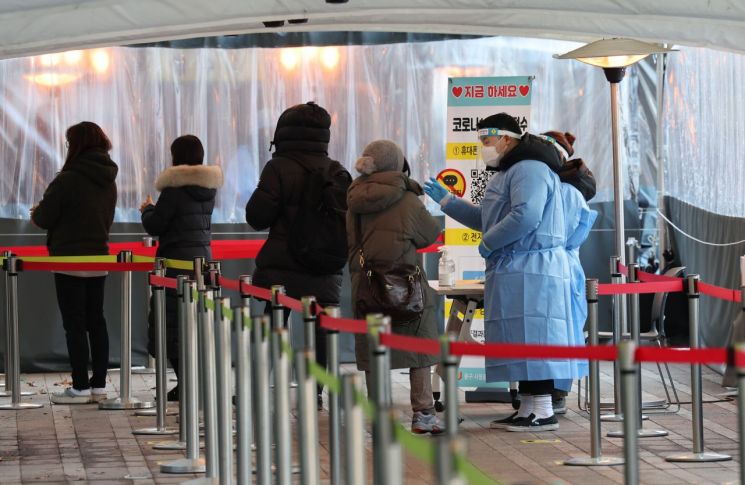 On the morning of the 20th, citizens lined up for testing at the temporary COVID-19 screening clinic in front of Seoul City Hall. [Image source=Yonhap News]
If one does not belong to the high-risk group, even if they visit a screening clinic, they cannot immediately receive a PCR test; PCR testing is only available if a positive result is obtained from the provided self-test kit.
If symptoms are present and the patient visits a respiratory-specialized clinic, they will receive a professional rapid antigen test after a doctor's consultation. If positive, the institution will conduct a PCR test. While the test itself is free, the patient must pay a consultation fee of 5,000 KRW at clinics. This is the first case where patients bear a cost related to COVID-19 testing and treatment, which had previously been fully covered by health insurance.
For unvaccinated individuals, the negative confirmation certificate required to use facilities under the quarantine pass system will also be replaced by a self-test kit or rapid antigen test negative certificate at screening clinics. However, the validity period is shortened from the previous 48 hours to 24 hours. The certificate can be issued if the self-test kit is conducted under the supervision of screening clinic administrators or if a professional rapid antigen test is performed after a doctor's consultation at a respiratory-specialized clinic and the result is negative.
Respiratory-specialized clinics are ▲23 in Gwangju ▲15 in Jeonnam ▲2 in Pyeongtaek ▲3 in Anseong, totaling 43 locations where testing and treatment are conducted. If a positive diagnosis is made at the clinic, remote health monitoring will be conducted at the same clinic. If other outpatient care needs arise, a system is in place to link testing and treatment so that patients can receive care at hospital outpatient centers.
Epidemiological investigations will also shift from the previous full investigation policy to investigations focused on high-risk groups (priority testing groups) such as family members, and the isolation period for fully vaccinated confirmed cases will be shortened to 7 days. Accordingly, from the 26th, fully vaccinated confirmed cases will have their isolation lifted immediately after 7 days during home treatment or other treatment processes.
© The Asia Business Daily(www.asiae.co.kr). All rights reserved.