Only 47 Days Left Until the Presidential Election, Support Rates Tight Within Margin of Error
Rankings Swapped, Double-Digit Gap Surveyed... Difficult to Gauge Trend
In 2017 Presidential Election, Candidate Moon Jae-in Confirmed 'Dominance' with 34.7% Support at D-50
Will the Two-Party TV Debates on the 30th and 31st Mark Another Turning Point?
[Asia Economy Reporter Oh Ju-yeon] With 47 days left until the next presidential election, the approval ratings of the two major party candidates are in a tight race within the margin of error, leading even experts to describe it as an "unprecedented close contest." In past presidential elections, predictions were possible around 50 days before the vote, but this time, voter sentiment has shifted rapidly, with rankings reversing within just half a month, creating a foggy situation that makes outcome predictions difficult. Since gaining an advantage before the Lunar New Year is crucial to maintaining momentum until the voting day, both candidates are expected to focus their efforts next week on securing the "40% approval rating threshold."

According to the Central Election Survey Deliberation Commission on the 21st, recent results from three institutions' regular opinion polls conducted in the third week of January show that voter support, which favored Lee Jae-myung, the Democratic Party presidential candidate, during the year-end and New Year period, has shifted toward Yoon Seok-youl, the People Power Party presidential candidate, this month. Notably, approval ratings have fluctuated significantly this month.
In a poll conducted by Hankook Research commissioned by KBS (from January 17 to 19, targeting 1,000 people aged 18 and over, with a 95% confidence level and ±3.1% margin of error), Candidate Lee recorded 34.5%, and Candidate Yoon 33.0%, showing a close race within the margin of error (a 1.5 percentage point gap). Compared to the early January poll conducted half a month ago (Lee 39.1%, Yoon 26.0%), where the gap was 13.1 percentage points, this is a significant narrowing. Since Lee also led in the late December poll (Lee 39.3%, Yoon 27.3%), there was cautious optimism within the Democratic Party's election committee about stabilizing in the 40% range, but recently the race has returned to a close contest within the margin of error. A senior Democratic lawmaker said, "We will work hard on policy announcements to break out of the box-range approval ratings before the Lunar New Year," adding, "We are very concerned about how to capture the 20s age group."
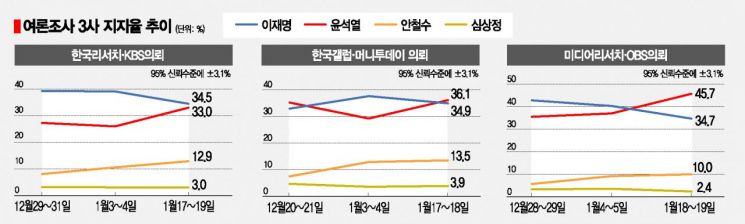
The Korean Gallup poll released on the same day (January 18 to 20, targeting 1,002 people aged 18 and over, with a 95% confidence level and ±3.1% margin of error) also showed Candidate Lee at 34% and Candidate Yoon at 33%, indicating a neck-and-neck race within the margin of error. Compared to the previous week, Lee's rating dropped by 3 percentage points, while Yoon's rose by 2 percentage points. By age group, Lee led among those in their 40s and 50s, while Yoon led among those aged 60 and above. Among people in their 20s, Yoon led with 30%, followed by Lee at 22%. The Korean Gallup poll commissioned by Money Today (January 17 to 18, 95% confidence level ±3.1 percentage points) also showed the two candidates (Lee 36.1%, Yoon 34.9%) in a close race within the margin of error.
In some cases, the rankings have reversed with double-digit gaps. In a poll conducted by Media Research commissioned by OBS (January 18 to 19, targeting 1,020 people aged 18 and over, with a 95% confidence level and ±3.1% margin of error), Candidate Lee recorded 34.7%, while Candidate Yoon recorded 45.7%, showing an 11 percentage point gap. Compared to the late December poll where Lee had 42.8% and Yoon 35.5%, this is a complete reversal.
With about a month and a half left until the presidential election and a close race within the margin of error continuing, premature conclusions have become difficult. In past elections, candidates leading in polls conducted around 50 days before the election maintained their momentum until the end. For example, in March 2017, a poll conducted 50 days before the election (March 18 to 19) showed Candidate Moon Jae-in leading with 34.7% support, continuing his dominant trend (JoongAng Ilbo Research Team, targeting 2,000 people aged 19 and over, with a 95% confidence level and ±2.2% margin of error).
However, this time, such trends have not solidified, making it difficult to predict the outcome. The differing results from various polling institutions add to the challenge of forecasting. Accordingly, interpretations suggest that it is still difficult to definitively state the trend. Park Si-young, CEO of Win-G Korea, said on TBS Radio that "post-election surveys show that only about half of voters decide their choice three weeks before the election day."
There is also a forecast that the two-person TV debate scheduled for the 30th or 31st of this month will be another turning point. Bae Jong-chan, director of Insight K Research Institute, said on YTN Radio, "The TV debate could have a significant influence on female voters who have not yet decided their minds." Lee Taek-soo, CEO of Realmeter, predicted, "President Moon Jae-in received 41% of the vote during the impeachment process in 2017," adding, "If a candidate surpasses 40%, the actual vote share could reach up to 45%."
For detailed information regarding opinion polls, please refer to the Central Election Survey Deliberation Commission website.
© The Asia Business Daily(www.asiae.co.kr). All rights reserved.
![User Who Sold Erroneously Deposited Bitcoins to Repay Debt and Fund Entertainment... What Did the Supreme Court Decide in 2021? [Legal Issue Check]](https://cwcontent.asiae.co.kr/asiaresize/183/2026020910431234020_1770601391.png)