Relaxation of Musculoskeletal Disease Industrial Accident Determination Criteria
'Principle of Presumption' Standards Unclear
Risk Expansion Due to Workplace Sanctions
May Cause Moral Hazard Issues
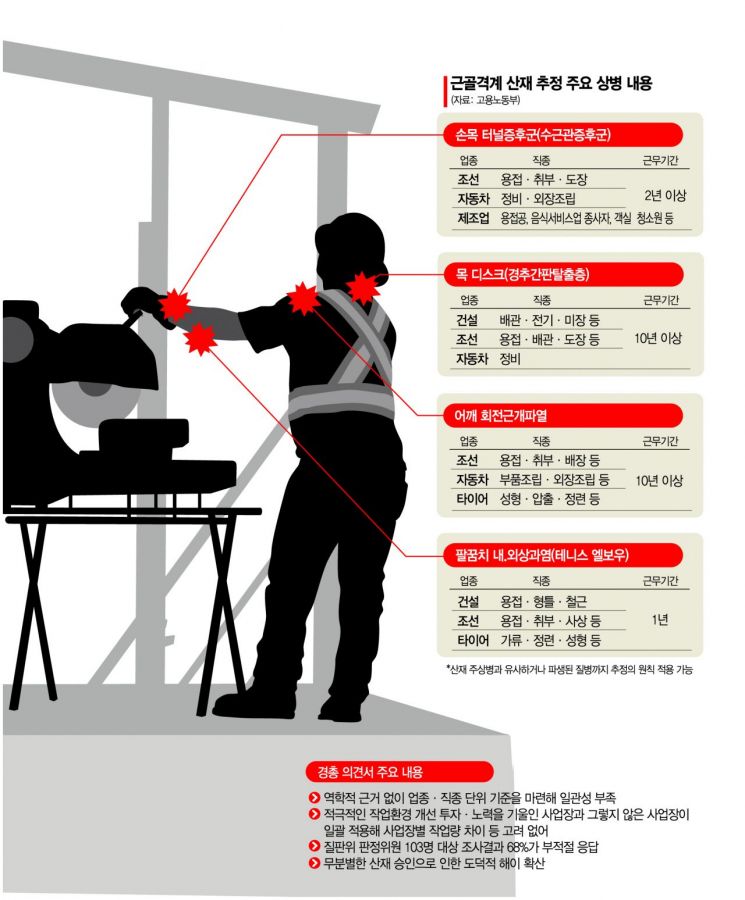
[Asia Economy Reporter Ki-min Lee] The biggest reason for the business community's opposition to the government's plan to recognize musculoskeletal diseases of workers who have worked for more than one year in shipbuilding, automobile, tire, and construction industries as industrial accidents without separate investigations is the lack of precise criteria. Additionally, the surge in industrial accident claims, moral hazard among workers, and strengthened workplace sanctions are also burdensome factors for companies.
In particular, with the Serious Accident Punishment Act coming into effect on the 27th, putting corporate executives such as CEOs of workplaces where accidents occur at risk of direct punishment, concerns are rising that repeated workplace sanctions on top of this could lead to the collapse of companies.
◆ Business Management Difficulties Foreseen Due to ‘Presumption Principle’ Without Investigation = According to the government and business circles on the 21st, if the Ministry of Employment and Labor's proposed revision to the "Musculoskeletal Disease Industrial Accident Recognition Criteria Notice" is passed, up to 80% of production workers in workplaces will be judged for industrial accidents not through direct investigation but by applying the ‘presumption principle.’ The Ministry of Employment and Labor has set the presumption principle criteria for musculoskeletal diseases targeting six body parts (neck, shoulder, waist, elbow, wrist, knee) and specific industries (shipbuilding, automobile, tire, etc.) and occupations (welders, painters, mechanics, assemblers, etc.) with one to ten or more years of service. The presumption principle will also be extensively applied to similar diseases in the same body parts. For example, for neck disc herniation (cervical disc herniation), similar diseases such as cervical stenosis, cervical spondylosis, and ossification of the posterior longitudinal ligament will no longer require on-site investigations.
The business community points out that the industry and occupation-based recognition criteria in the notice lack epidemiological evidence and consistency. Although the Ministry of Employment and Labor conducted related research three times, the results were derived from analyzing data for only one specific year, and sufficient epidemiological evidence was not adequately presented. Moreover, the applicable occupations varied with each research result, raising issues with the systematic and logical consistency of the criteria.
They also criticized that, according to the notice, workplaces that have actively invested in and made efforts to improve working environments and those that have not will be uniformly applied, and differences in workload between workplaces are not considered. Major countries such as Denmark, Germany, and France specify detailed criteria for musculoskeletal disease industrial accident recognition, including the number and amount of heavy object handling and working time and frequency by body part.
The Korea Employers Federation (KEF) stated in its opinion that the revision notice would lead to indiscriminate overuse of the presumption principle, and 68% of orthopedic doctors and ergonomics experts surveyed responded that the presumption principle criteria are inappropriate and should not be applied. According to a survey conducted by KEF targeting 103 members of the National Occupational Disease Judgment Committee (ODJC), 68% of orthopedic and ergonomics experts, who play a major role in musculoskeletal disease industrial accident judgments, responded that the presumption principle criteria are inappropriate.
Professor Su-geun Kim of the Department of Occupational and Environmental Medicine at Yongin Gangnam Hospital pointed out, "The normal way to set the presumption principle is to define it after reviewing literature confirming the causal relationship between work-related factors such as the amount of heavy object handling, the number or duration of improper postures, and vibration exposure and specific diseases." He added, "It is against basic principles to prepare recognition criteria in a convenient way without reviewing the causal relationship between work factors and diseases." He expressed concern that "the criteria, prepared based on existing industrial accident claim groups, make it easier to approve industrial accidents in specific industries and occupations, causing unreasonable discrimination."
In particular, the business community believes it is obvious that indiscriminate industrial accident approvals and moral hazard problems will spread, leading to decreased corporate motivation to improve working environments and repeated government workplace sanctions. Professor Dong-pil Woo of the Department of Ergonomics at Dong-Eui University pointed out, "If unscientific criteria prepared without objective work investigations are applied, companies that have actively invested in improving working environments and those that maintain poor working conditions will all receive the same industrial accident approval results." He criticized, "The Ministry of Employment and Labor's notice revision is a measure that reduces companies' motivation to improve safety and health and expand investment."
With the Serious Accident Punishment Act and Industrial Accident Criteria Revision... "Are They Telling Us Not to Do Business?" = As corporate activities are expected to shrink due to the enforcement of the Serious Accident Punishment Act, the revision of industrial accident criteria has drawn criticism from the business community and academia, with some saying it is "showing off with corporate money" and "telling companies not to do business." Prior to the enforcement of the Serious Accident Punishment Act, there were continuous calls for re-amendment because if a serious accident such as a worker's death occurs and it is confirmed that corporate managers violated obligations such as establishing safety and health management systems, they are punished separately from existing laws like the Industrial Safety and Health Act, and there are no government support policies for prevention.
Industrial accident insurance is a mandatory insurance fully borne by companies, and concerns are pouring in that "if the musculoskeletal disease industrial accident criteria change, companies will face repeated situations of being punished and only paying money, making management difficult." According to the Ministry of Employment and Labor, the annual industrial accident insurance benefit expenditure was about 6 trillion won as of 2020. Three years earlier, in 2017, it was about 4 trillion won, but since the Moon Jae-in administration took office, the industrial accident insurance recognition rate has significantly increased, leading to a sharp rise in benefit expenditures.
The business community expects that if the Ministry of Employment and Labor's proposed revision is implemented as is and the scope of industrial accident insurance recognition expands, companies' insurance premium burdens will increase much more sharply than now.
Jeon Seung-tae, head of the Industrial Safety Team at KEF, said, "Since the current government took office, the industrial accident approval rate has increased significantly, and companies' industrial accident insurance benefit burdens have already increased greatly. If the scope of industrial accident recognition expands further, companies' financial burdens will increase even more."
Professor Jin-woo Jung of Seoul National University of Science and Technology also strongly criticized, "After the legislature passed the Serious Accident Punishment Act, the executive branch immediately changed the industrial accident judgment criteria to focus on sanctions. Since prevention measures take a long time to show actual effects, the legislature and executive have outsourced responsibility to companies."
© The Asia Business Daily(www.asiae.co.kr). All rights reserved.
![User Who Sold Erroneously Deposited Bitcoins to Repay Debt and Fund Entertainment... What Did the Supreme Court Decide in 2021? [Legal Issue Check]](https://cwcontent.asiae.co.kr/asiaresize/183/2026020910431234020_1770601391.png)















