Increased 'Jipkok' Time and No School Life
"Apathy and Boredom Rise" Depression Risk Up
3 out of 10 Office Workers Experience 'Corona Blue'
Efforts to Overcome Through Communication and Hobbies
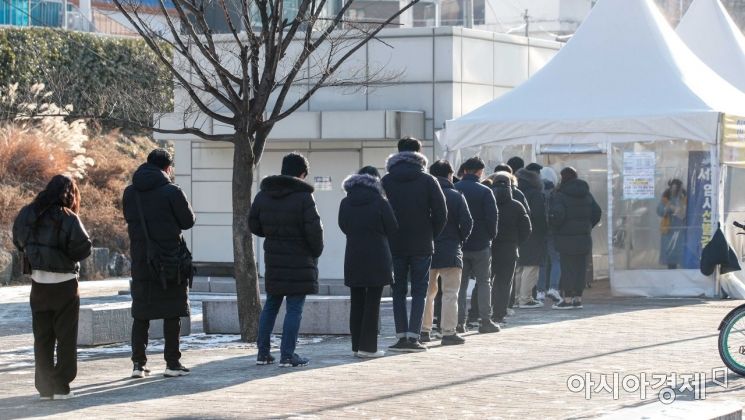 On the 21st, when 6,769 new COVID-19 cases were reported, citizens visiting the temporary screening clinic at Sogang University Station in Mapo-gu, Seoul, were waiting to get tested. Photo by Jinhyung Kang aymsdream@
[Asia Economy Reporter Lee Jung-yoon] "Comparing my mental state before and after COVID-19, I feel a greater sense of lethargy."
Park (34), an office worker who describes himself as an extrovert, said that before the outbreak of COVID-19, he used to relieve stress by spending weekends with friends or colleagues. However, due to quarantine rules, meeting acquaintances freely became difficult, and as time spent at home increased, feelings of depression crept in. As his psychological state changed, he tries to relieve stress by driving alone to the mountains or the sea on weekends. He said, "When I do 'bulmeong' (staring into a fire) or 'padomeong' (staring at the waves) at the mountains or sea, the frustration seems to ease a bit," adding, "I want to take off my mask soon and meet my friends freely."
As the COVID-19 situation has lasted for about two years, long-term restrictions on outdoor activities have increased mental health risks. Feelings of depression have spread throughout society. According to the Ministry of Health and Welfare's December 2021 survey on the mental health status of the public during COVID-19, announced on the 11th of this month, mental health levels have not improved. The survey included 2,063 adults aged 19 to 71 nationwide, and about one in five were found to be at risk of depression.
Lee Yeon-ji (24, pseudonym), a senior at a university in the Seoul metropolitan area, also experienced depression after being unable to attend school for a long time. Despite actively participating in volunteer work helping children who cannot attend academies due to financial difficulties and in campus clubs, she said she could not engage properly due to infection concerns. She said, "To soothe the lethargy and boredom that came from not being able to attend school, I started a new hobby of making desserts like bread and cakes."
In particular, office workers who still have to face their bosses and colleagues during the COVID-19 era express greater feelings of depression. Choi (28), an employee at a mid-sized company, said, "Even when I try to relieve stress at work, various restrictions like personnel limits mean I end up staying at home," adding, "I feel very depressed but have nowhere to release it, so it just keeps building up." According to a survey conducted by Saramin, a job matching platform, targeting 303 companies, 21.8% of participating companies reported having employees currently experiencing COVID Blue. The average proportion of employees experiencing COVID Blue among total staff was 34.5%.
Experts explain that the prolonged COVID-19 pandemic has had a significant impact on feelings of depression. Professor Lim Myung-ho of Dankook University's Department of Psychology said, "As COVID-19 has continued for a long period of two years, even people with high resilience?the ability to recover from mental distress?can experience lethargy and despair," adding, "To overcome COVID Blue, it would help to maintain a regular lifestyle, continue communication with people around you, and engage in hobbies and self-comforting activities."
© The Asia Business Daily(www.asiae.co.kr). All rights reserved.
![User Who Sold Erroneously Deposited Bitcoins to Repay Debt and Fund Entertainment... What Did the Supreme Court Decide in 2021? [Legal Issue Check]](https://cwcontent.asiae.co.kr/asiaresize/183/2026020910431234020_1770601391.png)















