CPI Rose 5.0% in December Last Year
Due to Sharp Increase in Energy and Food Prices
"Inflation Will Gradually Ease"
[Asia Economy Reporter Cho Hyun-ui] The Eurozone (19 countries using the euro) recorded the highest inflation rate ever in December last year, but the European Central Bank (ECB) dismissed the possibility of tightening. The ECB sought to ease concerns by stating that inflation will gradually decline within the year due to easing energy prices and supply bottlenecks.
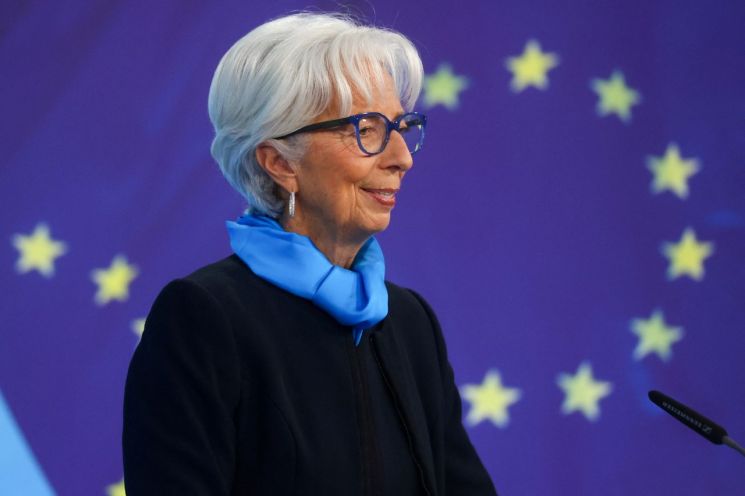
On the 20th (local time), ECB President Christine Lagarde emphasized in a media interview, "The economic recovery cycle in the United States is ahead of Europe. We have enough reason not to act as quickly and brutally as the U.S. Federal Reserve (Fed) imagines." She maintained the stance of continuing accommodative monetary policy despite tightening pressures.
However, President Lagarde added, "We have started to respond (to inflation) little by little," and emphasized, "If data and other factors indicate an environment where tightening policies are necessary, we are prepared to respond with monetary policy measures."
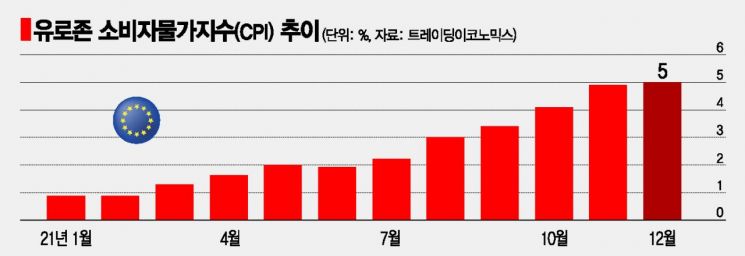
According to Eurostat, the statistical office of the European Union (EU), on the same day, the Eurozone's Consumer Price Index (CPI) in December last year rose 5.0% year-on-year. This is the highest level since the introduction of the single currency, the euro. Compared to the previous month, it increased by 0.4%.
Analysis suggests that the sharp rise in energy and food prices led the inflation increase. Energy prices soared 25.9% year-on-year, and food, alcoholic beverages, and tobacco surged 3.2%. Eurostat explained, "Energy prices, which skyrocketed due to gas and electricity bills hitting households especially hard, had a significant impact."
By country, Estonia had the highest annual inflation rate at 12.0%. Lithuania also recorded double digits at 10.7%, ranking second, followed by Poland (8.0%), Latvia (7.9%), and Hungary (7.4%). On the other hand, the lowest inflation rates were in Malta (2.6%), followed by Portugal (2.8%), Finland (3.2%), Denmark and France (3.4%), and Austria (3.8%).
The Eurozone inflation rate has been rising for eight consecutive months since May last year (1.9%). After entering the 2% range in June, it rose to the 3% range in July, the 4% range in October, and surged to the 5% range in December.
Unlike the Eurozone, the United Kingdom is tightening the reins. Andrew Bailey, Governor of the Bank of England (BOE), warned the day before that "inflationary pressures in the UK may last longer than initially expected." The UK’s inflation rate during the same period is 5.4%, the highest in 30 years, meaning prices are rising faster than wages.
Governor Bailey said, "Financial markets do not expect energy prices to start easing again until the second half of 2023," and added, "There are concerns that due to rising prices and employment difficulties, there may be secondary effects on wages."
Meanwhile, U.S. Treasury Secretary Janet Yellen also forecasted a slowdown in inflation. On the first anniversary of President Joe Biden’s inauguration, Secretary Yellen defended the economic achievements of the Biden administration’s first year and expressed hope that inflation will approach 2% by the end of this year. She said, "If we succeed in controlling the pandemic, inflation will gradually fall and return to the normal level of around 2% by the end of this year."
© The Asia Business Daily(www.asiae.co.kr). All rights reserved.
![User Who Sold Erroneously Deposited Bitcoins to Repay Debt and Fund Entertainment... What Did the Supreme Court Decide in 2021? [Legal Issue Check]](https://cwcontent.asiae.co.kr/asiaresize/183/2026020910431234020_1770601391.png)