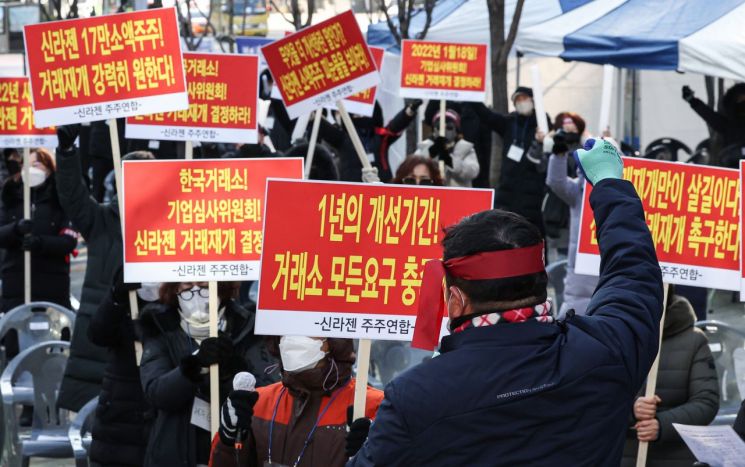
[Asia Economy Reporter Lee Seon-ae] The delisting process of SillaJen from the stock market is expected to follow the same path as Kolon TissueGene, whose review is scheduled for next month. Although the Corporate Delisting Committee decided on delisting, the KOSDAQ Market Committee is likely to grant an improvement period, allowing SillaJen to avoid delisting for the time being. However, considering that Kolon TissueGene’s improvement period was extended by an additional year after a delisting decision following a one-year improvement period?resulting in shareholders’ funds being tied up for over two years?the concerns of SillaJen’s minority shareholders are expected to deepen.
According to the financial investment industry on the 21st, the decision by the Korea Exchange’s Corporate Delisting Committee to delist SillaJen was influenced by whether the clinical trials stated in the improvement plan submitted by SillaJen were carried out. The committee and SillaJen engaged in a prolonged dispute over the execution of these clinical trials.
At the review on the 18th, the committee judged that SillaJen lacked the will to carry out research and development. They cited failure to conduct clinical trials as per the improvement plan and a shortage of R&D personnel as grounds. In response, SillaJen stated, "It is true that research personnel left due to company circumstances, but since the acquisition of M2N, the workforce has been expanded." SillaJen’s R&D organization consists of a total of 15 personnel across four teams under the R&D headquarters and corporate research institute, and three teams under its wholly owned subsidiary, SillaJen Bio. Among them, there are three PhD holders and six with master’s degrees. The committee argued that expertise such as physician-scientists needs to be strengthened.
However, the issue of research personnel was not a major reason for the delisting decision. The clinical trial plans and current progress stated in the improvement plan submitted by SillaJen a year ago had a significant impact on the delisting decision. The plan to complete some clinical trials by 2021 was not met.
SillaJen has been conducting kidney cancer clinical trials divided into four groups: A, B, C, and D. At the time of submitting the improvement plan, considering funding shortages, they decided to slow down the newly started Group D trial and complete the trials for Groups A, B, and C early by 2021. Subsequently, SillaJen claimed that positive signals emerged from the Group D trial involving 19 subjects. Treatment effects were observed when Regeneron and the oncolytic virus Pexa-Vec were administered together to patients unresponsive to immune checkpoint inhibitors.
The SillaJen shareholder coalition explained, "According to a prior agreement with clinical partner Regeneron, clinical efficacy was confirmed around May last year, and in July, it was finally agreed to expand the target patient group." They added, "Contrary to the original plan, the Group D clinical trial was expanded, and the completion period for Groups A, B, and C was adjusted to 2022." Although there was a discrepancy in the clinical trial completion dates within the improvement plan, SillaJen emphasized that they did not fail to carry out clinical trials but rather expanded from Groups A, B, and C to include Group D. On the other hand, the committee viewed the failure to complete tasks by last year as evidence of a lack of research competitiveness necessary to continue operations.
The SillaJen shareholder coalition stressed, "The progress of Group D’s trial, combining SillaJen’s Pexa-Vec and Regeneron’s Semiplimab, is proof that the drug’s efficacy is better than expected and could create better conditions for technology export." They argued that the reasons for delisting cited by the exchange are weak and unacceptable. They requested, "Delisting based on reasons not stipulated in regulations is illegal," and asked the market committee to decide to resume trading within 20 business days.
Nevertheless, the market outlook is that the possibility of the committee reversing the delisting decision is extremely low. The exchange plans to hold a market committee meeting within 20 business days (by February 18) to decide on delisting and whether to grant an improvement period of up to one year. If delisting is decided again, SillaJen can file an objection, leading to a second market committee meeting. At this stage, SillaJen may be granted an improvement period instead of delisting. This is considered the most likely scenario by the financial investment industry.
This follows the same pattern as Kolon TissueGene. Due to the so-called ‘Invossa incident,’ Kolon TissueGene was delisted by the committee but avoided delisting by receiving a one-year improvement period from the market committee. After one year, the market committee again decided on delisting, but Kolon TissueGene’s objection extended the period by another year. Approximately 64,000 minority shareholders of Kolon TissueGene, whose final delisting decision is expected around the Lunar New Year holiday, have had their funds tied up for over two years. Kolon TissueGene was ordered to stop sales in March 2019 and trading was suspended from May of the same year.
If SillaJen also receives an improvement period through objection at the market committee, it can avoid delisting for one year. Even if delisting is decided again afterward, another objection can extend the period by one more year, allowing for up to two years of extension. As of the end of Q3 last year, SillaJen had 174,186 minority shareholders holding 66,253,111 shares (92.60% stake). Based on the current suspended stock price of 12,100 KRW, the value of shares held by minority shareholders amounts to 801.6 billion KRW. Ultimately, minority shareholders’ funds worth approximately 800 billion KRW will be tied up for two years.
However, although unlikely, if the result is not overturned at the second market committee meeting, the liquidation trading process will begin. SillaJen’s last option is to file a lawsuit. In this case, the liquidation trading process will be suspended, and the court’s decision will determine whether delisting proceeds. SillaJen has stated that if the worst-case scenario unfolds, it is prepared to engage in litigation.

© The Asia Business Daily(www.asiae.co.kr). All rights reserved.
![User Who Sold Erroneously Deposited Bitcoins to Repay Debt and Fund Entertainment... What Did the Supreme Court Decide in 2021? [Legal Issue Check]](https://cwcontent.asiae.co.kr/asiaresize/183/2026020910431234020_1770601391.png)