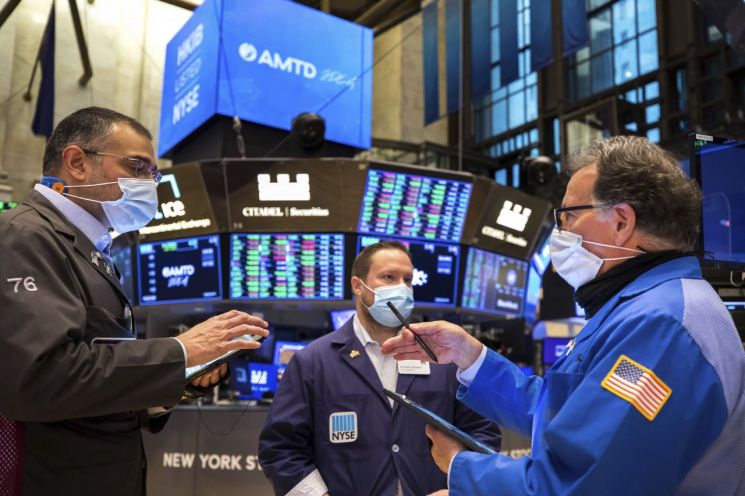
[Asia Economy New York=Special Correspondent Joselgina] Large-cap stocks are not a safe haven either. The U.S. New York stock market, unable to shake off concerns about early tightening, has been showing a continuous downward trend. Following the Nasdaq index, which had already entered a technical correction phase, the large-cap-focused S&P 500 index also fell below the 4500 level. Pessimistic forecasts even suggest it could plunge nearly 45%. HSBC, which had consistently maintained a 'buy recommendation' since President Joe Biden's inauguration, has also downgraded its investment opinion on U.S. stocks to 'neutral.'
On the 20th (local time), the S&P 500 index closed at 4482.73, down 1.10% from the previous session. This is the first time since October 2021 that the S&P 500 has fallen below the 4500 mark. This index represents more than 80% of the market capitalization of U.S.-listed companies and is considered the best indicator of the U.S. stock market. On the same day, the Dow Jones Industrial Average and the Nasdaq index also closed down 0.89% and 1.30%, respectively.
This is interpreted as a downward pressure resulting from expectations that the U.S. central bank, the Federal Reserve (Fed), will begin tightening earlier than initially anticipated to curb soaring inflation.
The fact that HSBC, which had maintained an 'overweight' opinion since the Biden administration began, downgraded its investment opinion on the U.S. to 'neutral' is not unrelated to this. HSBC forecasted that "U.S. stocks will face downward pressure due to inflation concerns, supply chain disruptions, and the central bank's tightening moves."
Some quarters have even issued shocking forecasts that the stock market could soon be halved. Jeremy Grantham, the legendary Wall Street investor and founder of GMO, described the U.S. stock market as being in a 'superbubble' state and stated, "The S&P 500 index could plunge nearly 45% to around the 2500 level."
Grantham, famous for accurately predicting the collapse of the Japanese asset bubble in the 1990s, the dot-com bubble burst in 2000, and the 2008 subprime mortgage crisis, said, "The current situation is similar to Japan in the 1980s when the stock and real estate markets were extremely overvalued," and predicted, "The Nasdaq index, which is tech-stock focused, will fall even more sharply."
Reflecting market concerns, the Chicago Board Options Exchange (CBOE) Volatility Index (VIX), known as Wall Street's fear gauge, rose 1.77 points (7.63%) to 25.66 compared to the previous session.
On this day in the New York stock market, Peloton, a representative pandemic (global pandemic) beneficiary stock, plunged 24% on news that it temporarily halted product production due to a failed demand forecast. Large-cap stocks with significant market capitalization such as Apple (-1.03%), Amazon.com (-2.96%), Nvidia (-3.66%), and JP Morgan Chase (-0.85%) also continued their downward trend. After tech and growth stocks, which are sensitive to interest rates, were hit first, it seems large-cap stocks are also not escaping the fallout.
Since the beginning of the year, the S&P 500 index has fallen nearly 6%. The tech-focused Nasdaq index has retreated 9.53%, and the Dow Jones index has dropped 4.47%. Kathy Bostjanic, Chief Economist at Oxford Economics, expressed concern, saying, "We are facing a situation of high market volatility due to increased uncertainty surrounding the economy, inflation, and interest rate outlooks." Ryan Detrick of LPL Financial said, "Market volatility is high in years with interest rate hikes and midterm elections," adding, "There could be more aggressive movements in the market this year."
© The Asia Business Daily(www.asiae.co.kr). All rights reserved.
![User Who Sold Erroneously Deposited Bitcoins to Repay Debt and Fund Entertainment... What Did the Supreme Court Decide in 2021? [Legal Issue Check]](https://cwcontent.asiae.co.kr/asiaresize/183/2026020910431234020_1770601391.png)















