[Asia Economy Reporter Baek Kyunghwan] A man who secretly filmed a woman's body in a public place was brought to trial but was acquitted by the Supreme Court. Although the investigative agency obtained a search warrant and analyzed the illegal footage, the defendant was not given the opportunity to participate. According to the principle of the Criminal Procedure Act, the person subject to seizure or their attorney must be guaranteed the opportunity to participate in the analysis of seized items.
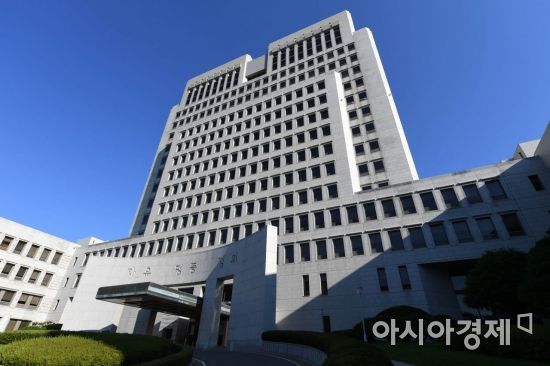
On the 21st, the Supreme Court's 3rd Division (Presiding Justice Kim Jae-hyung) announced that it dismissed the prosecution's appeal in the final trial of Mr. A, who was charged with violating the Special Act on the Punishment of Sexual Crimes (filming using a camera, etc.), and confirmed his acquittal.
Mr. A, a man in his 30s, was caught in March 2018 attempting to illegally film a victim in a women's restroom in Ansan City, Gyeonggi Province, and was handed over to the police. Subsequently, the police obtained a search warrant and seized Mr. A's mobile phone for analysis but failed to secure evidence from the time of the crime. Instead, they discovered other videos on the phone showing Mr. A illegally filming students' school uniform skirts 24 times on a bus.
However, since the police did not involve Mr. A or confirm his intention to participate during this process, the first and second trial courts acquitted Mr. A. The illegal footage on the mobile phone, which was evidence to prove the charges, was collected unlawfully. The courts judged that the videos were evidence collected in violation of the warrant principle under the Criminal Procedure Act and thus lacked evidentiary value. In particular, they pointed out, "When videos related to separate criminal charges are discovered incidentally, further searches must be stopped, and a separate search warrant for the other criminal charges should have been obtained."
The Supreme Court's judgment was no different. The Supreme Court stated, "Even if there was an error in the lower court's ruling regarding the law on objective relevance, since there was illegality in not guaranteeing the defendant's right to participate, these videos constitute illegally collected evidence and cannot be used as evidence of guilt," adding, "The error of the lower court does not affect the judgment."
© The Asia Business Daily(www.asiae.co.kr). All rights reserved.
![User Who Sold Erroneously Deposited Bitcoins to Repay Debt and Fund Entertainment... What Did the Supreme Court Decide in 2021? [Legal Issue Check]](https://cwcontent.asiae.co.kr/asiaresize/183/2026020910431234020_1770601391.png)















