Until the 28th, traditional markets, companies with violation records, and online sellers targeted
Hanwoo undergoes genetic testing, and pork is immediately identified on-site using rapid origin test kits
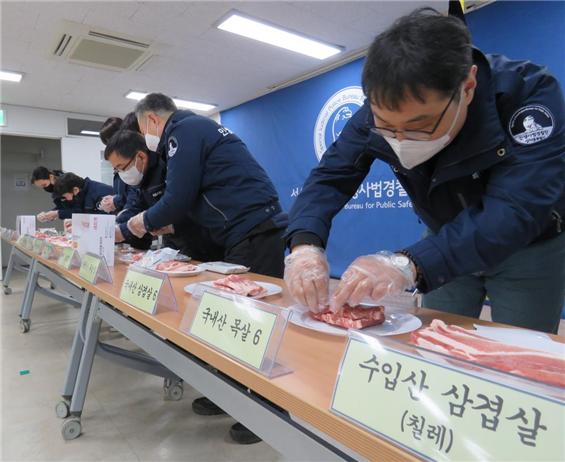
[Asia Economy Reporter Lim Cheol-young] The Seoul Metropolitan Government's Civil Life Judicial Police Unit announced on the 21st that it will conduct a special inspection on illegal origin labeling of representative gift and ritual food items, Korean beef (Hanwoo) and pork, from the 21st to the 28th ahead of the Lunar New Year holiday.
For Hanwoo, the Civil Life Judicial Police Unit will focus offline inspections on post-trace management, targeting companies with a history of violations, while online inspections will focus on Hanwoo gift sets, which have seen increased online purchase demand.
The offline inspection will involve purchasing Hanwoo twice before and after the Lunar New Year holiday from about 40 companies that have been penalized in the past five years (2017?2021) for violations of the Act on the Labeling of Origin of Agricultural and Fishery Products, to check for intentional and repeated violations. The purchased Hanwoo will be subjected to genetic testing by the Seoul Institute of Health and Environment and the National Agricultural Products Quality Management Service to verify if it is domestically produced. Online inspections will also purchase Hanwoo gift sets sold at relatively affordable prices to many consumers and request testing.
The pork origin inspection will be conducted using the newly developed rapid origin testing kit, the first time a local government has utilized it, allowing immediate determination of origin at livestock product sales sites within traditional markets. The pork origin rapid testing kit was developed in 2021 by the National Agricultural Products Quality Management Service and can determine pork origin within five minutes on-site. Domestic pork shows two lines on the kit due to antibodies from vaccination against swine fever, while foreign pork without antibodies shows one line. Six traditional markets in Seoul with high user traffic in each district will be selected for inspection.
Companies found violating the law will face criminal charges or fines under the Act on the Labeling of Origin of Agricultural and Fishery Products. False origin labeling can result in imprisonment of up to seven years or fines up to 100 million KRW, while failure to label origin can incur fines up to 10 million KRW.
Additionally, any citizen can contribute to public interest by reporting food-related crimes with decisive evidence. Under the Seoul Metropolitan Government Ordinance on Protection and Support for Public Interest Whistleblowers, rewards of up to 200 million KRW may be granted after committee review. Reports can be made via smartphone apps, the Seoul city website, phone, and other methods as detailed below.
Kang Ok-hyun, head of the Seoul Civil Life Judicial Police Unit, stated, “Since this inspection is conducted after prior notice, strict measures will be taken against any companies found violating the law. In 2022, we will continue to listen carefully to citizens’ reports and cooperate with related agencies, utilizing the latest investigative techniques to thoroughly investigate illegal acts that undermine food safety such as origin fraud, so that citizens can safely enjoy their food.”
© The Asia Business Daily(www.asiae.co.kr). All rights reserved.
![User Who Sold Erroneously Deposited Bitcoins to Repay Debt and Fund Entertainment... What Did the Supreme Court Decide in 2021? [Legal Issue Check]](https://cwcontent.asiae.co.kr/asiaresize/183/2026020910431234020_1770601391.png)















