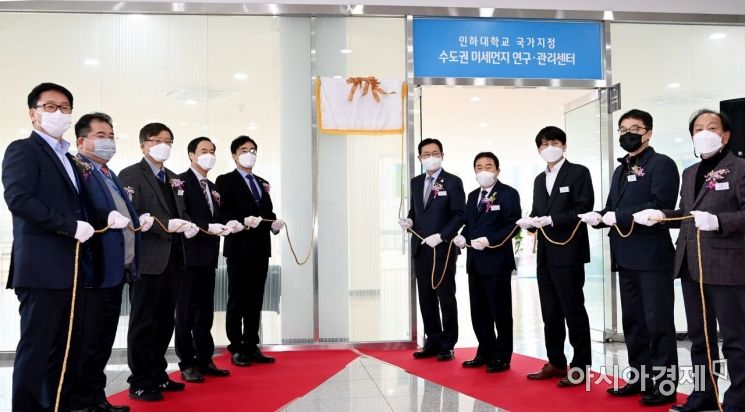
 Opening Ceremony of the Metropolitan Area Fine Dust Research and Management Center
 [Photo provided by Incheon City]
[Asia Economy Reporter Park Hyesook] The Metropolitan Area Fine Dust Research and Management Center opened on the 20th at Inha University Aerospace Convergence Campus (Songdo International City).
The center was selected last September through a collaborative project between Incheon City and Inha University under the Ministry of Environment's public contest, and is composed of 27 members, including 18 researchers and 9 administrative staff.
It receives an annual national budget of 460 million KRW to conduct surveys, research, and education aimed at preventing and managing health damage caused by fine dust.
The center plans to analyze the characteristics of fine dust generation in the metropolitan area to predict regions at risk of air pollution, build and verify a high-resolution air pollutant emission database, and focus on preventing health damage to the public.
In particular, it will carry out fine dust reduction research projects considering the characteristics of the Incheon area, such as environmental improvement projects for asphalt manufacturers and road paving research to suppress re-scattered dust.
The metropolitan area, with its high population density and concentration of automobiles and various industrial facilities, is heavily influenced by foreign sources such as China and Mongolia, and along with Chungnam, is considered one of the regions with the worst air quality nationwide.
To improve air quality, the Metropolitan Air Quality Management Office, along with Incheon, Seoul, and Gyeonggi Province, has been establishing and systematically managing the metropolitan air quality management plan since 2015.
As a result, fine dust concentrations in the metropolitan area have continuously improved, with last year's ultrafine dust concentration (20㎍/㎥) decreasing by more than 30% compared to 2015 (29㎍/㎥).
© The Asia Business Daily(www.asiae.co.kr). All rights reserved.
![User Who Sold Erroneously Deposited Bitcoins to Repay Debt and Fund Entertainment... What Did the Supreme Court Decide in 2021? [Legal Issue Check]](https://cwcontent.asiae.co.kr/asiaresize/183/2026020910431234020_1770601391.png)















