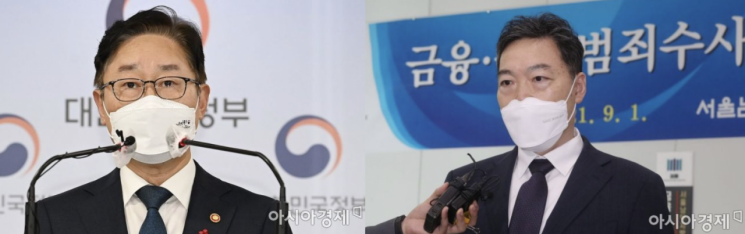
 Minister of Justice Park Beom-gye and Prosecutor General Kim Oh-soo. Photo by Kim Hyun-min kimhyun81@
[Asia Economy Reporter Choi Seok-jin, Legal Affairs Specialist] Attention is drawn as Prosecutor General Kim Oh-soo has openly opposed the Ministry of Justice’s directive, led by Minister Park Beom-gye, to conduct a public recruitment process for appointing an external expert in the field of major accidents as a chief prosecutor.
Within and outside the prosecution, concerns are rising that Minister Park might be engaging in a last-minute "entrenchment personnel move" to install a pro-government figure, such as a member of the Lawyers for a Democratic Society (Minbyun), as a chief prosecutor. Moreover, this unprecedented measure may violate current laws such as the Prosecutors’ Office Act, leading to strong internal opposition within the prosecution, raising questions about whether the personnel appointments will proceed according to Minister Park’s intentions.
According to the legal community on the 20th, the Supreme Prosecutors’ Office sent a notice the previous day to all high prosecutors, district prosecutors, and branch chiefs nationwide stating, "On January 17, the Ministry of Justice announced a public recruitment to newly appoint prosecutors at the Supreme Prosecutors’ Office level with expertise in the field of major accidents," and "Regarding this, the Prosecutor General explicitly conveyed that it is difficult to accept."
Prosecutor General Kim cited reasons for opposition including: ▲the possibility that the move violates the intent of personnel-related laws and organizational regulations such as the Prosecutors’ Office Act; ▲concerns over infringement on the political neutrality and independence of the prosecution; and ▲the potential to undermine the self-esteem and morale of prosecution members.
The Supreme Prosecutors’ Office stated, "We fully empathize with the concerns and worries of prosecution members regarding this appointment announcement and will actively express the Prosecutor General’s opinions on personnel matters pursuant to Article 34 of the Prosecutors’ Office Act," adding, "We will do our utmost in various ways to alleviate the concerns of prosecution members, including faithfully presenting necessary opinions during the deliberations of the Prosecutors’ Personnel Committee under Article 35 of the Prosecutors’ Office Act."
Article 34, Paragraph 1 of the Prosecutors’ Office Act (Appointment and Assignment of Prosecutors) stipulates, "The appointment and assignment of prosecutors shall be made by the President upon the recommendation of the Minister of Justice. In this case, the Minister of Justice shall consult the Prosecutor General before recommending the assignment of prosecutors."
Regarding the interpretation of this provision, which requires the minister to "consult" the Prosecutor General in personnel matters, there is no specific standard on how much the minister must reflect the Prosecutor General’s opinion. Consequently, during the tenure of former Minister Choo Mi-ae, the opinions of then Prosecutor General Yoon Seok-youl on personnel matters were not reflected at all, causing conflict.
Earlier, Minister Park announced at a press conference at the end of last year that he would select a major accident expert as a chief prosecutor. On the 17th, the Ministry of Justice issued a "2022 Prosecutor Appointment Support Notice," accepting applications for new appointments of prosecutors at the chief prosecutor level until the 21st. The Ministry specifically stated that it plans to select individuals with practical experience or expertise in major accidents, industrial accidents, industrial safety, or labor fields.
In response, strong opposition voices have continued within the prosecution through the internal network E-Pros.
Prosecutor Jung Yu-mi of Gwangju High Prosecutors’ Office said, "I am watching a strange notice recruiting a major accident expert," adding, "If they were recruiting experts to support the front lines, I would be deeply grateful, but since they are recruiting Supreme Prosecutors’ Office-level experts rather than personnel to support the front lines, I am puzzled."
She also said, "It is heartbreaking that two large-scale construction accidents occurred consecutively in Gwangju, and if this tragedy is being used as an opportunity to entrench an unrelated personnel appointment in the prosecution, that would be very malicious."
The implication is that it is difficult to understand recruiting a chief prosecutor, a senior figure within the prosecution, through public recruitment rather than a prosecutor who will lead investigations on the front lines.
Senior Prosecutor Kang Su-san-na of Incheon District Prosecutors’ Office said, "I saw the team cohesion of a soccer team managed by a coach who had never played soccer through a newly established neighboring team, and now it seems we are hiring someone who has no experience handling the ball for 10 years as a coach or manager."
This is interpreted as expressing concern by analogy to the difficulties faced by the Corruption Investigation Office for High-ranking Officials (CIO) after appointing Kim Jin-wook, who had no investigative experience, as its head.
Senior Prosecutor Jung Hee-do of Seoul Eastern District Prosecutors’ Office said, "I wonder if there is someone looking out for them," adding, "It is very sad to see the Ministry of Justice and prosecution deteriorate to this extent."
The strong internal opposition within the prosecution stems from the fact that no external personnel have yet been appointed to the investigative command line. Under the Moon Jae-in administration, as part of prosecution reform and under the banner of "de-prosecution of the Ministry of Justice," several senior positions in the Ministry of Justice, traditionally held by prosecutors, were filled by external personnel through public recruitment.
Examples include former Vice Minister Lee Yong-gu, who served as Legal Affairs Officer and Deputy Minister of Justice but resigned over a taxi driver assault issue; former Director Cha Gyu-geun of the Immigration and Foreign Policy Headquarters, who was demoted to a research fellow at the Judicial Research and Training Institute after being indicted in the Kim Hak-eui illegal deportation case; former Human Rights Director Hwang Hee-seok and current Human Rights Director Wi Eun-jin, both from Minbyun; and current Legal Affairs Officer Lee Sang-gap.
However, appointing a chief prosecutor of a frontline prosecution office through external public recruitment, rather than a policy institution like the Ministry of Justice, is extremely unusual. Also, since there are prosecution members with experience investigating major accident cases internally, suspicions arise about Minister Park’s sudden intention to seek an external person without investigative experience.
Although the current administration appointed an external person as head of the Supreme Prosecutors’ Office Inspection Department, legal grounds were established in 2009 by amending the Prosecutors’ Office Act to add Article 28-2 (Special Provisions on Appointment of Prosecutors in Charge of Inspection at the Supreme Prosecutors’ Office).
In light of this, appointing an external person as a chief prosecutor of a frontline prosecution office through public recruitment without separately establishing legal grounds is indeed problematic. However, if Minister Park pushes forward his will despite Prosecutor General Kim’s opposition and internal resistance, there is realistically no clear way to stop it.
After Minister Park’s position to appoint a major accident expert as chief prosecutor through public recruitment became public and opposition intensified inside and outside the prosecution, the Blue House reportedly conveyed to the Ministry of Justice its opposition, stating, "It is burdensome to make chief prosecutor promotion appointments at the end of the administration."
Subsequently, Minister Park took a step back, saying, "Appointments of Supreme Prosecutors’ Office-level prosecutors will proceed only for one position." It appears that among the two vacant chief prosecutor-level positions?the deputy chief prosecutors of Gwangju High Prosecutors’ Office and Daejeon High Prosecutors’ Office?only the deputy chief prosecutor of Gwangju High Prosecutors’ Office will be appointed through public recruitment. In fact, Minister Park’s current move is inconsistent with the current administration’s policy of continuously reducing chief prosecutor-level positions within the prosecution.
Meanwhile, the Ministry of Justice will hold a Prosecutors’ Personnel Committee meeting at the Government Complex Gwacheon from 10 a.m. on the 21st.
Earlier, Minister Park stated that this personnel committee meeting is a forum to discuss principles and standards for personnel of ordinary prosecutors related to the regular prosecution personnel appointments scheduled for February.
Since the application period for chief prosecutor recruitment ends on the 21st, it is expected that the agenda related to chief prosecutor appointments will not be discussed at this meeting.
However, if the personnel committee is held after the recruitment process is completed and before appointments are made, Deputy Prosecutor General Park Sung-jin, who will attend as a member of the committee, is expected to convey the opinions of Prosecutor General Kim and other internal prosecution members to the other committee members.
© The Asia Business Daily(www.asiae.co.kr). All rights reserved.
![User Who Sold Erroneously Deposited Bitcoins to Repay Debt and Fund Entertainment... What Did the Supreme Court Decide in 2021? [Legal Issue Check]](https://cwcontent.asiae.co.kr/asiaresize/183/2026020910431234020_1770601391.png)