1735 to 798 Cases Surge Over Two Days
Over 10,000 Expected This Month
Omicron Dominance Becomes Reality This Week
Clinics Also Join Testing Efforts
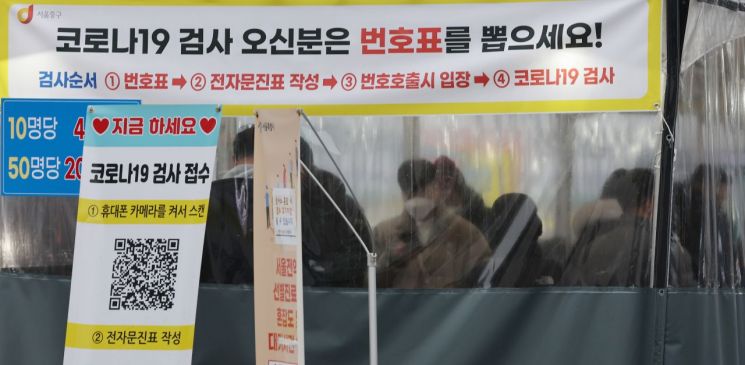 On the 19th, citizens are waiting for their turn to be tested at the temporary COVID-19 screening clinic in Seoul Station Plaza, Jung-gu, Seoul. [Image source=Yonhap News]
[Asia Economy Reporter Lee Chun-hee] The COVID-19 pandemic is intensifying as the number of new confirmed cases surged by around 800 for two consecutive days, driven by the spread of the Omicron variant. The government’s threshold for transitioning to an Omicron response system is set at 7,000 daily confirmed cases, and projections indicate that the number of cases will far exceed 10,000 within this month. There are calls to establish a more detailed and precise Omicron response system.
Unprecedented Surge Due to Omicron Impact
According to the Central Disease Control Headquarters (CDCH), as of midnight on the 20th, the number of new COVID-19 confirmed cases was 6,603, an increase of 798 from the previous day. Of these, 6,357 were locally transmitted and 246 were imported cases. Following a sharp rise of 1,735 cases from the previous day to 5,805 on the 19th, marking the first time this month that cases exceeded 5,000, the number of cases reached the 6,000 range for the first time in 27 days.
The weekly average of locally transmitted cases, adjusted for daily fluctuations, has also rebounded. It had dropped to 3,331.6 on the 13th, the early stage level of the fifth wave, but recovered to 4,076.7 the day before and rose further to 4,445.4 on the 20th.
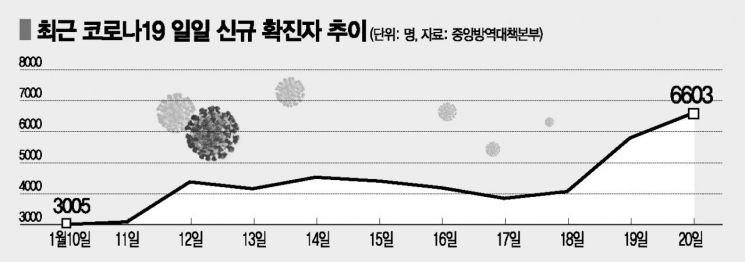
The current spread trend is unprecedented since the COVID-19 outbreak began. It is common for confirmed cases to surge around Wednesdays due to the "weekend effect," where the number of PCR tests decreases on weekends and holidays. However, typically, the number of cases fluctuates around the previous day’s level without a significant increase the following day. This is the first time since the pandemic began that confirmed cases have increased by more than 800 for two consecutive days compared to the previous day.
The rapid spread of the Omicron variant is behind this trend. Omicron, known to be 3 to 4 times more transmissible than the Delta variant, is now spreading widely in South Korea, causing an unprecedented surge. The government predicts that Omicron will become the dominant strain within this week. The detection rate of Omicron has been rapidly increasing. While the domestic detection rate was only 4.0% in the fifth week of December, it jumped threefold to 12.5% in the first week of January and doubled again to 26.7% in the second week.
Authorities expect the domestic detection rate of Omicron to exceed 50% as early as the 21st. The detection rate among imported cases is already 94.7%, with most cases identified as Omicron. Professor Jung Jae-hoon of Gachon University College of Medicine’s Department of Preventive Medicine stated, "It is certain that Omicron is spreading. Considering that the detection rate of Omicron is increasing by more than 30% weekly, confirmed cases could rise to 8,000 to 9,000 next week and possibly reach 10,000."
Urgent Need to Transition to ‘Omicron Response’ System
With the daily confirmed cases approaching the government’s threshold of 7,000 for transitioning to an Omicron response system, preparations must be expedited. The government previously announced that to minimize social and economic damage during the Omicron wave while maintaining a stable healthcare system, it would manage high-risk groups to prevent severe cases and introduce a flexible quarantine system emphasizing autonomy and responsibility.
Under the response system, PCR tests will be prioritized for high-risk groups such as those aged 65 and older, symptomatic individuals, or those epidemiologically linked through close contact. Asymptomatic individuals under 65 will first undergo rapid antigen tests at medical institutions to confirm COVID-19 infection, and if positive, will receive additional PCR testing. To expand capacity and reduce public resistance, local clinics and hospitals will also participate in COVID-19 testing, and health insurance coverage will be applied to rapid antigen tests.
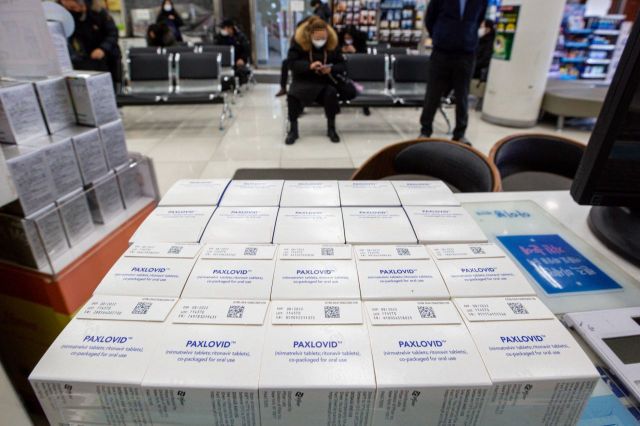 On the 14th, the oral COVID-19 treatment Paxlovid was delivered to a pharmacy in Guro-gu, Seoul. Photo by Jinhyung Kang aymsdream@
To prevent social paralysis caused by rapid spread, the home treatment and self-quarantine period will be shortened from 10 days to 7 days. Confirmed cases will be released from isolation on the 7th day after confirmation, and contacts will be released on the 7th day if they test negative on a PCR test on the 6th day.
The treatment system will focus on home care. Given Omicron’s high transmissibility but lower severity, it is expected that asymptomatic and mild cases will surge rather than severe cases. During the response phase, most mild cases will receive outpatient treatment and prescriptions at local clinics and hospitals and undergo home care. As part of the preparation, the government mandated home treatment for Omicron variant infections as of the previous day. Previously, due to high transmissibility, even asymptomatic or mild cases were hospitalized or admitted to residential treatment centers, but now all patients except those with severe symptoms must receive home care.
Experts advise that preparations for mild cases, including home treatment, must be made. Professor Jung said, "Initially, securing intensive care beds is necessary, but after some time, preparations for mild cases are needed. Administrative support to ensure smooth administration of oral antiviral treatments, which are crucial in the mild patient care system, is currently insufficient, so such support capabilities must be well prepared."
© The Asia Business Daily(www.asiae.co.kr). All rights reserved.