Omicron Response Quarantine System Transition Threshold 'Daily Confirmed Cases 7,000' Approaching
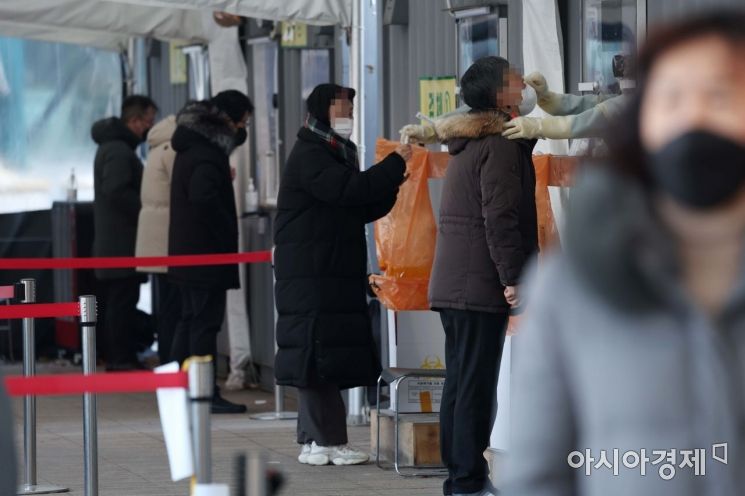 On the 18th, the temporary screening clinic in front of Seoul City Hall was bustling with citizens. / Photo by Mun Ho-nam munonam@
[Asia Economy Reporter Kim Daehyun] As the Omicron COVID-19 variant begins to spread domestically in earnest, the number of new confirmed cases surged to the mid-6,000s on the 20th. The number of new confirmed cases, which had been decreasing due to the full-scale rollout of the third vaccination and strengthened quarantine measures since last month, is now on the rise again as the Omicron variant becomes dominant.
The Central Disease Control Headquarters announced that as of midnight on this day, there were 6,603 new COVID-19 cases, bringing the total number of confirmed cases to 712,503. The number of new cases increased by 798 from the previous day's 5,805, marking the first time in 27 days since December 24 last year (6,233 cases) that the daily cases reached the 6,000 range. This is 2,439 more than 4,164 cases a week ago and 2,480 more than 4,123 cases two weeks ago.
The number of new confirmed cases is expected to exceed 7,000 per day around this weekend. The government has announced plans to shift the quarantine system to respond to Omicron if daily cases exceed 7,000.
Meanwhile, the number of critically ill patients has steadily decreased, dropping to the 400 range for the first time in 62 days. On this day, the number of critically ill patients was 488, down 44 from 532 the previous day. As of 5 p.m. the previous day, the nationwide COVID-19 severe bed occupancy rate was 23.4%, maintaining the 20% range for three consecutive days. The number of deaths increased by 28, bringing the total to 6,480 (cumulative fatality rate 0.91%).
Looking at the infection routes of new confirmed cases, 6,357 were reported as local transmissions. Among local cases, Gyeonggi had 2,364, Seoul 1,292, and Incheon 407, totaling 4,063 cases (63.9%) in the metropolitan area. Non-metropolitan cases exceeded 2,000 for the first time since the COVID-19 outbreak. Non-metropolitan cases included Daegu 355, Gwangju 350, North Gyeongsang 220, South Gyeongsang 218, South Chungcheong 208, Busan 193, North Chungcheong 174, South Jeolla 157, North Jeolla 131, Gangwon 107, Daejeon 94, Ulsan 69, Sejong and Jeju 9 each, totaling 2,294 cases (36.1%). There were 246 imported cases.
The domestic COVID-19 vaccination completion rate was 85.1% as of midnight on this day, with a cumulative total of 43,676,631 people vaccinated. The third dose vaccination rate reached 47.2% of the total population (a cumulative 24,219,031 people).
© The Asia Business Daily(www.asiae.co.kr). All rights reserved.