Representative Dining Prices Including Kimchi Jjigae Rise Simultaneously
Perilla Leaves and Lettuce Prices Soar Ahead of the Holiday
[Asia Economy Reporters Lim Hye-seon and Jang Se-hee] On the afternoon of the 19th, at a traditional Korean meal restaurant in Sangam-dong, Mapo-gu, Seoul, a notice at the entrance reads, "Due to rising ingredient costs, prices have been unavoidably increased." The price of a set meal, which was 8,000 won until last year, has risen to 9,000 won. Lettuce and perilla leaves have also disappeared from the side dishes. The price of Sundaegukbap (Korean blood sausage soup with rice) has increased by 1,000 won. Kim (39), who works at a nearby office, said, "If you include the cost of coffee with the meal, a single meal costs up to 15,000 won," adding, "As a single-person household, I usually eat out, but with soaring prices, I can't afford to eat out anymore."
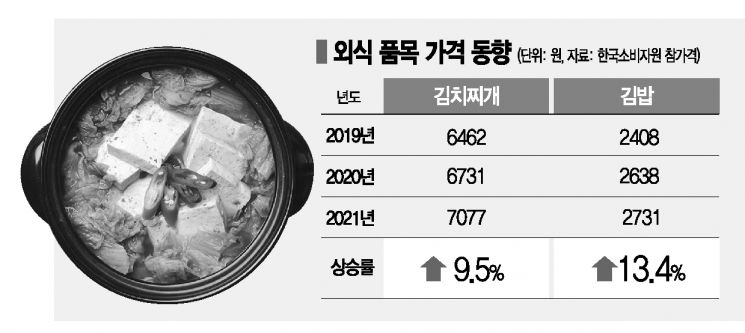
The cost of dining out is becoming serious. As prices for dining-out menus such as gimbap, jajangmyeon, and kimchi jjigae soar, the era where a single meal approaches 10,000 won is becoming a reality. According to the Korea Consumer Agency's comprehensive price information portal on the 20th, the price of a bowl of bibimbap sold in restaurants in Seoul is 9,154 won, up 4.8% from 8,731 won a year ago. Kimchi jjigae, which was 6,731 won last year, rose to 7,077 won, and naengmyeon, which was 9,000 won, increased to 9,731 won. Gimbap also rose from 2,408 won to 2,731 won.
Since the second half of last year, prices for chicken, hamburgers, and coffee have also been steadily adjusted upward. Chicken now costs over 20,000 won to buy, hamburger set prices approach 10,000 won, and among coffee types, the relatively inexpensive Americano costs between 4,500 and 5,000 won.
The sharp rise in dining-out prices is due to the recent steep increase in raw material costs such as ingredients, as well as overall labor costs.
According to the Korea Agro-Fisheries & Food Trade Corporation (aT), vegetable prices have risen more than 20% compared to a month ago. The price of bell peppers (10 kg) jumped to 108,800 won, nearly double the price from a month ago (56,970 won).
Lettuce (4 kg) and perilla leaves (2 kg) also increased by 32.5% and 21.0%, respectively. The price of a carton of eggs (30 pieces) is 6,223 won; it had maintained the 5,000 won range until two months ago but is rising again. The price of Korean beef (Hanwoo) has also increased compared to the average year.
Various processed foods are also seeing chain price increases, deepening people's worries. Ramen, instant rice, tuna, cola, convenience store porridge, and gochujang (red chili paste) have all risen by 2 to 15%.
As a result, according to the Bank of Korea, the average producer price index last year (provisional, base year 2015 = 100) was 109.6, up 6.4% from 103.03 a year earlier. This is the highest record in 10 years since 2011 (6.7%). Agricultural products rose 5.2%, seafood 1.8%, and restaurant prices increased by 1.0%. Looking at detailed items, strawberries (172.4%), apples (26.4%), squid (19.2%), rice cakes (3.8%), and hamburger and pizza specialty stores (3.9%) all saw price increases.
Professor Lee Eun-hee of Inha University's Department of Consumer Studies said, "International supply chain issues continue, and with rising electricity and fuel costs, price increases are expected to persist this year as well," adding, "The suffering of low-income groups is expected to worsen, so countermeasures are needed."
© The Asia Business Daily(www.asiae.co.kr). All rights reserved.