[Asia Economy Reporters Yoo In-ho, Yang Nak-gyu (Military Specialist), Lee Ji-eun] Kim Jong-un, General Secretary of the Workers' Party of Korea, hinted at ending the suspension of nuclear tests and intercontinental ballistic missile (ICBM) test launches around the first anniversary of U.S. President Joe Biden's inauguration, signaling an intention to confront the U.S. with a hardline stance going forward.
The achievements of the Moon Jae-in administration, which had devoted five years to improving inter-Korean relations, are also at risk of being undone. With the U.S. stepping up pressure through additional sanctions on North Korea and actions via the United Nations Security Council, tensions surrounding the Korean Peninsula are expected to escalate as North Korea announces a review of its posture.
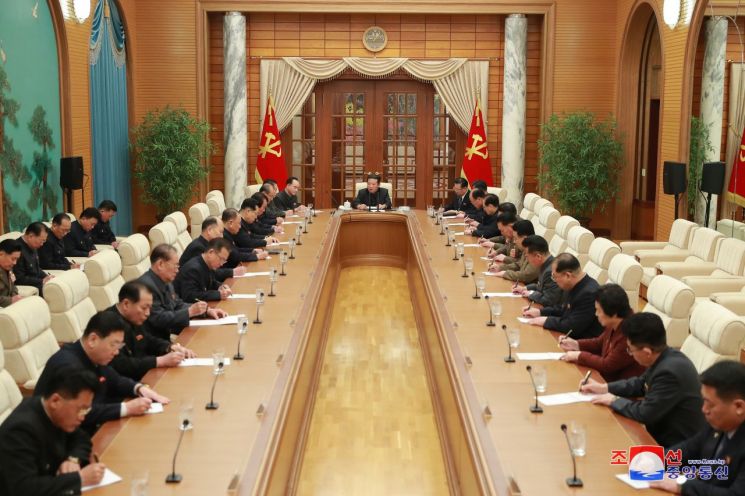
◆ Considering Termination Aligned with Biden Administration's First Year = At the 6th Political Bureau meeting of the 8th Central Committee of the Workers' Party on the 19th, General Secretary Kim stated that they would consider restarting all activities currently on hold, implying the lifting of the nuclear and missile moratorium. North Korea had declared a halt to nuclear tests and ICBM test launches along with the closure of its nuclear test site at the April 2018 plenary meeting of the Central Committee.
Diplomatic circles are paying close attention to the timing of North Korea's posture shift. The Biden administration has focused its foreign policy on building a coalition to counter China during its first year, pushing North Korea issues to the back burner. In this context, General Secretary Kim has observed the Biden administration’s stance, which offers dialogue but no incentives. Both North Korea and the U.S. have practiced 'strategic patience.'
However, Kim Jong-un is now in a situation where patience is no longer viable. With North Korea’s missile provocations continuing into the new year, the U.S. has responded with additional sanctions and pressure through the UN Security Council, prompting North Korea to threaten lifting the moratorium.
Diplomatic experts consider the 2018 moratorium on nuclear tests and ICBM launches to be effectively broken. Hong Min, a research fellow at the Korea Institute for National Unification, said, "Looking at North Korea’s five-year weapons development plan, which includes hypersonic missiles, military reconnaissance satellites, enhancing ICBM capabilities, and submarine-launched ballistic missiles (SLBM), they inevitably have to break the moratorium to conduct tests." He added, "The roughly four-year moratorium achieved through the Panmunjom Declaration and the Singapore Summit has effectively ended."
Some interpret North Korea’s omission of direct mention of lifting the nuclear and ICBM moratorium as a message to pressure the Biden administration by signaling a forthcoming hardline policy.
Park Won-gon, a professor of North Korean Studies at Ewha Womans University, said, "While there is a clear intention to continuously pressure the Biden administration, there is no explicit statement about completely abolishing the moratorium North Korea has maintained." He added, "Ultimately, through hints about policy direction, North Korea will continue efforts to prioritize its issues on the Biden administration’s foreign policy agenda."
◆ North Korea Threatens 'U.S. Red Line' = General Secretary Kim is expected to continue military provocations for the time being. Following the 80th anniversary of Kim Jong-il’s birthday on February 16, the March presidential election and joint U.S.-South Korea military exercises are scheduled. The 110th anniversary of Kim Il-sung’s birthday on April 15 will follow. During this period, there is a high possibility of additional military demonstrations related to the 'Five Major Tasks' mentioned at last January’s Party Congress. These tasks include hypersonic missiles, super-large nuclear warheads, improving 15,000 km strike accuracy, developing solid-fueled ICBMs for underwater and ground launch, and possessing nuclear submarines and underwater-launched nuclear strategic weapons.
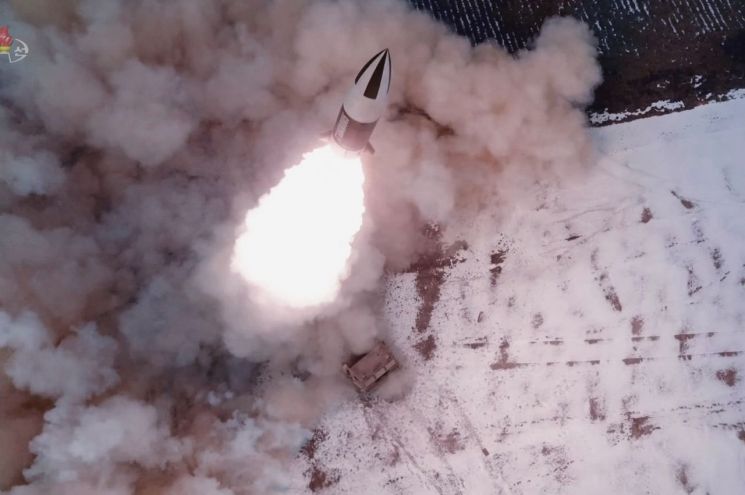
North Korea has also accelerated the frequency of missile test launches this year. After the first missile test on the 5th, the second was launched just six days later, followed by launches on the 14th and 17th, shortening intervals to three days. There is speculation about possible launches on the 20th or 21st.
One interpretation of North Korea’s rapid-fire launches is that it has begun a major performance upgrade of its existing missile systems. Consequently, the next launch might be a large-caliber multiple rocket launcher or a cruise missile.
Some predict that by launching strategic weapons other than hypersonic missiles, North Korea could cross the U.S. red line. Yang Moo-jin, a professor at the University of North Korean Studies, said, "By February 16, or at the latest April 15, North Korea may conduct strategic weapon launches, including nuclear missile tests, to demonstrate its presence," adding, "This signals a return to a highly volatile situation."
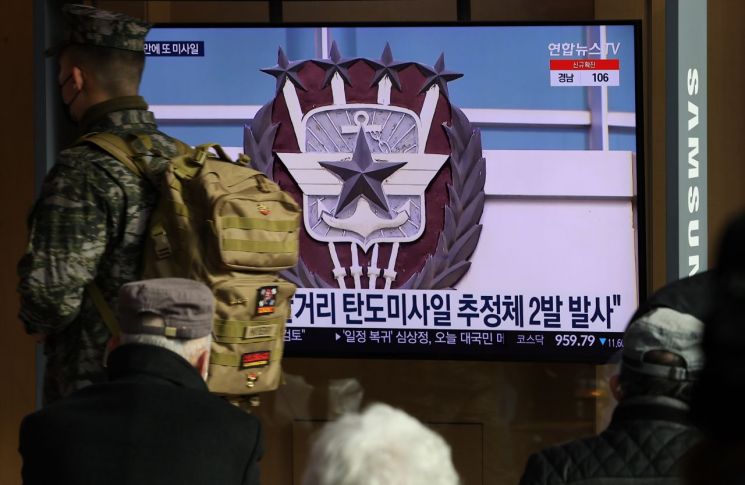
◆ Rising Tensions on the Korean Peninsula = As North Korea and the U.S. engage in a hardline standoff, concerns are growing that tensions on the Korean Peninsula will significantly increase. Although the U.S. still offers dialogue, it is likely to maintain a tough stance for the time being. If North Korea proceeds with actual nuclear tests and ICBM launches ahead of the U.S. midterm elections in November, it would pose a threat to the U.S. mainland and become a political liability for the Biden administration. This means that North Korea’s moratorium withdrawal would be a major failure for the Democratic administration.
With the likelihood of North Korea escalating military provocations, the prospects for a declaration to formally end the Korean War have also dimmed. Kim Hyun-wook, a professor at the Korea National Diplomatic Academy, said, "(North Korea) seems to view the North Korea-U.S. framework as completely broken and considers North Korea-U.S. talks nearly over," adding, "Trust in the South Korean government has also significantly eroded, and internally, North Korea is shifting decisively toward a hardline diplomatic approach."
© The Asia Business Daily(www.asiae.co.kr). All rights reserved.