Institute for Basic Science
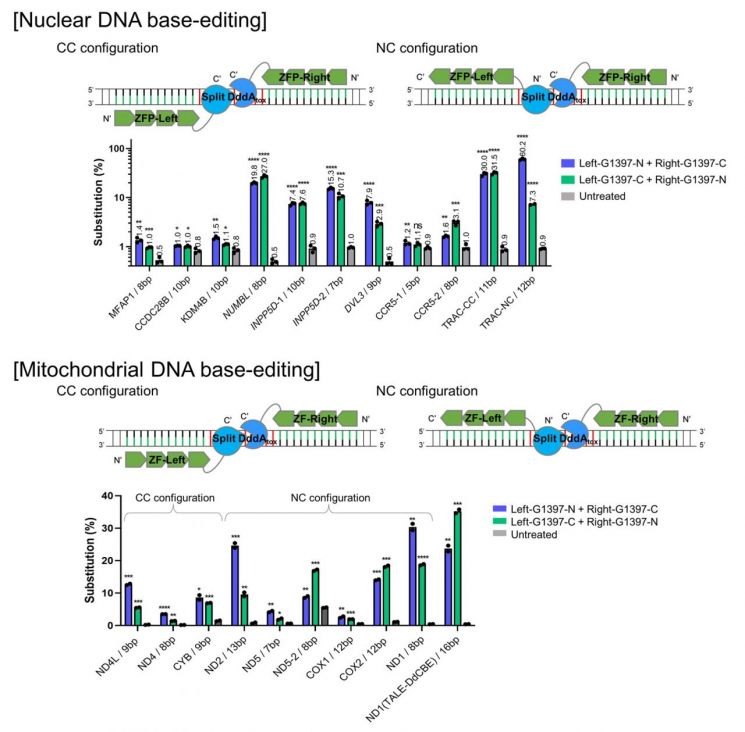 Various ZFD pairs targeting nuclear and mitochondrial DNA within cells were produced. ZFDs can be designed in CC and NC structures, allowing for production with diverse structural orientations. It was confirmed that ZFDs can substitute cytosine/guanine (C/G) base pairs with thymine/adenine (T/A) at efficiencies of up to 60% in nuclear DNA and up to 30% in mitochondrial DNA.
[Asia Economy Reporter Kim Bong-su] The research team at the Institute for Basic Science (IBS) Genome Editing Research Center announced on the 20th that they have successfully developed a new nuclear and mitochondrial DNA base editing technology called "Zinc Finger Deaminase (ZFD)."
Mitochondria are organelles within cells that produce energy. Mutations in mitochondrial DNA can cause fatal defects not only in vision and hearing but also in the central nervous system, muscles, and heart. Mitochondrial diseases are relatively common genetic disorders, occurring in about one in 5,000 people. However, mitochondrial DNA editing has been impossible with the widely used CRISPR-Cas9 genome editing technology.
In response, in 2020, a new base editor called DdCBE was developed using the bacterial-derived DddA deaminase and a deactivator protein. This was the only mitochondrial DNA base editing technology available.
Building on this, the research team fused the existing DddA deaminase with a zinc finger protein to develop a new nuclear and mitochondrial DNA base editing technology called "Zinc Finger Deaminase." Zinc finger proteins are more than half the size of the previously used deactivator proteins, allowing for various structural designs and easier application. They also have cell-penetrating ability, enabling nucleic acid-free genome editing.
The researchers first created 24 pairs of ZFD structures to identify the optimal configuration. They then succeeded in substituting cytosine-guanine (C·G) base pairs with thymine-adenine (T·A) in nuclear and mitochondrial DNA using ZFD. Using the developed ZFD or ZFD-DdCBE hybrids allows induction of mutations that were not possible with DdCBE alone. Furthermore, by improving the zinc finger protein or altering the delivery method, they significantly enhanced accuracy by reducing off-target effects.
Director Kim Jin-su stated, "ZFD is expected to be widely used not only for research and treatment of mitochondrial diseases and other intractable diseases but also for editing DNA of other organelles such as chloroplast DNA in plants. Due to its small size, ZFD offers many advantages for cellular delivery and is anticipated to have broad applications when combined with various technologies."
The research results were published online on the 18th in the international biology journal Nature Communications (IF 14.919).
© The Asia Business Daily(www.asiae.co.kr). All rights reserved.
![User Who Sold Erroneously Deposited Bitcoins to Repay Debt and Fund Entertainment... What Did the Supreme Court Decide in 2021? [Legal Issue Check]](https://cwcontent.asiae.co.kr/asiaresize/183/2026020910431234020_1770601391.png)















