KRISS Develops Precision Temperature Distribution Measurement Technology
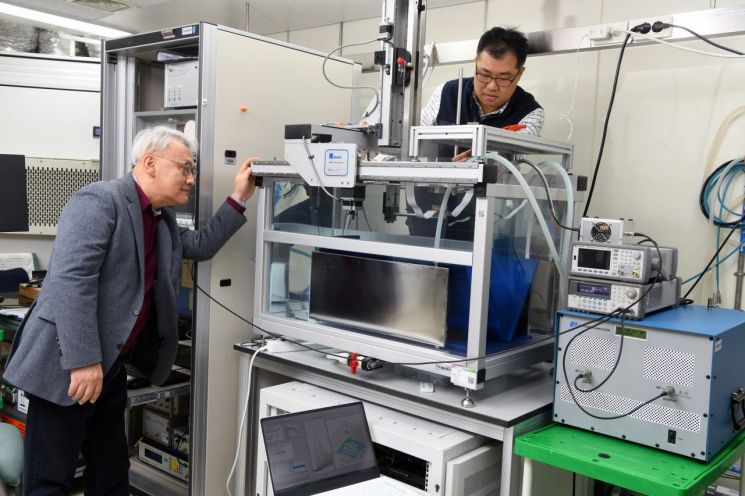 Kim Yong-tae, Principal Researcher of the Ultrasonic Standards Team, and Do Il, Principal Researcher of the Medical Measurement Team at the Korea Research Institute of Standards and Science (KRISS), are conducting performance evaluation of an ultrasonic therapy device.
[Asia Economy Reporter Kim Bong-su] A technology has been developed to enhance the safety of ultrasound therapeutic devices used in tumor removal surgeries and to expand their application targets.
The Korea Research Institute of Standards and Science (KRISS) announced on the 20th that it has succeeded in developing a precise measurement technology for internal temperature distribution in materials to evaluate the performance of ultrasound-based therapeutic devices. This advancement will enable more accurate safety assessments of focused ultrasound therapeutic devices used in tumor treatment, significantly contributing to increased treatment efficacy and reduced side effects.
Focused ultrasound therapeutic devices concentrate ultrasound waves inside the human body to locally generate heat and mechanical energy, achieving therapeutic effects. They are used in surgical treatments that apply high heat to tumors to induce necrosis, as well as in stimulating tissues for procedures such as facial lifting, abdominal fat reduction, and drug delivery.
To enhance treatment effects and minimize side effects, it is essential to focus ultrasound only on the desired target area within the body to raise the temperature while minimizing temperature increases in surrounding tissues to prevent damage. Measuring temperature changes at specific locations caused by focused ultrasound is essential for evaluating the performance and safety of these therapeutic devices.
However, the current testing method recommended by the Ministry of Food and Drug Safety involves inserting a temperature probe (thermometer) inside the material to measure temperature distribution, which cannot accurately measure temperature due to ultrasound reflections at the probe. There is also a limitation where heat generated by ultrasound is conducted along the temperature probe, which has high thermal conductivity, causing distortion in the temperature distribution.
The institute developed a thin-film temperature sensor array technology that can accurately measure internal temperature distribution without affecting ultrasound propagation. The array integrates a total of 100 temperature sensors spaced 1 mm apart on a thin film only 3 μm (micrometers) thick, which is over 30 times thinner than the thickness of a human hair. This solved the ultrasound reflection problem caused by temperature probes and enabled precise measurement of temperature distribution at the focus and surrounding areas. As a result, temperature distribution during focused ultrasound procedures can be precisely measured and controlled. This also allows for expanding the range of diseases treatable by therapeutic devices, which is expected to strengthen the international competitiveness of domestic ultrasound medical device manufacturers.
Kim Yong-tae, a principal researcher at KRISS, stated, “As ultrasound output increases, precise temperature measurement technology to minimize side effects on the human body will become even more important,” adding, “We plan to work with domestic ultrasound therapeutic device manufacturers to ensure this technology is used not only by medical device manufacturers but also in clinical settings.”
The research results were published in the international academic journal 'IEEE Sensors Journal' in November of last year.
© The Asia Business Daily(www.asiae.co.kr). All rights reserved.
![User Who Sold Erroneously Deposited Bitcoins to Repay Debt and Fund Entertainment... What Did the Supreme Court Decide in 2021? [Legal Issue Check]](https://cwcontent.asiae.co.kr/asiaresize/183/2026020910431234020_1770601391.png)
















