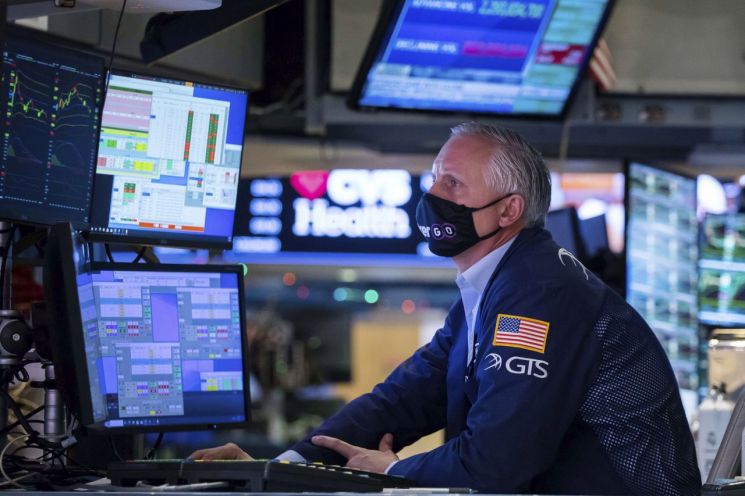
[Asia Economy New York=Special Correspondent Joselgina] The US Nasdaq index, centered on technology stocks, has fallen more than 10% from its peak, entering a 'technical correction' phase. This is interpreted as a result of investors massively selling technology stocks sensitive to interest rates as the Federal Reserve (Fed), the US central bank, signals tightening. The three major indices of the New York stock market closed lower for two consecutive days, and the price of gold, a representative safe-haven asset, surged.
On the 19th (local time) in the New York stock market, the Nasdaq index closed at 14,340.25, down 166.64 points (1.15%) from the previous session. Compared to the previous high on November 19 last year (16,057.44), it dropped by a whopping 10.69%, entering a correction phase. It is the first time in about 10 months since March 8 last year that the Nasdaq index has entered a correction phase.
On the same day, the Dow Jones Industrial Average and the S&P 500 index also closed down 0.96% and 0.97%, respectively. Although the sharp rise in bond yields that had put the stock market on edge somewhat eased that day, concerns about early tightening remained. Morgan Stanley, Procter & Gamble (P&G), and others posted strong earnings, but it was not enough to lead the overall market.
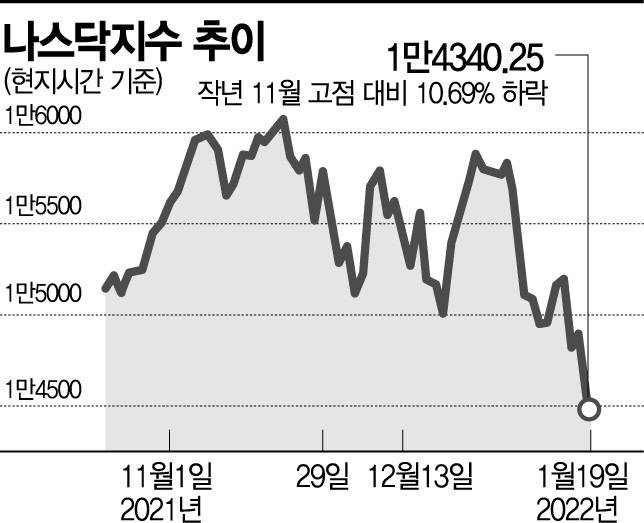
By stock, the decline in technology stocks was clear. Tesla's stock price fell 3.38% from the previous session, breaking the so-called 'Cheonsla'. Nvidia (-3.23%), Apple (-2.10%), and Amazon (-1.65%) also retreated.
Investors are particularly paying attention to the fact that the Nasdaq index has entered a technical correction. This year, the Nasdaq index has fallen more than 8%, recording a larger decline than the Dow and S&P 500 indices. The reason for the assessment that the technology stocks, which had continued high growth thanks to 'zero interest rates' after the pandemic, have been cooled down by the early tightening forecast is because the US, suffering from the highest inflation in 40 years, will inevitably face greater downward pressure on the stock market if it accelerates tightening faster than market expectations.
Mark Newton, chief strategist at Fundstrat, said, "This is evidence that the market is gripped by fear," adding, "The Nasdaq index has not yet reached its bottom. It will take about two more weeks to reach the bottom." The volatility index (VIX·23.85), known as Wall Street's fear index, rose 4.65% that day.
On the other hand, the price of gold, a safe-haven asset, surged. On that day, February gold futures on the New York Mercantile Exchange closed at $1,843.20 per ounce, up $30.80 (1.7%) from the previous trading day.
© The Asia Business Daily(www.asiae.co.kr). All rights reserved.