Green New Deal, Zero-Energy Materials Spotlighted with Strengthened Insulation Regulations
Special Nano-Technology Applied, World-Class Insulation Performance and Solar Heat Blocking Effect
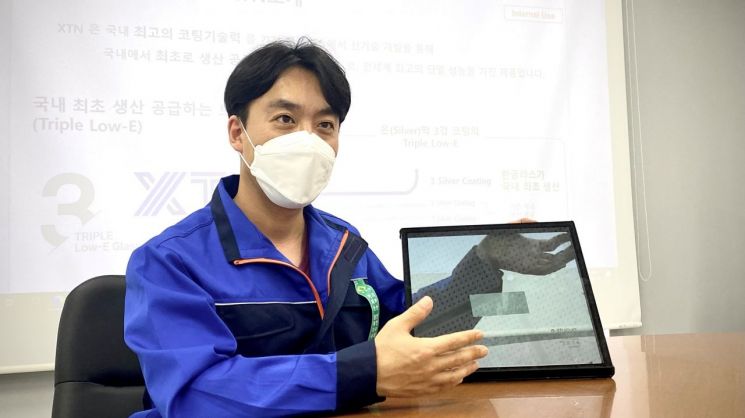 A company representative is explaining the Triple Roy Glass XTN145II, the first of its kind released domestically by Hanglas. Photo by Hanglas
[Asia Economy Reporter Kim Heeyoon] As carbon neutrality emerges as a global issue, zero-energy materials that achieve carbon reduction are gaining attention.
According to the industry on the 20th, with the government's Green New Deal project promotion and the strengthening of insulation regulations, demand for high-performance low-emissivity (Low-E) glass, an essential material to prevent energy loss, is increasing.
Low-E glass coated with silver is known for its excellent insulation performance. Recently, triple Low-E glass applied at construction sites is glass coated with three layers of silver film. Triple Low-E glass was previously produced only by some companies in the United States or Europe, but in May last year, Hanglas introduced the country's first triple Low-E glass XTN145II after years of development.
Hanglas explained that the XTN145II applies a special nano process to achieve world-class insulation performance and solar heat blocking capabilities. The reason Low-E glass has excellent insulation performance is due to the silver (Silver) film coated on the glass. However, if the silver film is made thicker, insulation improves but the glass becomes mirror-like, losing transparency and increasing external reflectance, causing severe glare.
To solve this problem, Hanglas applied a special nano coating technology to XTN145II that coats multiple thin layers of silver film while maintaining appropriate transmittance, achieving insulation performance. Additionally, it maintains an appropriate level of visible light entering indoors to keep interiors bright while selectively blocking solar heat from outside, making it an optimized material for zero-energy buildings that can save cooling energy.
Typically, high-performance products like triple Low-E glass are planned for application during the building design process. However, XTN145II, recognized for its excellent insulation performance after release, was exceptionally applied at the G Tower Knowledge Industry Center site in Gwangmyeong. A site official stated that it is expected to help save more energy than the product applied in the original design due to its superior insulation performance.
In addition to its main products of architectural flat glass and coated glass, Hanglas is developing various solution products including triple Low-E glass. Representative technologies include ▲electrochromic smart glass that changes transmittance color with electrochromic materials to control solar heat ▲building-integrated photovoltaic (BIPV) systems applying colored cover glass to solar modules used as building exterior materials ▲heated coated glass with an added heating system to coated glass ▲and hybrid special coated glass with added functions such as antibacterial, anti-reflective, and self-cleaning coatings on the glass surface.
A Hanglas official said, "The newly developed XTN145II has world-class insulation performance and is optimized for domestic zero-energy buildings, offering a perfect balance of performance, price, and delivery." He added, "In the future, we will develop eco-friendly products to reduce building energy consumption and cooling/heating costs, as well as establish eco-friendly plants to improve pollution control facilities and fine dust reduction devices."
© The Asia Business Daily(www.asiae.co.kr). All rights reserved.
![User Who Sold Erroneously Deposited Bitcoins to Repay Debt and Fund Entertainment... What Did the Supreme Court Decide in 2021? [Legal Issue Check]](https://cwcontent.asiae.co.kr/asiaresize/183/2026020910431234020_1770601391.png)