Emergency Economic Central Countermeasures Headquarters Meeting
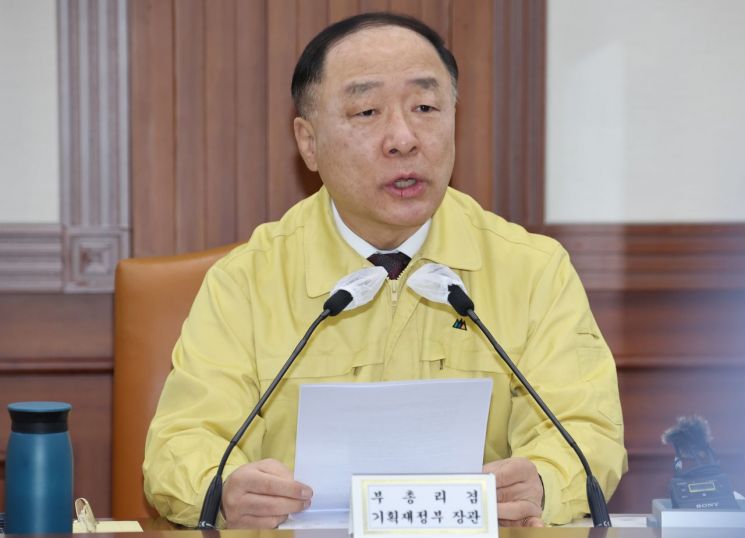 Hong Nam-ki, Deputy Prime Minister and Minister of Economy and Finance, is speaking while presiding over the "53rd Emergency Economic Central Countermeasures Headquarters Meeting" held at the Government Seoul Office Building on the 20th. 2022.1.20
 [Photo by Yonhap News]
[Sejong=Asia Economy Reporter Son Seon-hee] The government is pushing to establish a comprehensive government-wide response support system to systematically coordinate labor-management conflicts. This move is interpreted as a response to growing concerns from the business community just one week before the enforcement of the Serious Accident Punishment Act on the 27th.
Hong Nam-ki, Deputy Prime Minister and Minister of Economy and Finance, chaired an emergency economic central countermeasure meeting at the Government Seoul Office on the morning of the 20th, stating, "This year, major labor policy issues such as the enforcement of the Serious Accident Punishment Act, the introduction of labor director systems in public institutions, and discussions on the exemption system for working hours are being raised simultaneously. Additionally, new conflict issues such as industrial transformation due to COVID-19, related employment problems, and platforms may emerge." He added, "It is very important to balance and coordinate various opinions, including union demands and management positions, regarding these labor policy issues and on-site conflicts."
Regarding last year's labor-management relations, he evaluated, "Labor-management relations were relatively stable based on indicators such as no disputes in large workplaces (a 15.4% decrease in lost workdays)," but also noted, "there were some aspects where the perceived labor-management relations were somewhat unstable due to certain strikes."
Meanwhile, the government plans to finalize a 14 trillion won supplementary budget proposal?the first ever in January?at the Cabinet meeting on the 21st and submit it to the National Assembly on the 24th. While the fiscal authorities are injecting funds like this, the Bank of Korea has recently raised interest rates and begun tightening monetary policy, leading to criticism of a 'policy mismatch.' There are also concerns that the government's fiscal injection policy could further stimulate already rising inflation.
In this regard, Deputy Prime Minister Hong said, "From the beginning of the year, it is an absolutely necessary time to have precision and consistency in economic policies within the policy mix with seriousness and tension." He emphasized, "The government will actively consider economic policies in the first half of the year under the firm principle of 'tailored precision and consistent coherence,' covering support for small business owners, price stabilization for people's livelihoods, and backing economic recovery." He added, "Under the three major constraints of 'prioritizing quarantine, external variables, and fiscal perspectives,' we must harmoniously pursue quarantine and livelihood balance, economic recovery and price control, interest rate hikes and supplementary budget support, and external variables and export enhancement without mismatch," and expressed hope for "shared understanding and cooperation among economic agents."
Regarding recent difficulties faced by export companies due to soaring logistics costs, Deputy Prime Minister Hong stated, "To resolve logistics difficulties, we will deploy eight temporary vessels in January and more than 4,000 cargo flights on the trans-Pacific route in the first half of the year." He also said, "The weekly allocation of regular vessel space for small and medium shippers will be expanded from 550 TEU to 900 TEU, and the logistics cost support budget, including logistics-exclusive export vouchers, will be increased to 32 billion won."
Concerning items experiencing supply instability such as energy raw materials like coal and natural gas, and automotive semiconductors, he said, "The possibility of immediate supply disruptions is low," but expressed concern that "there is a constant possibility that increased price volatility could lead to cost burdens." Accordingly, he announced, "We will promote menu-style tailored supply management for 200 'core economic security items.'"
© The Asia Business Daily(www.asiae.co.kr). All rights reserved.