"Counting Age in Korean Ways: 'Se-neun Nai', 'Man Nai', 'Yeon Nai'... Confusion Over Age Calculation
Petitions to Abolish 'Korean Age' Rise Every New Year
83.4% Respondents Support 'Standardizing Man Nai'
Some Concern Over Confusion in Titles and Hierarchy if Standardized"
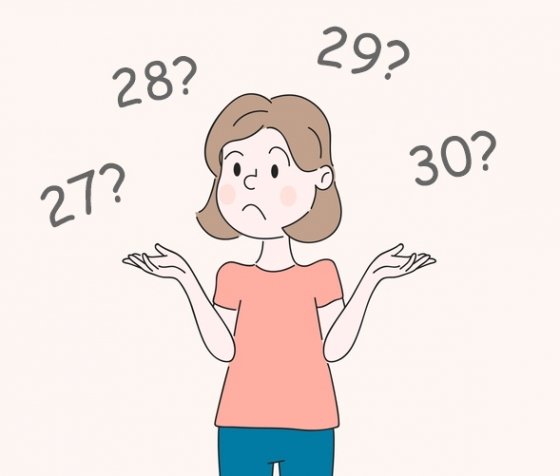 In Korea, three different age calculation methods are commonly used, causing frequent confusion. There is a growing demand to unify under the internationally standardized "international age."
 Photo by Getty Images Bank
[Asia Economy Reporter Kang Juhee] If you are Korean, you have probably experienced confusion at least once when filling out documents at government offices or hospitals about how old you are. This issue arises because the age calculation method commonly used in daily life differs from the one used in public institutions. To prevent such confusion, there is a growing demand to mandate the use of the internationally accepted 'international age' (man-nai).
On the 17th, Yoon Seok-yeol, the presidential candidate of the People Power Party, announced a pledge to unify the age standard to 'international age.' The aim is to stop using the 'Korean age' commonly used in daily life and standardize the international age, which is the basis for taxes, medical care, and welfare, to reduce unnecessary confusion.
The debate over age calculation methods recurs every year. At the beginning of the year, the Blue House's public petition board is filled with posts complaining about the inconvenience caused by the various age calculation methods used in Korea, such as "Please establish international age" and "Abolish Korean age and set it straight."
There are three age calculation methods used in Korea. The Korean age (se-neun nai), which starts at 1 at birth and increases by one each New Year; the international age (man-nai), which starts at 0 at birth and increases by one on each birthday; and the year age (yeon nai), which starts at 0 at birth and increases by one each New Year.
Among these, the most widely used method in Korea is the Korean age. However, hospitals and public institutions use the international age, which is the international standard, causing considerable confusion. For example, a person born in August 1993 would be 30 years old by Korean age in 2022, 28 years old by international age, and 29 years old by year age.
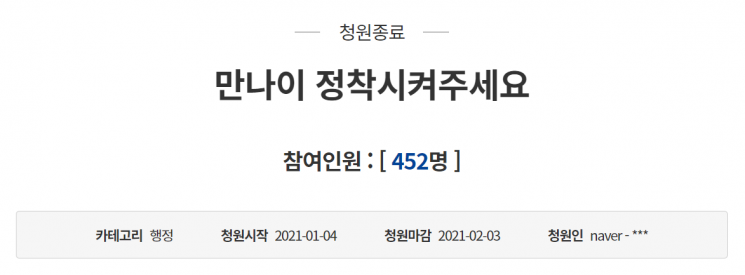 A petition posted on the Blue House National Petition Board last January demanding "to establish the use of international age." Photo by Blue House Board Capture
Because of this, citizens express inconvenience. They usually use Korean age but have to go through the extra step of thinking, "How old am I by international age?" when filling out official documents. Although calculating international age is not difficult, having to repeatedly check and confirm even basic information like one's name can sometimes feel bothersome.
Especially since countries other than Korea use international age as the standard, communication with foreigners can often be uncomfortable. Foreigners sometimes call the Korean age the "Korean Age." Searching this keyword on social networking services (SNS) reveals many posts expressing confusion and frustration about the Korean age system. One Korean netizen lamented, "It's really difficult to explain Korean age to friends from other cultures," adding, "Most foreign friends show expressions of disbelief, asking how one can have three different ages."
The Korean age is known to have originated from East Asian cultures such as China and Japan. The origin of Korean age includes theories such as counting age from when the baby is in the mother's womb, thus considering the baby one year old at birth, or that the concept of 'zero' did not exist in the East, so the birth year was counted as one year old. However, China adopted international age after the Cultural Revolution in the late 1960s, and Japan also revised related laws in 1902 to use international age. Currently, Korea is the only country still using Korean age.
Public opinion on standardizing international age is generally positive. A survey conducted by the startup Newneek in December last year on the topic of 'standardizing international age' showed that among 2,021 respondents, 83.4% (1,686 people) supported standardizing international age. Opposition was 12.8% (258 people), and others accounted for 3.8% (77 people).
However, some still argue that Korean age should continue to be used. In Korea, age often determines forms of address and hierarchy, so standardizing to international age could cause new confusion. There is also the argument that Korean age is already widely established in society and should be regarded as a unique cultural element.
Experts suggest that issues related to age should move toward eliminating excessive ageism. One sociology professor said, "Controversies related to the international age standard have been mentioned several times but have not changed in the end. The fundamental problem is that age-based hierarchy or discrimination, i.e., ageism, still exists in Korean society, and that issue needs to be addressed." He added, "If international age is to be standardized, there needs to be consideration on how to encourage people to adopt it."
© The Asia Business Daily(www.asiae.co.kr). All rights reserved.
![User Who Sold Erroneously Deposited Bitcoins to Repay Debt and Fund Entertainment... What Did the Supreme Court Decide in 2021? [Legal Issue Check]](https://cwcontent.asiae.co.kr/asiaresize/183/2026020910431234020_1770601391.png)
















