Korea Price Association, Survey Results of 8 Traditional Markets Nationwide
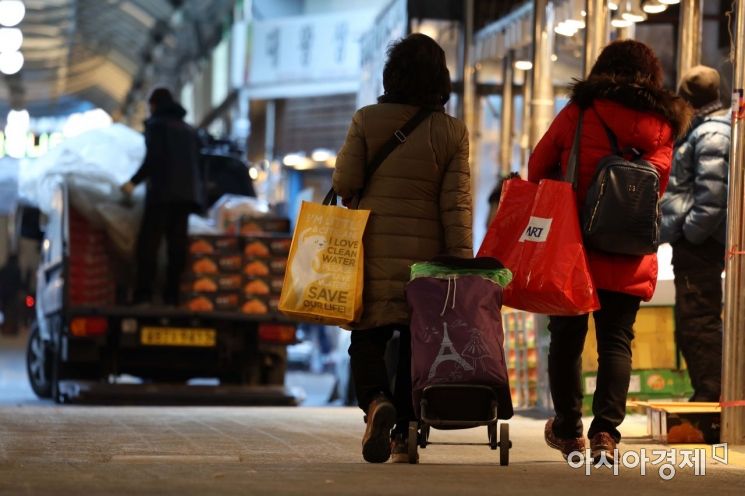 On the 14th, ahead of the Lunar New Year holiday, citizens were shopping at the Cheongnyangni Agricultural and Marine Products Market in Dongdaemun-gu, Seoul. Photo by Mun Ho-nam munonam@
[Asia Economy Reporter Lim Chun-han] This year, the cost of setting up a Seol Charye table for a family of four using traditional markets is estimated to be about 240,290 KRW. This represents a 2.8% increase from last year's 233,750 KRW.
On the 19th, the Korea Price Association announced that this result came from a price survey conducted on the 17th of 29 Charye items across eight traditional markets in six major cities nationwide: Seoul, Busan, Daegu, Gwangju, Incheon, and Daejeon.
Among the 29 surveyed items, prices of 17 items, including pears, rose, while 12 items, such as spinach, declined. Although pear production increased compared to last year, the cultivation area decreased due to the spread of fire blight disease, causing the price of five pears to rise 3.5% to 20,250 KRW. The price of dried persimmons (gotgam) rose 45.5% to 13,440 KRW, as the harvest volume of the raw material persimmons decreased and favorable weather conditions increased sugar content, boosting demand.
For greens, the quality was good and cultivation areas expanded, leading to generally lower prices. Spinach (400g) was sold at 2,270 KRW, down 15.3%, green onions (1 bunch) dropped 48.4% to 2,320 KRW, and radish (1 piece) decreased 3.6% to 1,630 KRW.
Beef and pork prices fluctuated differently depending on the cut. Beef for skewers (600g) and pork loin (500g) rose 3% and 1.2% respectively, selling at 25,880 KRW and 5,190 KRW. Conversely, beef for soup (brisket, 400g) fell 10.4% to 18,080 KRW. Eggs and chicken prices continued to rise due to supply instability caused by the outbreak of highly pathogenic avian influenza (AI) and increased household demand.
Special eggs (30 pieces) were sold at 6,730 KRW, up 5.7%, and live chicken (3 birds) at 17,930 KRW, up 5.8%. Since household demand for beef, pork, and eggs remains strong, prices are high, but it is expected that the government’s plan to increase the supply of seasonal products will help curb the price rise.
The Korea Price Association stated, "With the increase in COVID-19 cases, demand for home-cooked meals is growing, and certain item prices are strong due to adverse weather and rising raw material costs. However, the government plans to expand the supply of 10 major seasonal products by 1.4 times, so supply conditions are expected to gradually improve."
© The Asia Business Daily(www.asiae.co.kr). All rights reserved.
![User Who Sold Erroneously Deposited Bitcoins to Repay Debt and Fund Entertainment... What Did the Supreme Court Decide in 2021? [Legal Issue Check]](https://cwcontent.asiae.co.kr/asiaresize/183/2026020910431234020_1770601391.png)















