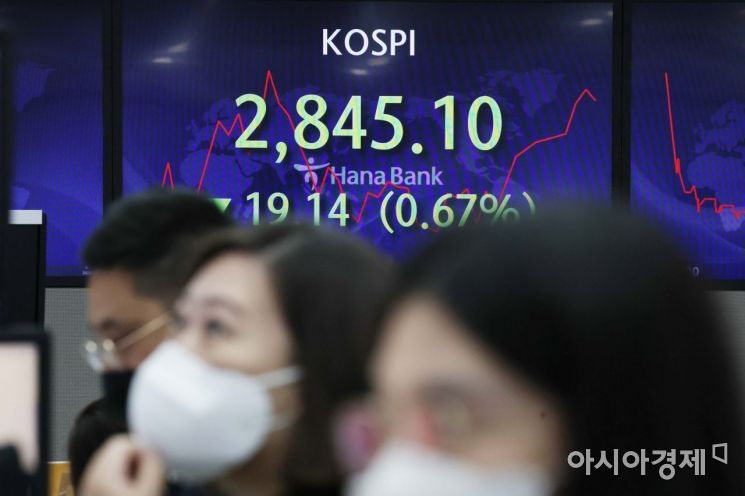
 On the 19th, dealers are working in the dealing room of Hana Bank in Euljiro, Seoul. On this day, the KOSPI index opened at 2,840.34, down 23.90 points (0.83%) from the previous session. The won-dollar exchange rate started at 1,195.0 won, up 4.9 won. Photo by Moon Honam munonam@
[Asia Economy Reporter Junho Hwang] Since the beginning of this year, the three major asset management companies dominating the Exchange-Traded Fund (ETF) market have started a competition to lower management fees.
On the 19th, according to the financial investment industry, Mirae Asset Global Investments, which uses the ETF brand 'TIGER,' lowered the total management fee of its leveraged product investing in the U.S. S&P 500 to 0.25%, the lowest level among overseas index leveraged ETFs listed on the Korea Exchange. Over the past year, Mirae Asset also lowered the total fees of TIGER Leverage (KRW 721 billion) and Inverse (KRW 428 billion) to the lowest domestic levels to capture the top trading volume positions held by KODEX Leverage (KRW 146 trillion) and Inverse (KRW 120 trillion).
To counter the rising Mirae Asset, Samsung Asset Management launched a counterattack. With the appointment of CEO Seobonggyun last year, Samsung firmly expressed its determination not to fall behind in the market share competition with Mirae Asset by lowering fees on seven KODEX ETF products. Notably, fees were reduced on products that had not gained much attention last year due to Mirae Asset's dominance. The fees for U.S. stock ETFs such as KODEX U.S. Semiconductor MV (net assets KRW 55 billion) and Smart Mobility were lowered to an industry-low 0.09%. The net assets of TIGER U.S. Philadelphia Semiconductor Nasdaq, which invests in similar stocks as U.S. Semiconductor MV, currently amount to KRW 1.089 trillion.
However, it remains uncertain whether this fee competition will actually lead to increased investment from investors, especially individual investors who are central to the growth of the ETF market. ETFs with lowered fees have not attracted investment due to the downturn in the industry. Samsung Asset Management and KB Asset Management have also reduced fees on ETFs investing in domestic healthcare and IT sectors, which continue to be in a correction phase since last year.
Even among asset management companies, there is skepticism that fee reductions will translate into actual inflows of investment funds. This is because fees constitute a small portion of the total costs. An industry insider analyzed, "Unless the investor is a major shareholder or institution investing in the order of billions of won, it may be difficult to see the effect of fee reductions," adding, "The divergence between the ETF's market price (actual buy/sell price) and its Net Asset Value (NAV) can have a greater impact on returns."
© The Asia Business Daily(www.asiae.co.kr). All rights reserved.