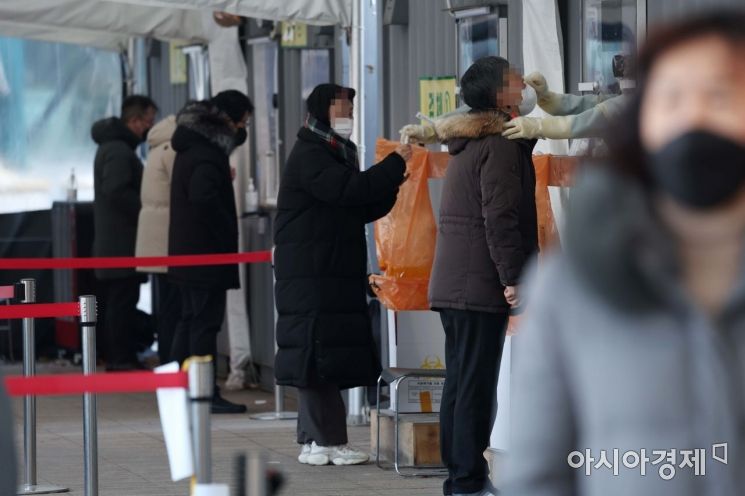
 On the 18th, the temporary screening clinic in front of Seoul City Hall was crowded with citizens. Photo by Moon Honam munonam@
[Asia Economy Reporter Lee Chun-hee] As the Omicron COVID-19 variant rapidly spreads, the number of new COVID-19 cases has exceeded 5,000 for the first time this month. With the number surpassing the Omicron preparedness criteria set by authorities, the response shift appears to be accelerating, including allowing home treatment for Omicron patients.
On the morning of the 19th, Son Young-rae, head of the Social Strategy Division at the Central Disaster and Safety Countermeasure Headquarters (CDSCH), said at a regular briefing in response to a question about the timing of the transition to the Omicron response system, "We are now preparing for the transition, and each system is entering the preparation stage," adding, "Please consider the decision not to require Omicron confirmed patients to be admitted to residential treatment centers but to switch to home treatment as a kind of preparatory procedure."
Previously, authorities announced that the Omicron 'preparedness phase' would be activated until daily confirmed cases reached 5,000, and once exceeding 7,000, a full-scale 'response phase' would begin to tackle the Omicron spread. According to the Central Disease Control Headquarters (CDCH), as of midnight on this day, the number of new COVID-19 cases was 5,085, surpassing 5,000 for the first time this month.
On this day, the CDSCH also changed the treatment principle so that home treatment would effectively become mandatory for confirmed Omicron variant cases. Previously, Omicron-infected individuals, including severe cases as well as asymptomatic or mild cases, were required to be admitted to hospitals or residential treatment centers to prevent further transmission. However, going forward, only high-risk elderly and patients with underlying conditions will be eligible for hospital or residential treatment center admission. This measure is part of the transition to the Omicron preparedness system.
In terms of the medical system, the focus will be on strengthening routine medical care centered on oral antiviral treatments. Son explained, "We are concretizing plans to secure a routine medical care system through active participation of local clinics and to ensure smooth operation of various treatment systems including oral antiviral drugs. Local governments and connected medical systems are entering a preparation process for these changes."
However, there are criticisms that the daily prescription volume of Pfizer’s oral antiviral treatment 'Paxlovid,' which is key to the medical system transition, is extremely low compared to the government’s announcement that up to 1,000 patients can be treated daily. Son explained, "There are some contraindicated medications, and many patients are taking them," adding, "There are quite a few cases where doctors cannot prescribe it."
Considering the rapid increase in Omicron cases, the government plans to accelerate the transition to the Omicron response system. Son said, "Considering the transmission characteristics of Omicron, we predict that the number of confirmed cases will increase somewhat rapidly in the future," and added, "We are speeding up the transition of the response system accordingly."
© The Asia Business Daily(www.asiae.co.kr). All rights reserved.
![User Who Sold Erroneously Deposited Bitcoins to Repay Debt and Fund Entertainment... What Did the Supreme Court Decide in 2021? [Legal Issue Check]](https://cwcontent.asiae.co.kr/asiaresize/183/2026020910431234020_1770601391.png)
















