KAIST-ETRI Joint Research Team
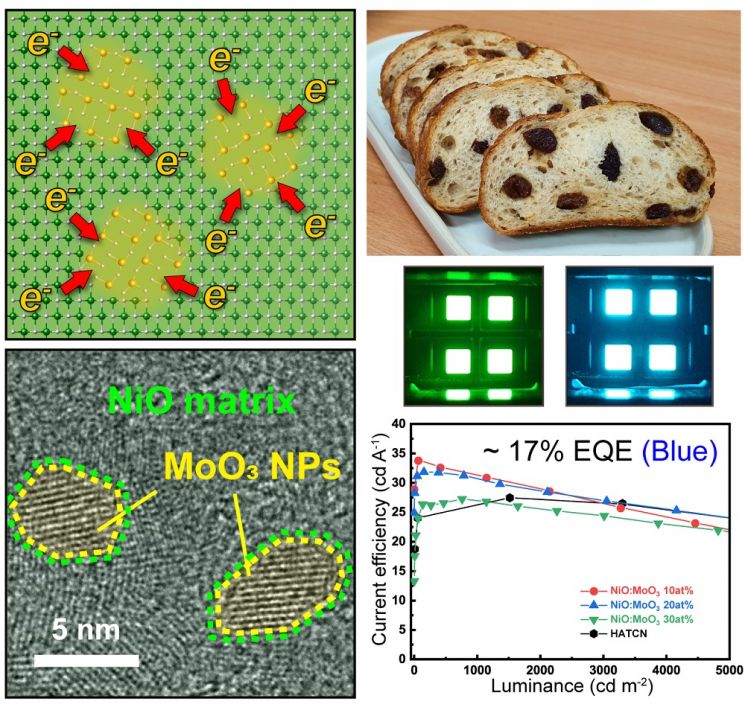 <Schematic of NiO:MoO3 Charge Transfer Complex with Raisin Bread Structure and Device Performance>
 Molybdenum oxide (MoO3) nanoparticles form a heterostructure resembling raisin bread within nickel oxide (NiO). Effective charge transfer between the two metal oxides induces a wide-range tunability of the thin film’s energy bands, enabling customized applications for various optoelectronic devices. This thin film was applied to green and blue organic light-emitting diodes (OLEDs), achieving an external quantum efficiency of approximately 17% in blue devices, surpassing commercial organic material-based devices and demonstrating both versatility and performance.
[Asia Economy Reporter Kim Bong-su] A Korean research team has succeeded in developing a new concept metal oxide composite nanomaterial applicable to next-generation display devices.
KAIST announced on the 19th that Professor Jeong Yeon-sik of the Department of Materials Science and Engineering and Honorary Professor Jeon Deok-young’s research team, in collaboration with Dr. Kwon Byung-hwa’s team at the Electronics and Telecommunications Research Institute (ETRI), discovered a new phenomenon where specific metal oxide nanoparticles dispersed at the nanometer (nm) scale inside another oxide form a charge transfer complex at the interface through charge exchange. The research team applied this to high value-added displays such as organic light-emitting diodes (OLEDs) and succeeded in surpassing the performance of existing devices based on commercial organic materials.
In optoelectronic devices with multilayer structures such as display light-emitting cells, metal oxides are widely used as charge transport and injection layers due to their excellent electrical properties and stability. However, to utilize these metal oxide materials more effectively in the future display industry, which progresses from OLEDs to quantum dot light-emitting diodes (QLEDs) and perovskite light-emitting diodes (PeLEDs), characteristics such as energy levels and electrical conductivity must be controllable over a wider range.
This is because, as the light-emitting layer materials diversify greatly into organic light-emitting materials, quantum dots, and perovskites, it is necessary to provide optimized electrical properties for each system to maximize the performance of display devices.
The research team focused on the charge transfer phenomenon occurring between two metal oxides with different energy levels. The charge transfer complex has a structure similar to that of raisin bread, where adding more raisins (nanoparticles) causes more sugar (charge) to move into the bread (matrix), making the entire bread sweeter, as an analogy.
This new concept was realized by combining molybdenum oxide (MoO3) nanoparticles and nickel oxide (NiO), effectively inducing charge transfer between the two metal oxides, achieving a wide range of energy level tuning and up to 2.4 times improvement in electrical conductivity. Applied to green and blue OLEDs, it demonstrated high versatility and performance by achieving 32% better external quantum efficiency than devices using existing commercial organic materials.
Professor Jeong Yeon-sik of KAIST stated, "This technology will contribute to the realization of cutting-edge displays essential for immersive metaverse implementation by innovating the method of controlling the performance of core materials."
The research results were published online on the 10th in the international journal Nature Communications.
© The Asia Business Daily(www.asiae.co.kr). All rights reserved.
![User Who Sold Erroneously Deposited Bitcoins to Repay Debt and Fund Entertainment... What Did the Supreme Court Decide in 2021? [Legal Issue Check]](https://cwcontent.asiae.co.kr/asiaresize/183/2026020910431234020_1770601391.png)















