Korea Research Institute of Chemical Technology Achieves Success in Developing Bitrimer New Material
[Asia Economy Reporter Kim Bong-su] A domestic research team has developed a polymeric new material for 4D printing that can self-heal wounds and has shape memory capabilities.
The Korea Research Institute of Chemical Technology announced on the 19th that the research team led by Drs. Kim Yong-seok, Kim Dong-gyun, and Park Sung-min developed a shape-memory bitrimer new material for 4D printing that is capable of self-healing and recycling. A bitrimer refers to a new material that combines the chemical stability of thermosetting polymers with the processability of thermoplastic polymers.
The shape-memory bitrimer material developed by the research team is expected to be applied in customized medical devices, soft robots, and shape-variable electronic devices using 4D printing technology. 4D printing adds concepts such as self-transformation and self-assembly to 3D printing. Simply put, it is a technology where a 3D structure printed using smart materials that respond autonomously to external stimuli undergoes self-deformation under specific conditions. In the field of 4D printing, shape-memory polymers are core smart polymer materials that remember their initial polymer shape and return to their original form from a deformed state upon appropriate stimulation. As the 3D and 4D printing markets expand, a large amount of crosslinked polymer waste is expected to accumulate worldwide. There is an urgent need to develop ‘recyclable multifunctional polymer materials’ that can be directly applied to existing 3D printing processes.
Although researchers worldwide have attempted to develop shape-memory polymer new materials for 4D printing, they have not overcome drawbacks such as excessive use of monomers and crosslinkers and losses during the printing process. The threshold for developing technology that allows easy recycling of crosslinked materials (chemical bonding reactions connecting different linear polymer chains with other chains) during the 3D printing process has also not been crossed.
The research team succeeded in synthesizing a shape-memory bitrimer new material through two-step functional crosslinking reactions of commercially available polymers currently used as filament materials for 3D printing. By controlling the crosslinking structure, they developed a new material with various functions, including adjusting the shape-memory and recovery properties of the bitrimer material, self-healing by heat, and re-molding.
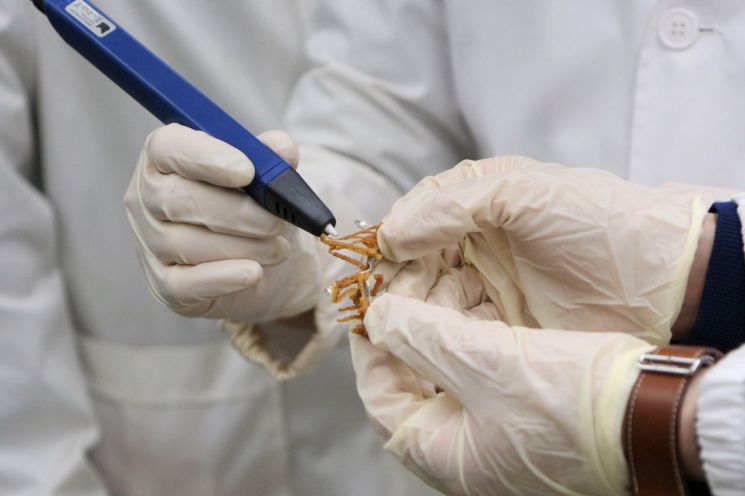
Tests on the newly developed material confirmed that after scratching the film-type material and heat-treating it at high temperature for 30 minutes, it self-heals. Despite having a crosslinked structure, the film-type material that easily breaks into small pieces can be restored to its original state and recycled through a pressing process under high temperature and strong pressure. Filament extrusion molding and 4D printing are also possible. When the new material is loaded into a filament extruder, clean filaments can be obtained, and using a 3D pen, 3D structures with shape-memory and recovery capabilities can be easily fabricated.
The research team stated, "With this technological development, we expect to secure core technologies for the practical application of 4D printing through active collaboration with companies in the materials field," and added, "Since the material is capable of self-healing and recycling, it is expected to contribute to reducing the large amount of crosslinked polymer waste that may occur in the future."
The research results were published as a cover paper in the December issue last year of the international scientific journal ‘Advanced Science.’
© The Asia Business Daily(www.asiae.co.kr). All rights reserved.
![User Who Sold Erroneously Deposited Bitcoins to Repay Debt and Fund Entertainment... What Did the Supreme Court Decide in 2021? [Legal Issue Check]](https://cwcontent.asiae.co.kr/asiaresize/183/2026020910431234020_1770601391.png)















