People's Bank of China Likely to Cut Loan Prime Rate by 0.15?0.20 Percentage Points on 20th
Development and Reform Commission to Expedite Implementation of Infrastructure Projects and Domestic Demand Revitalization Policies
[Asia Economy Beijing=Special Correspondent Jo Young-shin] China is expected to cut its benchmark interest rate as part of economic stimulus measures. China announces the average value of the Loan Prime Rate (LPR), which serves as the benchmark interest rate, on the 20th of each month.
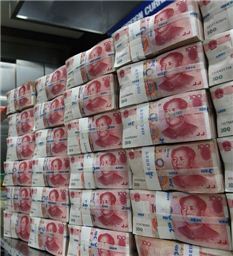
According to Chinese media including the economic specialist outlet Caixin on the 19th, the People's Bank of China, the central bank, has decided to apply market interest rates in a timely manner to proactively respond to downward economic pressures.
Liu Guochang, Deputy Governor of the People's Bank of China, also hinted at an LPR cut. He stated, "Monetary policy must be sufficient, precise, and forward-looking," adding, "We will open the monetary policy toolbox further to maintain economic stability." Deputy Governor Liu further said, "One year is a very short time," and "Although it is the beginning of the year, we must hurry for this year's economic plans. If delayed, difficult situations may arise." This is interpreted as an indication that the LPR will be cut on the upcoming 20th.
The cut is also expected to be significant. On December 20 last year, China cut the LPR by 0.05 percentage points. At that time, there was much debate about the size of the cut, with the market reacting that it was too small. Typically, the LPR is cut within a range of 0.05 to 0.25 percentage points. Inside China, it is forecasted that the cut will be between 0.15 and 0.20 percentage points.
Caixin analyzed that since the second half of last year, the Chinese economy has faced three pressures: demand contraction, supply shocks, and weakened expectations, and that the interest rate cut is a monetary policy by financial authorities to cope with these risks.
Following the 0.5 percentage point cut in the reserve requirement ratio (RRR) and the 0.05 percentage point cut in the LPR in December last year, Chinese financial authorities also cut the Medium-term Lending Facility (MLF) loan rate, a policy fund rate, by 0.1 percentage points on the 18th. In one month, they have used all three monetary policy tools at their disposal.
Sun Guofeng, Director of the Monetary Policy Department at the People's Bank of China, said, "The LPR is determined comprehensively considering bank capital, risk premiums, and market supply and demand," adding, "We will reflect market conditions so that corporate loan interest rates can fall."
However, it is uncertain whether China's interest rate cut policy will produce visible results in the market. Caixin reported that last year, corporate loans in China had an annual interest rate of 4.61%, the lowest level since the reform and opening up, but corporate loans decreased compared to the previous year, and it remains to be seen whether Chinese commercial banks will bear corporate risks.
Meanwhile, the National Development and Reform Commission (NDRC), the main agency overseeing China's economic development plans, also expressed its intention to stimulate the economy. Yuan Da, spokesperson for the NDRC, said that China's economy will face many pressures and challenges in 2022, and that efforts will be made to ensure that infrastructure projects and domestic demand activation policies by local governments are implemented promptly. Spokesperson Yuan emphasized, "New policies in finance, monetary policy, employment, industry, investment, and environmental protection will be introduced this year for stable growth," and stressed that China will maintain healthy and sustainable economic development.
© The Asia Business Daily(www.asiae.co.kr). All rights reserved.
![User Who Sold Erroneously Deposited Bitcoins to Repay Debt and Fund Entertainment... What Did the Supreme Court Decide in 2021? [Legal Issue Check]](https://cwcontent.asiae.co.kr/asiaresize/183/2026020910431234020_1770601391.png)














