Subscription Deposit Hits 32 Trillion on First Day
Minus Accounts at Four Major Banks Increase by 1.2 Trillion in One Day
Expected to Rise Further on Final Day
Concerns Over Household Debt Risks Amid Interest Rate Hikes
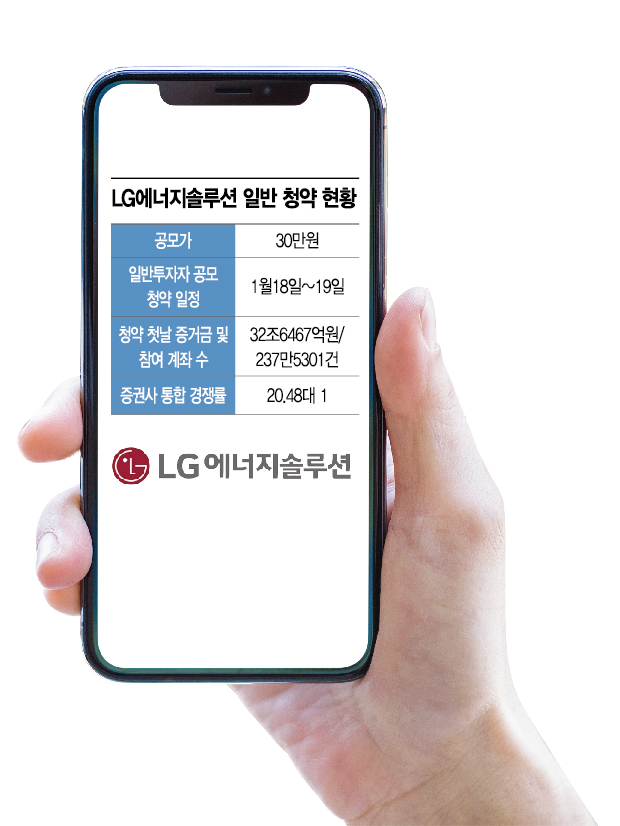
[Asia Economy Reporters Sunmi Park, Kiho Sung] #. Office worker Kim Cheol-ho (alias, 49 years old) opened a new overdraft account and took out a loan of 45 million KRW to apply for 300 shares after hearing from colleagues that investing in LG Energy Solution (LG EnSol) IPO shares could result in a ‘ttasang’?where the opening price is twice the IPO price and then soars to the upper limit price.
As LG Energy Solution sets a new record for IPO popularity by gathering over 32 trillion KRW in subscription deposits on the first day of general subscription, the outstanding balance of credit loans at the four major commercial banks has surged, reviving the atmosphere of ‘debt investment (bit-tu)’ and ‘all-in investment (young-kkeul).’ Amid a period of rising interest rates with credit loan rates approaching 5% per annum, the growing trend of debt investment and all-in investment since the beginning of the year raises concerns that it could trigger a household debt bomb.
According to the financial sector on the 19th, the outstanding balance of overdraft accounts at the four major commercial banks?Kookmin, Shinhan, Hana, and Woori?was 43.3559 trillion KRW on the day before, which was the first day of LG EnSol’s general subscription. This is about 1.5 trillion KRW higher than a week earlier on the 10th, with an increase of 1.2 trillion KRW in just one day of subscription. As more people opened overdraft accounts in preparation for the LG EnSol subscription, the number of new overdraft accounts has steadily increased over the past week. The number of new overdraft accounts at the four major banks was 1,368 as of the day before, nearly 500 more than on the 10th.
Considering that more subscription deposits usually pour in on the last day of subscription, it is highly likely that the outstanding balance of credit loans in the banking sector will increase further for the LG EnSol IPO subscription. The outstanding balance of credit loans at the four major commercial banks had decreased by about 100 billion KRW from 117.0528 trillion KRW at the end of last month to mid-this month.
LG EnSol collected 32.6467 trillion KRW in subscription deposits on the first day, recording a combined competition rate of 20.48 to 1 based on the number of subscription shares. This amount exceeds the 22.1594 trillion KRW in subscription deposits recorded by SKIET, which currently holds the top spot for subscription deposits, on the first day of its subscription in April last year.
Although the financial authorities have been strongly managing household debt, including the application of the second stage of the Debt Service Ratio (DSR) from this month, which has reduced the increase in household loans in the banking sector recently, the record-breaking success of large-scale IPOs has revived the atmosphere of debt investment and all-in investment.
The problem lies in the fact that with the base interest rate rising since the beginning of the year, loan interest rates are also increasing, which could worsen household debt. According to the banking sector, the Cost of Funds Index (COFIX), which serves as the benchmark for bank loan interest rates, rose by 0.14 percentage points in one month, reaching its highest level in two years and six months. Reflecting the COFIX increase, interest rates on mortgage loans and jeonse (key money deposit) loans at commercial banks have all risen. Moreover, with the Bank of Korea raising the base interest rate by 0.25 percentage points this month, credit loan interest rates have approached the 5% annual level.
Currently, the credit loan interest rates (for grade 1 borrowers with a one-year maturity) at the four major banks range from 3.148% to 4.798% per annum. This represents an increase of 0.5 to 1 percentage point on both the upper and lower ends compared to the 2.65% to 3.76% range at the end of last year.
If household debt risks increase further from the beginning of the year, banks will inevitably raise their lending thresholds again. According to the ‘Financial Institution Lending Behavior Survey’ recently released by the Bank of Korea, the credit risk index expected by domestic banks for the first quarter was 16, up 5 points from 11 in the fourth quarter of last year. In particular, when looking at changes in the credit risk index by lending entity, the household index rose 3 points from 12 in the fourth quarter of last year to 15 in the first quarter of this year. A positive credit risk index indicates an increase in credit risk, meaning more financial institutions expect credit risk to rise in the future. The baseline is ‘0’ and the index ranges between 100 and -100. This suggests that strict loan screening, which was maintained last quarter, will continue this year.
A financial sector official expressed concern, saying, "Assuming the base interest rate rises to 1.75% this year, credit loan interest rates could rise to 6%. If household loans increase, banks will have no choice but to raise their lending thresholds again."
© The Asia Business Daily(www.asiae.co.kr). All rights reserved.
![User Who Sold Erroneously Deposited Bitcoins to Repay Debt and Fund Entertainment... What Did the Supreme Court Decide in 2021? [Legal Issue Check]](https://cwcontent.asiae.co.kr/asiaresize/183/2026020910431234020_1770601391.png)